
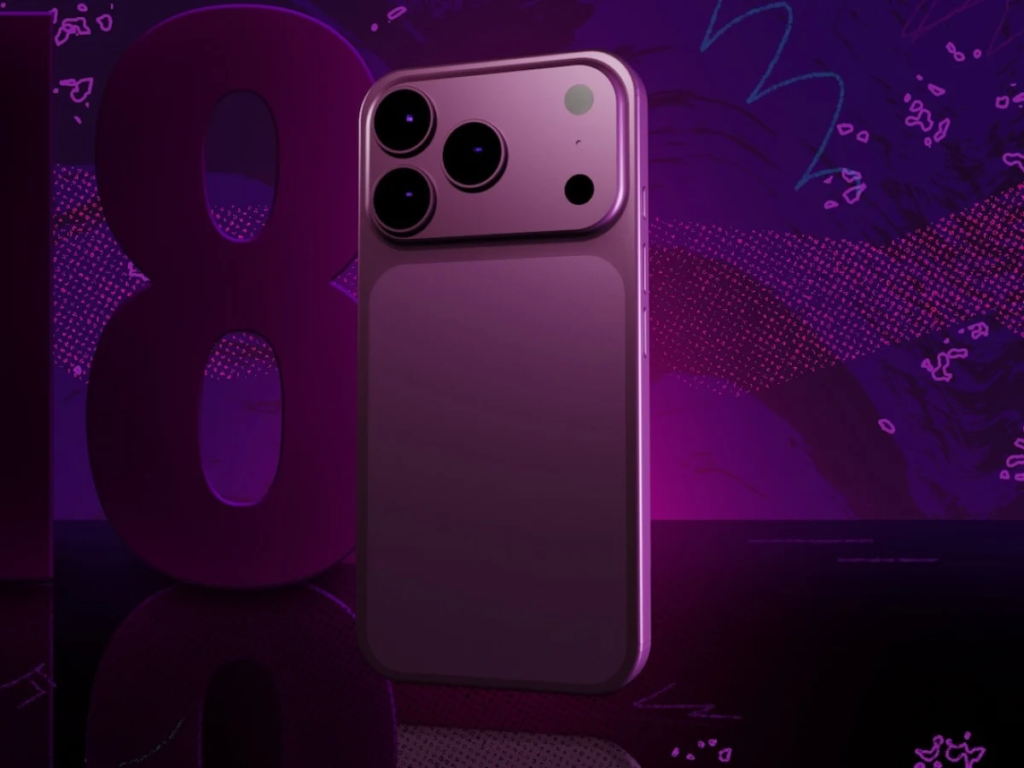
Apple’s iPhone 18 Pro is shaping up to be one of the company’s most ambitious flagship upgrades in years. While Apple has yet to officially announce the phone, multiple reports and supply-chain leaks point to major changes involving its processor, camera, modem, memory and display.
The rumored iPhone 18 Pro upgrades include a 2nm A20 Pro chip, a first-ever variable-aperture main camera, 12GB of RAM, Apple’s next-generation C2 modem and a smaller Dynamic Island.
The important caveat: these remain rumors until Apple takes the stage. Some specifications have also changed across reports, meaning buyers should treat the current information as a roadmap rather than a finished specification sheet.
Here are the five changes that could matter most.
What is the biggest iPhone 18 Pro upgrade?
The biggest changes may happen inside the phone rather than on its exterior.
Apple is reportedly preparing the A20 Pro, manufactured using TSMC’s 2nm process. The move from a 3nm manufacturing process to 2nm should allow Apple to pack more transistors into a similar area, potentially improving performance while reducing power consumption.
That matters because smartphone processors increasingly have to handle demanding artificial intelligence workloads alongside traditional tasks such as gaming, photography and video processing.
1. A20 Pro could bring Apple’s first 2nm iPhone chip
The A20 Pro is expected to be one of the headline features of the iPhone 18 Pro.
A smaller manufacturing process does not automatically mean a phone will be dramatically faster. The real benefit is the ability to improve performance and efficiency within a similar chip footprint.
Current reports suggest the A20 family could deliver roughly a 15% performance improvement and around 30% greater efficiency compared with the A19 generation, although these figures are estimates rather than Apple-confirmed specifications.
The chip is also reportedly expected to use advanced wafer-level packaging, potentially allowing memory and processing components to work more closely together.
For users, the practical benefits could include faster AI processing, improved gaming performance and longer battery life under comparable workloads.
Will the iPhone 18 Pro finally get a variable-aperture camera?
This may be the most visible photography upgrade.
Apple has reportedly been preparing a variable-aperture main camera for the iPhone 18 Pro and Pro Max. Supply-chain reports indicate that production preparations for the technology were already underway earlier this year.
Unlike a fixed-aperture lens, a variable-aperture system can physically adjust the size of the lens opening.
2. Variable aperture could change how the iPhone handles light
Think of the aperture as a controllable doorway for light.
In darker conditions, the camera can open the aperture wider to allow more light onto the sensor. In brighter environments, it can close the opening to control exposure.
The technology can also affect depth of field, giving photographers greater control over how much of a scene appears sharply focused.
That could be particularly useful for:
- Portrait photography
- Night photography
- Video recording in changing light
- Controlling exposure in bright environments
- Creating different background-blur effects
The feature would also represent a notable change because iPhone Pro models have traditionally relied on fixed-aperture main cameras.
One detail remains uncertain: some recent reports suggest the variable-aperture system could be exclusive to the iPhone 18 Pro Max, while other reporting has pointed to both Pro models receiving it.
That distinction will be important for buyers deciding between Apple’s two premium models.
Why could 12GB of RAM matter for the iPhone 18 Pro?
Apple does not typically advertise RAM capacity as prominently as Android manufacturers do, but memory could become increasingly important as on-device AI expands.
3. 12GB RAM could support heavier AI workloads
Reports indicate that the iPhone 18 Pro models could have 12GB of RAM.
The significance goes beyond having a larger number on a specification sheet.
More memory gives the operating system and applications additional room to keep data readily available. That becomes particularly useful when phones are simultaneously handling AI models, image processing, speech recognition and multiple applications.
Apple’s strategy increasingly involves running AI features directly on the device rather than sending every request to a remote server.
That makes memory, processor performance and power efficiency increasingly interconnected.
However, it is worth noting that reports already suggest the iPhone 17 Pro generation moved to 12GB RAM, so describing 12GB as an entirely new development for Apple’s Pro phones would be misleading.
The more important story may therefore be how Apple combines that memory with the A20 Pro’s architecture and packaging.
Is Apple replacing Qualcomm with its own C2 modem?
Apple has spent years trying to reduce its dependence on Qualcomm for cellular modem technology.
The iPhone 18 Pro could take another step in that direction with the company’s C2 modem.
4. C2 modem could give Apple more control over connectivity
Apple introduced its first in-house cellular modem, the C1, in the iPhone 16e. The C2 is expected to be the next generation of that technology.
Reports have linked the C2 with improvements in connectivity and power efficiency, but there is an important wrinkle: the modem configuration may vary by market.
Recent reporting suggests some U.S. iPhone 18 Pro models could continue using Qualcomm hardware, particularly because of mmWave requirements, while international versions could use Apple’s C2 modem.
If that happens, the phrase “iPhone 18 Pro gets Apple’s C2 modem” would be technically true for some markets but not necessarily every model worldwide.
For consumers, the modem’s real-world impact will come down to network compatibility, signal performance, battery consumption and support for advanced 5G technologies.
Could the Dynamic Island finally become smaller?
The fifth major change could be visible every time users look at the phone.
5. A smaller Dynamic Island could free up more screen space
Apple introduced the Dynamic Island with the iPhone 14 Pro as a way to turn the front-camera and Face ID cutout into an interactive software element.
Now, Apple is reportedly working toward reducing its physical footprint.
Multiple reports point to a smaller Dynamic Island on the iPhone 18 Pro, potentially enabled by moving some Face ID components beneath the display.
The change may appear subtle, but it addresses one of the most persistent visual compromises on modern iPhones.
A smaller cutout means more usable display area without requiring Apple to completely eliminate the front-facing camera and biometric hardware.
It also moves Apple another step toward the long-standing smartphone goal of an uninterrupted, all-screen front.
What could make the iPhone 18 Pro different from earlier upgrades?
Taken individually, none of these rumored features guarantees a revolution.
The more interesting story is how they could work together.
A 2nm processor could improve performance and efficiency. More memory could support increasingly demanding AI workloads. A variable-aperture camera could give photographers greater optical control. A new modem could give Apple greater control over connectivity hardware, while a smaller Dynamic Island could make the display feel less interrupted.
That combination could make the iPhone 18 Pro more than a routine annual processor-and-camera refresh.
At the same time, consumers should be careful with claims that the phone will represent an unprecedented leap. Apple has not confirmed these specifications, and some details remain contradictory across supply-chain reports.
When is the iPhone 18 Pro expected to launch?
Current reporting points to a September 2026 launch for the iPhone 18 Pro and iPhone 18 Pro Max. Some reports also suggest Apple could change its traditional release strategy, with the Pro models arriving first while standard iPhone 18 models follow later.
Apple has not officially confirmed the launch date or the final specifications.
That distinction matters because the current iPhone 18 Pro story is built largely from analyst predictions, supply-chain information and leaks. Some of those reports have already disagreed over camera availability, modem configurations and memory.
The safest expectation, therefore, is that the iPhone 18 Pro will receive substantial upgrades, while the exact hardware mix remains subject to change.
What should iPhone buyers watch before launch?
For anyone considering an upgrade, five details deserve particular attention when Apple officially announces the phone:
- Whether the variable-aperture camera appears on both Pro models or only the Pro Max
- Whether U.S. models use Qualcomm modems while other markets receive Apple’s C2
- Whether 12GB RAM becomes standard across the Pro lineup
- How much of the Dynamic Island is actually reduced
- Apple’s real-world performance and battery claims for the 2nm A20 Pro
These details will tell consumers far more than early renders or leaked specification tables.
The iPhone 18 Pro may ultimately be remembered less for one flashy feature than for how Apple combines silicon, cameras, connectivity and AI into a tighter package. For now, however, the phone remains a collection of increasingly credible rumors, not an officially confirmed product.
TL;DR
The iPhone 18 Pro is rumored to bring five major upgrades: a 2nm A20 Pro chip, a variable-aperture camera, 12GB RAM, Apple’s C2 modem and a smaller Dynamic Island.
The variable-aperture camera could be the biggest photography change, while the A20 Pro may deliver the largest performance and efficiency gains. The C2 modem could further Apple’s push toward in-house cellular hardware.
But there is still a large asterisk beside every specification until Apple announces the device.