
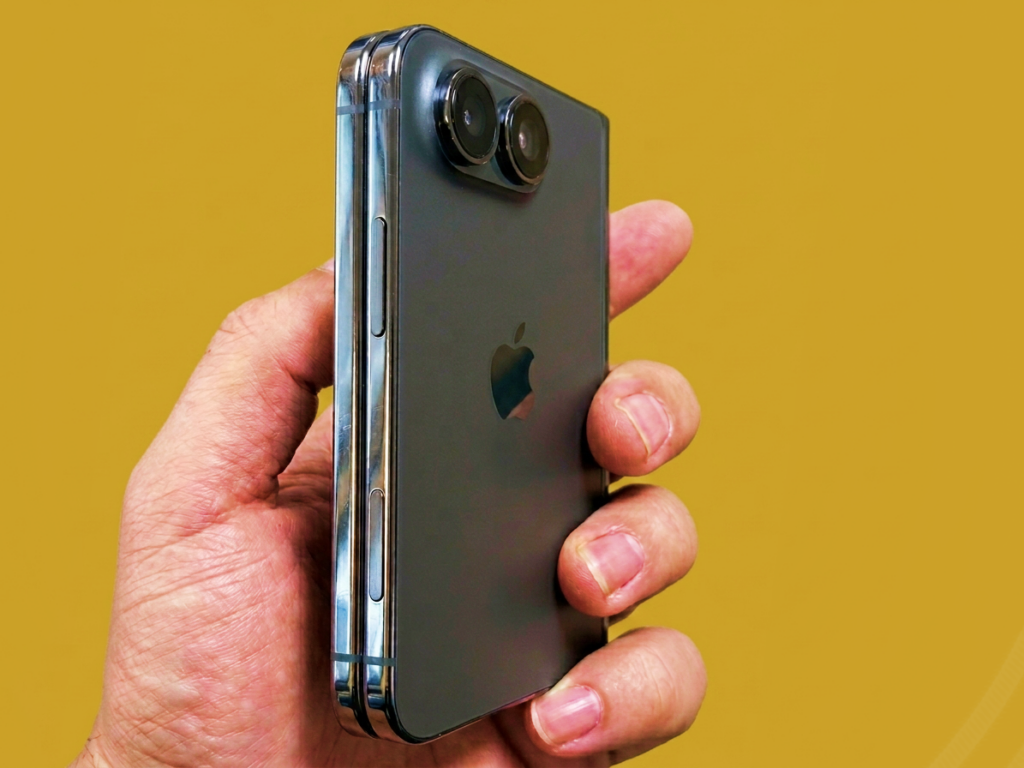
The latest iPhone Ultra Fold leak suggests Apple is preparing to do something unusual: rethink how a phone should feel in your hand by prioritizing how it works as a tablet.
Leaked dummy units of the so-called foldable iPhone, often referred to as the “Ultra” or “Fold,” reveal a device that breaks with familiar iPhone design choices. The headline changes? A return of Touch ID and a button layout that may frustrate as many users as it impresses.
What does the iPhone Ultra Fold leak reveal?
The leaks—based on physical dummy units—suggest Apple has finalized key aspects of the design.
Key highlights
- Foldable, wide form factor (closer to a small tablet than a tall phone)
- Touch ID integrated into the power button
- Volume buttons moved to the top edge
- Design optimized for landscape/tablet use
- Minimal visible changes for the standard Pro lineup
In contrast, the iPhone 18 Pro appears largely unchanged from its predecessor, making the foldable the real story.
Why is Apple bringing back Touch ID?
The return of Touch ID is one of the most interesting choices.
Practical reasons behind the move
Foldable devices introduce complications for facial recognition:
- Multiple orientations (folded vs unfolded)
- Variable camera positioning
- Increased likelihood of awkward angles
A side-mounted fingerprint sensor (built into the power button) solves these issues by offering the following:
- Consistent access regardless of orientation
- Faster authentication in tablet mode
- Familiar usability for users of devices like the iPad mini
This isn’t nostalgia, it’s functional design.
Why are the volume buttons on top?
This is where things get controversial.
The logic (in tablet mode)
When unfolded, the device behaves like a small tablet:
- Wider than a typical phone
- Designed for landscape use
- Buttons align naturally when held horizontally
In this context, top-mounted volume controls make sense.
The problem (in phone mode)
When folded into a traditional phone shape:
- Reaching the top edge becomes awkward
- One-handed use becomes harder
- Muscle memory from years of side buttons breaks
In short: Apple may have optimized for one use case at the expense of another.
Is Apple prioritizing tablet over phone?
All signs point to yes.
The design philosophy appears to mirror the experience of an iPad mini:
- Wide display
- Landscape-first interaction
- Button placement aligned with tablet ergonomics
This suggests Apple sees the foldable not as:
A phone that becomes a tablet, but rather
A tablet that can fold into a phone
That’s a subtle but important shift.
How does it compare to competitors?
Competitors like Huawei Pura X Max and Samsung’s foldables have generally:
- Kept side-mounted buttons
- Focused on phone-first usability
- Treated tablet mode as secondary
Apple appears to be flipping that approach.
Pros of Apple’s strategy
- Better tablet experience
- More natural media consumption
- Potentially improved multitasking
Cons
- Awkward one-handed use
- Learning curve for long-time iPhone users
- Possible accessibility concerns
Could software fix the ergonomics?
Apple may be planning software workarounds.
Potential solutions could include:
- Gesture-based volume controls
- On-screen sliders triggered by taps
- Adaptive UI depending on orientation
Apple has a history of smoothing hardware compromises with software—but until confirmed, this remains speculation.
What about MagSafe and other features?
Interestingly, the dummy units reportedly show no visible MagSafe ring on the foldable.
That could mean:
- Internal redesign of magnetic components
- Reduced emphasis on accessories
- Or simply incomplete dummy models
This is one area where leaks remain unclear.
Why this design will divide users
This isn’t just another iPhone iteration—it’s a philosophical shift.
People who will like it
- Users who want a true tablet experience
- Multitaskers and media consumers
- Early adopters of foldables
People who may dislike it
- One-handed phone users
- Those who prefer traditional layouts
- Users resistant to relearning controls
As the leak itself suggests: Apple has solved one problem and created another.
Should you take this leak seriously?
Dummy units are often accurate—but not final.
Before concluding:
- Apple has not officially confirmed the device
- Some hardware elements may still change
- Software features remain unknown
Still, these leaks align with broader industry trends toward hybrid devices.
TL;DR
- The iPhone Ultra Fold leak shows a wide, tablet-first foldable design
- Touch ID is returning via the power button
- Volume buttons are placed on the top—unusual for phones
- Apple appears to prioritize tablet usability over phone ergonomics
- The design could be innovative—or frustrating—depending on user habits