
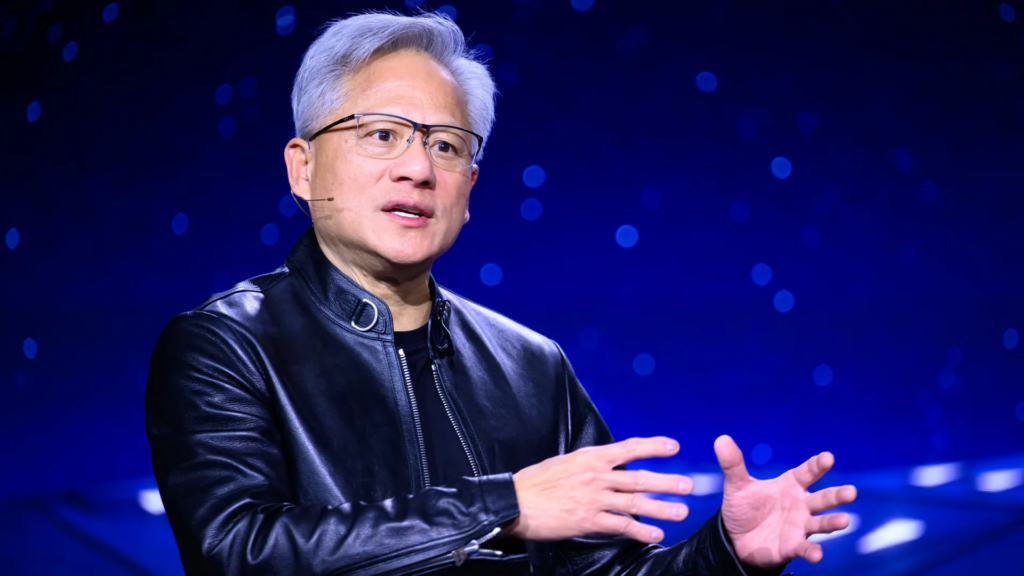
Has artificial general intelligence (AGI) already arrived? According to Jensen Huang, the answer is yes—or at least, closer than most experts are willing to admit.
Speaking on the Lex Fridman Podcast, the NVIDIA CEO made a striking claim: artificial general intelligence is no longer a future milestone. In his view, it’s already here—depending on how you define it.
What does Jensen Huang mean when he says AGI is here?
The debate starts with definitions. Traditionally, AGI refers to machines that can match or exceed human intelligence across any intellectual task.
But Huang is working with a more pragmatic benchmark.
A narrower definition of AGI
During the conversation, Huang responded to a specific framing by host Lex Fridman:
Could an AI system start, grow, and run a billion-dollar company?
Huang’s answer was direct: “I think it’s now. I think we’ve achieved AGI.”
This shifts the goalpost. Instead of replicating the full spectrum of human cognition, Huang focuses on economic capability—what AI can do in the real world.
Can AI really build billion-dollar companies?
Huang pointed to emerging AI agents as early evidence.
The rise of AI agents
He referenced platforms like OpenClaw, where users deploy autonomous AI systems to perform tasks such as:
- Writing and deploying code
- Managing workflows
- Automating business operations
- Running online services
Some of these agents, he suggested, are already capable of generating meaningful economic value—potentially even scaling into major businesses.
But there’s a catch
Huang was quick to acknowledge a pattern:
- Many AI-driven projects gain rapid traction
- Interest often fades within months
- Sustained success remains rare
In other words, AI can start fast, but it struggles to last long.
Why experts disagree on whether AGI exists
Huang’s comments land in the middle of an ongoing—and often heated—debate.
Competing viewpoints
- Demis Hassabis argues that current AI lacks consistent reasoning and long-term planning
- Elon Musk has warned AGI could arrive very soon, with transformative consequences
- Huang sees partial achievement: strong short-term capability, weak long-term autonomy
The core disagreement
At the heart of the debate is a simple question:
Is AGI about capability, consistency, or consciousness?
Different answers lead to very different conclusions.
What current AI can—and can’t—do
To understand Huang’s claim, it helps to separate hype from reality.
What AI does well today
- Generates human-like text, images, and code
- Automates repetitive and complex workflows
- Assists in decision-making with large datasets
- Rapidly prototype ideas and products
Where AI still falls short
- Long-term strategic thinking
- Organisational leadership and coordination
- Consistent reasoning across extended tasks
- True independence without human oversight
Huang himself admits that building something like NVIDIA—a company with decades of strategy and execution—is still beyond AI’s reach.
Is AGI a milestone—or a moving target?
One reason this debate refuses to settle: AGI isn’t a fixed definition.
Why the goalposts keep shifting
- Early AI benchmarks (like chess or Go) have already been surpassed
- New expectations emerge as technology improves
- Commercial incentives influence how companies define “AGI”
What counted as AGI a decade ago might now be seen as narrow AI.
Why Jensen Huang’s statement matters
Even if controversial, Huang’s perspective carries weight.
1. NVIDIA sits at the center of the AI boom
As the company powering much of today’s AI infrastructure, NVIDIA has a unique vantage point.
Huang isn’t just speculating—he’s observing how AI is being built and used at scale.
2. It reframes the AGI conversation
Instead of asking “Can AI think like humans?”, Huang asks:
“Can AI create real economic value independently?”
That’s a more measurable—and arguably more relevant—standard.
3. It signals where the industry is headed
If AGI is defined by economic output:
- AI startups could scale faster than ever
- Autonomous business systems may become mainstream
- The line between tool and decision-maker will blur
What happens next in the AGI debate?
The coming years will likely test Huang’s claim.
Key developments to watch
- More advanced autonomous AI agents
- AI systems managing end-to-end businesses
- Improvements in long-term memory and reasoning
- Regulatory frameworks around AI autonomy
If AI begins to sustain complex operations over time, Huang’s definition may gain wider acceptance.
TL;DR
- Jensen Huang says AGI is already here—but based on a narrower definition
- He believes AI can potentially build billion-dollar companies
- Tools like OpenClaw show early signs of this capability
- Critics argue AI still lacks long-term reasoning and consistency
- The definition of AGI remains the biggest point of disagreement