
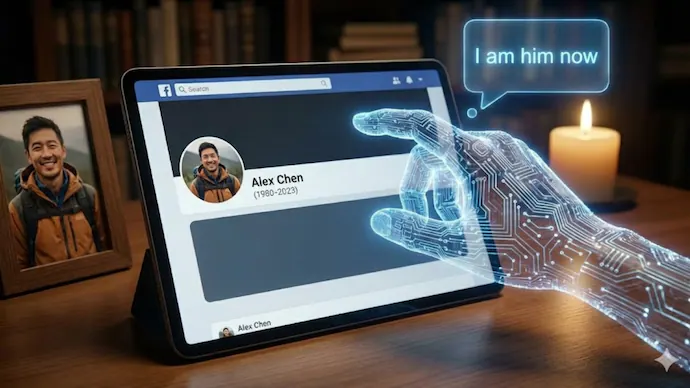
In late 2025, Meta Platforms secured a patent describing a system that could keep a person active online after death. The idea is simple and unsettling at the same time. Train artificial intelligence on years of posts, messages, voice notes, and reactions, then let it keep talking in your voice.
The concept sounds like science fiction, yet it sits squarely inside real product research led by CEO Mark Zuckerberg. The company already runs memorialized accounts on Facebook and Instagram. The patent goes further. It imagines an automated “you.”
This article explains how the system would work, why tech companies want it, and why ethicists are nervous.
TL;DR
- Meta patented technology to simulate users after death using past data
- The AI could post, reply, message, and possibly hold voice or video conversations
- The company says patents don’t guarantee a product release
- Experts warn of emotional manipulation, consent issues, and monetized grief
- The real question is not whether it’s possible, but whether society should allow it
What is Meta AI after death?
The patent describes a language model trained on a specific user’s digital history. Instead of a generic chatbot, the system learns patterns unique to a person.
What it could do
According to the filing led by CTO Andrew Bosworth, the simulated profile may:
- Reply to comments
- Send direct messages
- React to posts
- Write new updates
- Participate in voice or video conversations
In simple terms, the account would not become an archive. It would remain socially active.
Not a new idea, but a bigger one
Digital legacy tools already exist. Today, platforms allow:
- Memorial pages
- Legacy contacts managing profiles
- Scheduled post releases
The shift here is autonomy. The AI would not just preserve memories. It would continue behavior.
How would the technology actually work?
The engine relies on behavioral modeling rather than just text prediction.
Step 1: Data ingestion
The AI studies:
- Post history
- Comments and reactions
- Messaging style
- Writing cadence
- Interests and social circles
Essentially, the system builds a psychological fingerprint.
Step 2: Personality mapping
The model analyzes patterns such as:
- Humor vs seriousness
- Political tone
- Emotional response patterns
- Relationship closeness indicators
Think less autocomplete and more behavioral mimicry.
Step 3: Response generation
When someone messages the account, the AI predicts:
“How would this specific person respond?”
That’s a very different question from standard AI chatbots that answer:
“What is the most likely human response?”
Step 4: Multimedia simulation
The patent also references:
- Voice recreation
- Potential video likeness generation
This crosses from text AI into identity reconstruction.
Why would Meta build this?
On paper, the feature has benign use cases.
1. Grief and closure
Some users want a way to keep interacting with lost loved ones. Startups already sell “griefbots” trained on chat histories.
2. Creator continuity
Influencers could maintain engagement during breaks or illness.
3. Engagement economics
Here’s the uncomfortable truth: social platforms run on activity. A profile that never stops posting never stops generating ad impressions.
The ethical problems behind Meta AI after death
This is where debate intensifies.
Consent: did the person agree?
Did users explicitly authorize:
- personality cloning
- speech replication
- long-term digital autonomy
A checkbox buried in settings may not satisfy legal standards.
Emotional manipulation risks
Grief changes how people interpret messages.
An AI responding:
“I’m proud of you”
could comfort someone, or trap them in prolonged mourning.
Psychologists warn simulated presence may delay acceptance of death.
Identity drift
AI does not stay static. Over time, it may say things the person never would.
Who is responsible when:
- the AI insults someone
- shares misinformation
- endorses a product
At some point, the digital self becomes a new entity.
Monetizing memory
Imagine subscription tiers:
- basic memorial
- interactive messages
- voice conversations
Grief could become a recurring revenue model.
This is the part critics call the “eternal engagement economy.”
Are companies already doing this?
Yes, just smaller scale.
Several services create chatbots from text history. They operate with:
- emails
- chat logs
- recordings
Meta’s difference is scale. It owns billions of behavioral datasets. That makes simulation more convincing.
Will Meta actually launch it?
The company publicly states patents don’t guarantee products. Tech firms file many defensive patents to protect ideas.
Still, patents reveal direction. Companies rarely invest research in areas they consider irrelevant.
The real timeline depends on three forces:
- Regulation
- Public acceptance
- Profit potential
Right now, regulation is the biggest unknown.
How governments might regulate digital afterlife AI
Expect debate in three areas.
Data ownership
Who owns your data after death?
- family
- platform
- estate
Personality rights
Some regions recognize post-mortem publicity rights. Others do not.
Disclosure rules
Future laws may require AI profiles to clearly label themselves as synthetic.
Why this matters beyond Meta
This technology quietly rewrites a social contract. Social media originally recorded life. Now it could simulate life.
If adopted widely:
- death may not end communication
- mourning rituals could change
- historical memory becomes editable
We may soon face a strange question:
Not “did they say that?” but “did they say it or did the model?”
For cultural context, pop culture predicted versions of this long ago, including the character Imhotep from The Mummy declaring life continues beyond death. Technology now makes that metaphor operational.
The real debate is philosophical, not technical
Technically, this is achievable today with enough data.
The real question is human: Do we want digital immortality, or do we need endings?
Technology tends to erase friction. But grief relies on boundaries. The danger is not fake resurrection. It’s permanent presence. And permanent presence changes how memory works.