
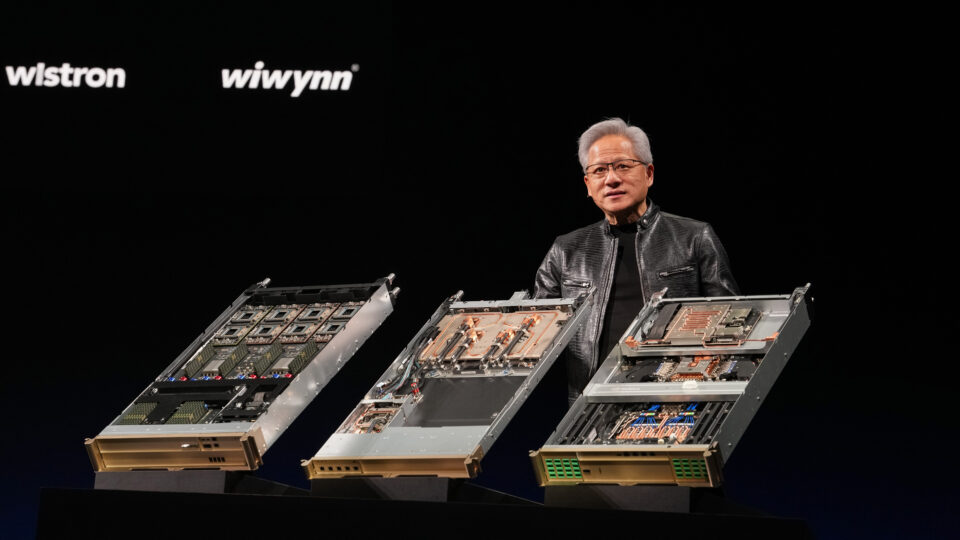
Nvidia CEO Jensen Huang used the stage at GTC Taipei 2026 to deliver a clear message: artificial intelligence is entering a new phase, one that extends far beyond chatbots and image generators. The next battleground, according to Nvidia, will be agentic AI, specialized infrastructure, and computing systems designed to think, plan, and execute tasks with minimal human intervention.
The keynote showcased Nvidia’s strategy for maintaining its dominant position in the AI race while expanding deeper into personal computing, enterprise software, and next-generation data centers.
Here are the five biggest announcements from the event and why they matter.
Nvidia and Microsoft expand their AI PC ambitions
One of the headline announcements was Nvidia’s deeper collaboration with Microsoft.
The two companies are reportedly working on a new generation of AI-powered personal computers built around Nvidia’s RTX Spark superchip and an AI-optimized version of Windows. The goal is to move advanced AI capabilities directly onto consumer and enterprise PCs rather than relying entirely on cloud-based systems.
This represents a major shift in how AI may be delivered in the future.
Why it matters
For years, most powerful AI systems have lived in data centers. Bringing advanced AI processing to local devices could offer:
- Faster performance
- Better privacy protections
- Lower cloud computing costs
- More personalized AI experiences
Agentic AI becomes Nvidia’s biggest priority
If there was one phrase that dominated JensenHuang’s presentation, it was “agentic AI.”
Unlike conventional AI assistants that simply respond to user prompts, agentic AI systems are designed to:
- Plan tasks independently
- Make decisions
- Execute multi-step workflows
- Adapt to changing circumstances
Jensen Huang argued that the industry is moving toward AI systems capable of functioning more like digital employees than digital assistants.
What is agentic AI?
Think of the difference between:
- A chatbot answering a question
- An AI agent researching a topic, booking meetings, creating reports, and updating databases without constant supervision
Many technology firms now view agentic AI as the next major evolution in artificial intelligence.
Why it matters
The shift could transform industries such as:
- Software development
- Customer support
- Research and analysis
- Healthcare administration
- Supply chain management
Nvidia says AI is moving from experimentation to business value
Another key theme throughout the keynote was return on investment.
Jensen Huang argued that AI is no longer an experimental tool reserved for research labs. Instead, businesses increasingly expect AI deployments to produce measurable benefits.
Companies are now evaluating AI based on:
- Productivity gains
- Cost reductions
- Revenue growth
- Operational efficiency
- Time savings
This reflects a broader trend across the technology industry, where executives are facing growing pressure to justify massive AI investments.
The reality check facing businesses
While AI adoption continues to accelerate, many companies are still struggling to prove clear financial returns.
Recent reports from firms such as Uber, Microsoft, and Starbucks have highlighted challenges involving:
- Rising AI infrastructure costs
- Token consumption expenses
- Governance issues
- Measuring productivity improvements
Nvidia’s message suggests the company believes agentic AI can help close that gap by delivering more tangible business outcomes.
Vera introduces Nvidia’s next CPU architecture
Jensen Huang also unveiled Vera, Nvidia’s newest CPU architecture built specifically for artificial intelligence workloads.
Unlike traditional processors designed for general-purpose computing, Vera has been engineered around the needs of AI systems.
Key specifications
According to Nvidia:
- Custom Olympus CPU core
- 88 CPU cores
- High-bandwidth memory support
- AI-first architecture
The company says Vera is designed to support environments where AI agents handle increasingly sophisticated workloads.
Why it matters
The announcement highlights an important shift in semiconductor design.
Chipmakers are no longer building hardware primarily for traditional software. Instead, they are creating processors optimized specifically for:
- AI training
- AI inference
- Autonomous agents
- Large language models
Vera Rubin becomes Nvidia’s next-generation AI platform
Perhaps the most important long-term announcement was Vera Rubin, Nvidia’s successor to its highly successful Blackwell platform.
The new infrastructure is designed to support increasingly demanding AI workloads across:
- Enterprise computing
- Cloud providers
- Research organizations
- AI startups
What Vera Rubin is designed for
The platform focuses on:
- Large-scale AI model training
- AI inference
- Agentic AI deployments
- Future data center infrastructure
Industry reports suggest major AI companies are already exploring next-generation Nvidia systems as they prepare for more computationally intensive AI applications.
Why it matters
The AI industry’s growth increasingly depends on infrastructure rather than software alone.
As models become larger and more capable, demand for advanced computing platforms continues to rise.
Nvidia’s strategy is to remain the foundation upon which much of the AI ecosystem is built.
What Jensen Huang’s keynote reveals about the future of AI
The biggest takeaway from GTC Taipei 2026 is that the AI conversation is evolving.
Just two years ago, the focus was almost entirely on models like ChatGPT and Claude. Today, the industry’s attention is shifting toward the infrastructure needed to power increasingly autonomous AI systems.
Several themes emerged clearly:
- Agentic AI is becoming a top priority.
- AI-native PCs are moving closer to reality.
- Specialized processors are replacing general-purpose computing.
- Businesses are demanding measurable ROI from AI investments.
- Data center infrastructure is becoming the critical battleground in the AI race.
For Nvidia, the message was straightforward: the future of artificial intelligence will be defined not only by smarter models but by the chips, platforms, and computing architecture that make those models possible.
TL;DR
Nvidia’s GTC Taipei 2026 keynote focused on the next phase of AI development:
- Nvidia and Microsoft announced deeper collaboration on AI-powered PCs.
- Agentic AI emerged as Nvidia’s central vision for future computing.
- Jensen Huang emphasized AI’s growing role as a business productivity tool.
- Nvidia introduced Vera, a new CPU architecture built specifically for AI.
- Vera Rubin was unveiled as Nvidia’s next-generation AI infrastructure platform.
Together, the announcements signal Nvidia’s ambition to remain at the center of the global AI ecosystem as the industry moves beyond chatbots toward autonomous AI systems.