
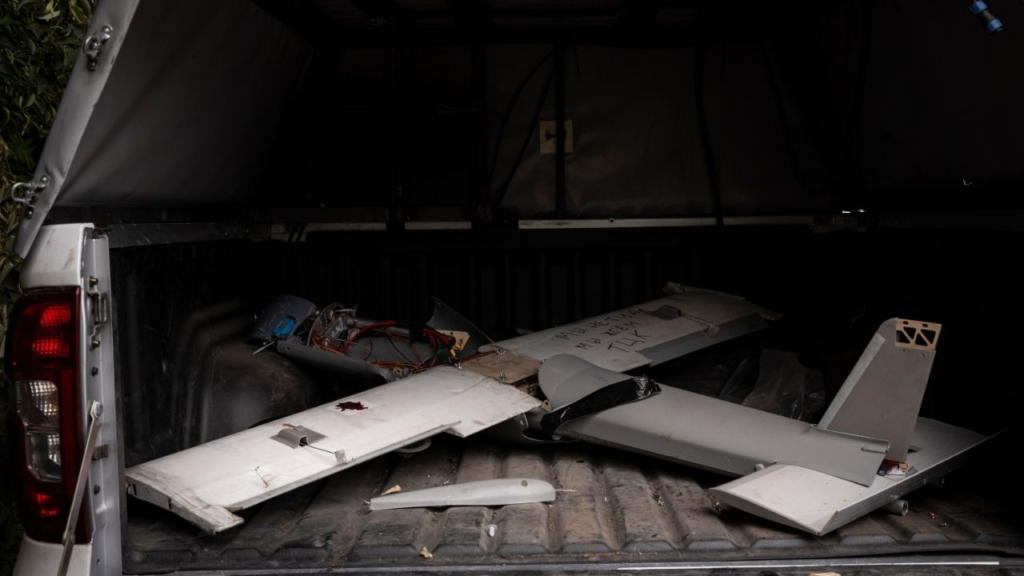
Small Nvidia computers designed for civilian robots and machine-vision systems are now turning up inside Russian weapons used against Ukraine, raising fresh questions about how easily commercially available artificial intelligence hardware can be diverted to the battlefield. Ukrainian forensic investigators recently identified Nvidia Jetson Orin computers in the wreckage of Russian drones tested in Zaporizhzhia. Ukrainian officials say the systems were being used to support autonomous target recognition, potentially allowing the drones to make critical targeting decisions without a human operator during the final stage of flight.
The same family of Nvidia hardware has also been found in Russia’s newer S-71M Monochrome air-launched cruise missile. Ukraine’s military intelligence agency said the discovery may indicate that the missile uses artificial intelligence for guidance.
Nvidia says it does not sell Jetson systems in Russia and describes them as consumer-grade products intended for students, developers and startups. The company says secondary-market sales are difficult to track.
The discoveries highlight an increasingly important problem in modern warfare: sophisticated AI does not necessarily require sophisticated military-specific hardware. A compact computer available through ordinary commercial channels can potentially become the processing core of an autonomous weapon.
What is Nvidia Jetson Orin?
Jetson is a family of small computers designed to run AI applications directly on devices rather than sending all the data to a remote server.
The technology is intended for so-called edge AI, where a machine processes information locally.
That makes it useful for applications such as:
- Robots
- Industrial inspection systems
- Smart cameras
- Autonomous machines
- Drones
- Computer-vision systems
A robot, for example, can use a Jetson computer to process images from a camera, recognize an object and respond without needing a constant connection to a cloud server.
The same capability is valuable in military systems because a drone operating in a contested environment cannot always rely on a stable radio link or access to a remote data center.
Why would a Russian drone need an Nvidia computer?
An autonomous drone needs to interpret the world around it.
Traditional drones can follow preprogrammed coordinates, while remotely piloted systems can receive instructions from a human operator.
An AI-guided system can add another layer.
A camera can capture the scene ahead. An onboard computer can process those images, identify objects and determine whether something matches the categories the system was trained to recognize.
That can be particularly useful when radio communications are disrupted or jammed.
According to the reporting by The New York Times, the Russian drones examined in Zaporizhzhia appear to represent a step beyond earlier systems that still required a human to confirm a target. Ukrainian investigators say the newer systems could make the final strike decision through onboard computing.
What did Ukrainian investigators find?
Ukrainian forensic teams recovered Jetson Orin hardware from Russian drones used in testing around Zaporizhzhia.
The New York Times reported that Ukrainian authorities showed reporters two guidance systems containing damaged but recognizable Nvidia components. Investigators said the systems were associated with a Russian drone program being tested between May and July 2026.
The systems reportedly contained the hardware needed to process sensor information onboard.
That matters because an autonomous weapon must make decisions locally if its connection to a remote operator is unreliable or deliberately absent.
The discovery therefore provides physical evidence that commercial AI computing hardware is being incorporated into Russian weapon systems.
Did an AI-guided Russian drone kill civilians?
According to Ukrainian air-defense officials and forensic specialists cited by The New York Times, a drone equipped with one of these systems killed three people in an attack in Zaporizhzhia on July 6.
The reporting says the drone was flying toward a gas station and that its onboard system was capable of recognizing potential targets.
It is important to distinguish between what investigators established from the wreckage and what remains an interpretation of the system’s behavior.
The presence of an Nvidia Jetson computer demonstrates that significant onboard computing was available. Determining exactly how the software made decisions requires analysis of the software, sensors, training data and mission programming.
Ukrainian investigators say the system was capable of autonomous targeting, but that conclusion should remain attributed to the investigators and forensic analysis.
How are these drones different from earlier AI-guided weapons?
Earlier Russian AI-assisted drones reportedly retained a “human in the loop.”
In such systems, AI could help with navigation or target recognition during the final part of a flight, but a human operator still had to approve the actual strike.
That distinction is important.
A human-in-the-loop weapon uses AI as a tool for the operator.
A more autonomous system can potentially identify a target and initiate the final attack without waiting for a person to make the last decision.
The New York Times reported that the drones tested in Zaporizhzhia represented a shift toward the latter model.
Why does autonomy matter on a battlefield?
Modern battlefields are saturated with electronic warfare.
Radio signals can be jammed. Navigation systems can be disrupted. Communications can be lost.
A remotely controlled drone becomes vulnerable if its operator cannot maintain a reliable connection.
An autonomous system can continue operating after losing that link.
A drone equipped with onboard computer vision may be able to navigate, recognize objects and complete at least part of its mission without external instructions.
That can make the weapon harder to disable through electronic warfare alone.
Was the Nvidia computer designed for weapons?
No.
Nvidia says Jetson products were developed for civilian applications and were not designed for military use.
The company described the modules found in Russian weapons as consumer-grade products sold to students, developers and startups for a wide range of legitimate uses.
Nvidia has also said that it does not sell these systems directly in Russia.
The company’s position is that the hardware reaches restricted markets through secondary sales and reseller networks.
That distinction is central to the story.
The discovery does not show that Nvidia sold AI computers directly to the Russian military.
It shows that hardware originating in the civilian commercial ecosystem has ended up inside Russian weapons.
How did the hardware reach Russia?
That remains unclear.
Nvidia said the Jetson products are widely available through resale markets and that the company cannot track every secondary transaction after a product is sold.
The circuit board associated with one of the recovered systems reportedly carried a “Made in China” marking.
That does not establish the route by which the hardware reached Russia.
The supply chain could involve distributors, resellers, intermediaries or third-country buyers.
The broader problem is that small commercial electronics move through global supply chains in enormous quantities, making it difficult to track their ultimate end users.
Why are commercial components so important to Russia?
Russia has faced extensive Western restrictions on access to advanced technology since its invasion of Ukraine.
Those restrictions have made imported electronics more difficult to obtain directly.
But sanctions do not automatically prevent every civilian component from reaching Russia.
A small computer originally sold for robotics can move through a complicated chain of intermediaries without the manufacturer knowing where it will eventually be used.
This is particularly significant for AI hardware because much of the technology is dual-use.
The same processor can power:
A factory inspection robot.
An autonomous delivery machine.
A research vehicle.
Or a military drone.
The hardware itself may not reveal the user’s intentions.
The Jetson has already appeared in another Russian weapon
The development extends beyond drones.
On August 12, Ukraine’s Defence Intelligence Directorate said it had identified an Nvidia Jetson Orin module in the S-71 Monochrome, a new Russian air-launched cruise missile. The agency said the component could indicate the use of AI technologies in the weapon.
The finding is particularly notable because the Orin module found in the missile was released after Nvidia had already ended direct business operations in Russia.
That suggests the hardware likely entered Russia through indirect channels.
The discovery has strengthened Ukrainian calls for tighter controls on technology that can be repurposed for autonomous weapons.
What is the S-71M Monochrome?
The S-71M is described as a Russian air-launched weapon with autonomous capabilities.
Ukrainian intelligence reported that the Jetson Orin module was found inside the missile and could be associated with AI-enabled guidance.
The exact role of the Nvidia computer inside the missile has not been publicly established with certainty.
It could be involved in image processing, target recognition or other forms of onboard guidance.
That distinction matters because the presence of an AI-capable computer does not automatically prove that a weapon independently selects human targets.
Why is edge AI useful for weapons?
Edge AI means computation happens on the device itself.
For a military system, that has several advantages.
The weapon does not need to send every camera frame to a remote operator.
It can process images locally.
It can react rapidly.
It can continue operating even when communications are disrupted.
And it can potentially make decisions faster than a human operator receiving and interpreting a video feed.
These characteristics explain why the same computing architecture that makes autonomous civilian robots practical can also make weapons more resilient to electronic interference.
What does Nvidia’s position mean?
Nvidia has emphasized that it does not sell Jetson computers in Russia and that the products are intended for civilian use.
The company also says it cannot track every product once it enters secondary markets.
That highlights a growing problem for technology companies.
Export controls are often designed around specific products and known customers.
But modern AI hardware can be relatively small, commercially available and useful for many different applications.
Once such a product enters a large global resale market, monitoring its eventual destination becomes difficult.
Does this mean Nvidia violated US sanctions?
The discovery of an Nvidia component in a Russian weapon does not, by itself, establish that Nvidia violated US export controls.
There is no evidence in the supplied reporting that Nvidia knowingly sold the hardware to the Russian military.
The company says the Jetson line was not sold in Russia and that it would take action if it identified customers violating export rules.
Determining whether any intermediary violated sanctions would require evidence about the specific supply chain, buyers and transactions.
That is different from simply finding a Nvidia component inside a weapon.
Why is this a bigger issue than one drone?
Because the same architecture is increasingly appearing across different Russian weapon systems.
Ukrainian authorities have reported Jetson hardware in multiple types of drones and now in the S-71M missile.
That suggests Russia is exploring a broader approach to onboard AI rather than experimenting with a single isolated prototype.
The technology also points toward a future in which inexpensive commercial computing may deliver capabilities once associated with specialized military hardware.
That could lower the cost of autonomous weapons.
What are the risks of autonomous targeting?
The biggest concern is not simply that a weapon can recognize objects.
It is what happens when recognition is connected directly to lethal action.
A system must distinguish between a military target and civilians, assess changing circumstances and operate under the rules of international humanitarian law.
Errors in computer vision can have deadly consequences.
So can ambiguous situations.
The New York Times reported that rights groups including the Red Cross have raised concerns about systems that allow computers to identify and strike targets without a human making the final decision.
This is one reason autonomous weapons remain the subject of intense international debate.
What does this mean for the future of AI warfare?
The important development may be the commoditization of the hardware.
Russia does not necessarily need a custom military supercomputer to build an autonomous drone.
A small commercial AI computer can provide enough processing power to interpret camera feeds and run neural-network models directly onboard.
That changes the economics of autonomous warfare.
Cheap drones paired with inexpensive AI hardware could potentially be produced at scale.
The barrier is no longer simply access to sophisticated algorithms. It is also access to commercially available computing components and the engineering expertise needed to integrate them.
The bigger picture
The discovery of Nvidia Jetson computers inside Russian weapons illustrates a major shift in modern warfare.
AI-enabled weapons do not always require secret military technology.
They can be built around components designed for ordinary civilian applications.
Nvidia says its Jetson computers were developed for robotics, machine vision and other beneficial uses and that the company does not sell them directly in Russia.
Yet Ukrainian investigators say the same hardware is now being used in Russian drones and has also been found in the S-71M Monochrome missile.
The immediate question is how Russia obtained the components.
The larger question is harder.
As AI hardware becomes cheaper, smaller and easier to buy through global supply chains, preventing its use in weapons becomes much more difficult.
That means the future of autonomous warfare may depend not only on military technology and battlefield tactics, but also on how effectively governments can control the flow of ordinary commercial electronics.