
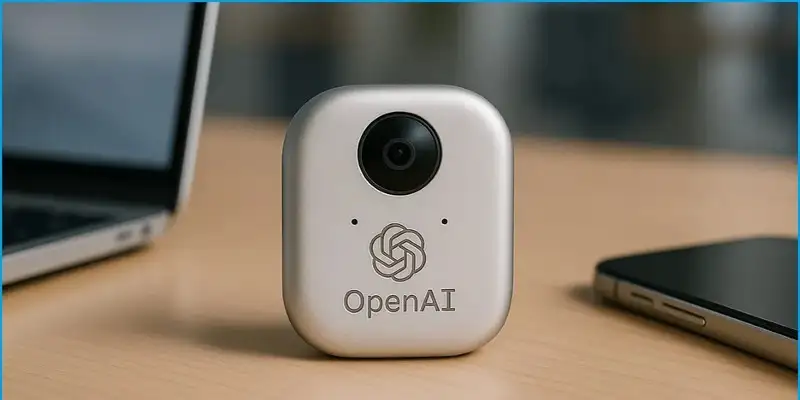
OpenAI’s long-rumored consumer gadget just got a firm timeline. The company confirmed in a court filing that its first OpenAI hardware device will not reach customers before February 2027, pushing back expectations that had centered on a late-2026 debut.
The delay isn’t just about engineering. It’s tangled in trademark litigation, branding strategy, and a broader question: what kind of product makes sense in a world where AI already lives inside phones, laptops, and browsers? Below is what we know, what we don’t, and why this launch matters beyond one product.
What is the OpenAI hardware device?
OpenAI has not revealed the product category: no specs, no form factor, and no confirmed use case. Only fragments exist, drawn from legal filings and public statements.
A collaboration with Jony Ive
The device is being developed with former Apple design chief Jony Ive, whose work defined the aesthetic language of the iPhone, iPod, and Apple Watch.
Key facts confirmed so far:
- The device is real and in active development
- It will not ship before February 2027
- A reveal could still happen earlier
- Ive’s hardware firm was part of a planned acquisition valued at around $6.5 billion
For context, Ive’s design philosophy centers on reducing visible complexity. That matters because AI products often suffer from the opposite problem: they are powerful but cognitively messy. This partnership signals an attempt to make AI feel less like software you open and more like a tool you naturally use
Why is the OpenAI hardware device delayed?
The delay is legal before it is technical.
Trademark battle over “io”
OpenAI originally linked the project to Ive’s company, io Products. A startup called Iyo sued over trademark usage, triggering a temporary restraining order.
As a result:
- OpenAI removed references to the partnership from public materials
- The company confirmed it will not use the “io” brand
- Marketing plans are being rewritten mid-development
This matters because hardware isn’t just engineering. It’s packaging, retail positioning, and ecosystem messaging. Apple spent years aligning the iPhone name with its identity. Losing a brand midstream forces a reset.
The court filing therefore, functions as a quiet but important signal: the product exists, but its identity is still under construction.
What could the OpenAI hardware device actually be?
Speculation is intense because OpenAI denied a viral teaser video, calling it “totally fake.” That vacuum invites theories.
Leading theories
Analysts and industry observers generally cluster around four possibilities:
- AI wearable
Glasses, a clip-on device, or a screen-free assistant similar in ambition to Humane AI Pin - Ambient assistant hub
A home device that replaces smart speakers with conversational intelligence - Professional productivity tool
A pen-like or notebook-like device designed for meetings and knowledge capture - Ear-centric interface
Advanced earbuds designed around constant conversational AI access
Each category targets a different problem: not computing power, but friction.
The core question OpenAI must solve
Phones already run AI apps. So a new device must justify itself by removing a step.
In hardware terms, the winning pitch must be:
You don’t open AI. It notices you need it.
That’s the philosophical territory Ive historically explored, turning digital tasks into background behavior.
Why OpenAI wants hardware at all
At first glance, software companies prefer platforms they don’t have to manufacture. Yet nearly every major tech platform eventually builds hardware. Google built Pixel. Amazon built the Echo. Meta built Quest.
Hardware gives control over three critical layers.
1. Context
AI improves dramatically with environmental awareness. Sensors, microphones, and cameras supply data that software cannot consistently process on third-party platforms.
2. Distribution independence
Today, OpenAI relies heavily on operating systems owned by competitors. A device creates a direct channel to users.
3. Interaction redesign
Current interfaces still mirror keyboard and screen logic from the 1970s. AI works best conversationally. Hardware allows redesign from first principles.
In short, the device isn’t just a gadget. It’s an attempt to define how people physically interact with intelligent software.
Why 2027 might actually be strategic timing
The delay could be intentional positioning rather than a setback.
The market is not ready yet
Recent AI hardware launches show a pattern:
- Early excitement
- Confusion about daily usefulness
- Limited adoption
Consumers understand phones. They don’t yet understand “AI companions.”
By 2027, several conditions change:
- AI agents become mainstream across operating systems
- Businesses rely on conversational workflows
- Always-listening interfaces feel normal instead of intrusive
Launching too early risks becoming a curiosity. Launching later risks irrelevance. OpenAI appears to be aiming for the adoption curve midpoint.
What the OpenAI hardware device could mean for Big Tech
The device’s importance isn’t tied to sales volume. It’s tied to interface ownership.
If successful
- AI shifts from apps to presence
- Operating systems lose dominance over interaction
- The “browser era” gives way to an “agent era”
If unsuccessful
- AI remains a feature inside phones and PCs
- Platform owners retain control
- OpenAI stays primarily a service provider
In other words, this is less like launching a laptop and more like proposing a new computing category.
TL;DR
- The OpenAI hardware device will ship no earlier than February 2027
- The delay stems partly from a trademark dispute over “io”
- The company won’t use the io branding anymore
- The product category remains secret, with wearables leading speculation
- The real goal is redefining how humans interact with AI, not just selling a gadget