
Quick Summary
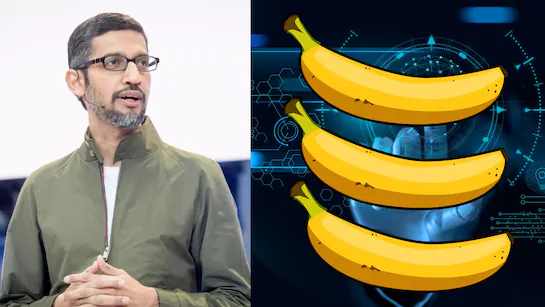
Sundar Pichai’s cryptic banana emojis are widely believed to tease Google’s new AI project “Nano Banana”—a lightning-fast image editing and generation tool that promises mask-free, text-driven edits with stunning realism.
Sundar Pichai’s cryptic banana post sparks buzz
When Google CEO Sundar Pichai dropped three banana emojis on X (formerly Twitter), the internet went wild. At first glance, the post seemed like a random midweek quirk. But within hours, speculation swirled that the bananas were more than just fruit—they were a hint at Google’s latest artificial intelligence project.
According to Grok, X’s in-platform AI assistant, the emojis are almost certainly a teaser for Google’s rumored “Nano Banana” AI model—an advanced image editing and generation tool said to rival the best in the field.
What is Nano Banana?
Nano Banana is reportedly a next-generation AI-powered image editing tool being developed by Google. Unlike traditional editors that require masks, layers, or precise manual adjustments, Nano Banana relies entirely on text-based instructions.
Here’s what sets it apart:
- Instant edits: Most changes happen in one to two seconds, bringing near real-time performance.
- Style and face consistency: Whether changing backgrounds, poses, or lighting, it preserves critical details across multiple edits.
- Text-driven control: Users simply describe what they want, and the model re-renders the image accordingly.
- Mask-free editing: Complex edits—like swapping outfits or adding objects—can be done without the need for Photoshop-style tools.
In other words, Nano Banana aims to combine the speed of consumer photo apps with the creative precision of pro-level design software.
How Google hinted at the project
Alongside Sundar Pichai’s banana emojis, Google DeepMind added fuel to the fire with a cryptic post:
“Image generation with Gemini just got a bananas upgrade and is the new state-of-the-art image generation and editing model. From photorealistic masterpieces to mind-bending fantasy worlds, you can now natively produce, edit and refine visuals with new levels of reasoning, control and creativity.”
This strongly suggests that Nano Banana is tied to Gemini, Google’s flagship AI system, and could become a native feature across Google products.
Where can you try Nano Banana?
Public access remains limited, but early testers have spotted Nano Banana on platforms like:
- LMArena’s “Battle Mode” – where users compare outputs from competing AI models in blind tests.
- Third-party fronts – sites like nanobanana.ai, Flux AI, Bylo.ai, and Dzine have offered experimental access, though availability is inconsistent.
Testers report Nano Banana excels at photorealistic rendering, scene reconstruction, and multi-element edits—beating out many existing models in early trials.
Why it matters
If Nano Banana performs as advertised, it could reshape the way people use image editing tools—both creatively and commercially.
- For casual users: No need to master Photoshop. Just type what you want.
- For creators: Faster workflows with better consistency across edits.
- For Google: A potential competitive edge against OpenAI’s DALL·E, Adobe Firefly, and MidJourney.
Sundar Pichai’s three banana emojis may have looked silly, but they signal a serious step forward in the AI race—one where speed, realism, and ease of use will determine which tool dominates the future of digital creativity