
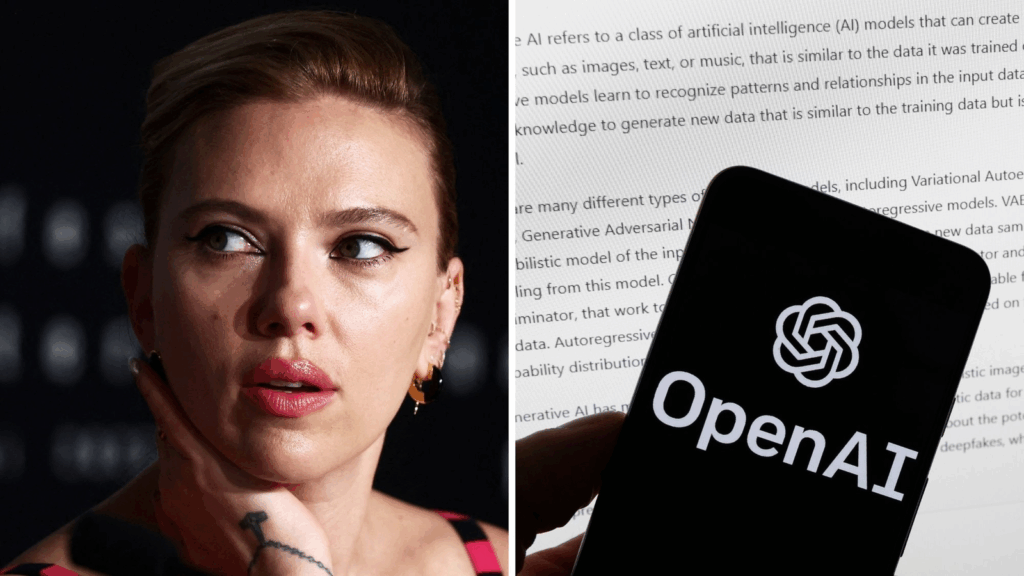
The rapid rise of generative AI has sparked a wave of lawsuits, with celebrities, media giants, and creators accusing tech companies of exploiting their work without consent. From cloned voices to pirated articles, these legal battles are redefining intellectual property rights in the AI era. Here are the five most consequential lawsuits against AI firms, including high-profile cases involving Taylor Swift, George Carlin, and Scarlett Johansson.
1. The New York Times v. Microsoft & OpenAI: The billion-dollar copyright showdown
Background: In December 2023, The New York Times sued Microsoft and OpenAI, alleging they used millions of its copyrighted articles to train AI models like ChatGPT without permission. The Times claims this created a “market substitute” for its journalism, diverting readers and advertisers while damaging its reputation through AI “hallucinations” (fabricated facts attributed to the Times)
Claims:
- Copyright infringement: Unauthorized use of articles for AI training.
- Unfair competition: AI outputs compete directly with the Times’ paywalled content.
- Trademark dilution: False attributions harm brand integrity.
Implications: If the court rejects OpenAI’s “fair use” defense, AI firms could face billions in damages and stricter content licensing rules.
2. Sarah Silverman & Authors Guild v. OpenAI: The book-piracy lawsuit
Background: In September 2023, comedian Sarah Silverman and 16 authors filed a class-action lawsuit against OpenAI, accusing it of training ChatGPT on pirated copies of their books. The suit claims AI-generated summaries and analyses of their works violate copyrights and deprive authors of income.
Claims:
- Copyright infringement: Unlicensed use of books to train AI.
- Unjust enrichment: Profiting from stolen creative work.
Status: Partially dismissed in February 2024, but core claims proceed. OpenAI argues ChatGPT’s outputs are “transformative” and non-competing.
Celebrity angle: Silverman’s involvement highlights how AI threatens creators’ livelihoods. The case could force AI companies to compensate authors or obtain licenses.
3. George Carlin estate v. Dudesy podcast: AI’s comedy imitation gone wrong
Background: In January 2024, the estate of late comedian George Carlin sued podcasters behind Dudesy for using AI to generate a fake Carlin stand-up special titled George Carlin: I’m Glad I’m Dead. The AI mimicked Carlin’s voice and style to discuss modern topics, sparking outrage.
Claims:
- Right of publicity: Unauthorized use of Carlin’s persona.
- Copyright infringement: The special derivative of Carlin’s copyrighted material.
Status: Settled in April 2024. The podcasters agreed to remove the special and never use Carlin’s likeness again.
Implications: This case sets a precedent for protecting deceased celebrities’ legacies from AI exploitation.
4. Scarlett Johansson v. OpenAI: The voice-cloning controversy
Background: In May 2024, Scarlett Johansson threatened legal action after OpenAI released a voice for its AI assistant “Sky” that closely resembled hers. Johansson revealed OpenAI CEO Sam Altman had approached her to voice the system, which she declined. Days later, “Sky” debuted with a Johansson-esque tone.
Claims:
- Copyright: Unauthorized use of her likeness and voice.
- Unfair competition: Leveraging her fame for AI credibility.
Status: OpenAI removed the “Sky” voice, but Johansson’s legal team continues to pursue damages. The case parallels a separate class-action suit against AI startup LOVO for cloning the voices of Johansson, Ariana Grande, and Conan O’Brien.
Celebrity impact: Johansson’s case underscores how AI threatens actors’ control over their personas.
Read more:
5. Arijit Singh v. Codible Ventures: India’s Landmark AI Voice Case
Background: In 2024, Indian playback singer Arijit Singh sued Codible Ventures and others for using AI to replicate his voice and sell merchandise with his image. The AI tools allowed users to convert text into Singh’s voice, while third parties sold unauthorized posters and GIFs.
Claims:
- Personality rights violation: Unlicensed commercial use of voice and image.
- Trademark infringement: Merchandise falsely implying endorsement.
Status: The Delhi High Court granted an interim injunction, ordering infringing content removed. The court ruled AI voice cloning violates personality rights, citing precedents like Anil Kapoor v. Simply Life India.
Global relevance: This case highlights how AI challenges personality rights worldwide, especially in markets with weak IP enforcement.
Why these lawsuits matter
- Fair use in question: Courts must decide if training AI on copyrighted data is “transformative” or theft.
- Celebrity rights expanded: Estates and living stars are gaining tools to combat AI impersonation.
- Global ripple effects: Rulings in the U.S. and India could shape international AI regulations.
So what’s next?
- Licensing deals: Expect AI firms like OpenAI to strike more content deals (e.g., with AP, Financial Times).
- Legislation: U.S. and EU lawmakers are drafting bills to regulate AI training data and deepfakes.
- Creator backlash: More celebrities may follow Taylor Swift, who pressured platforms to remove AI-generated explicit content in 2024.