
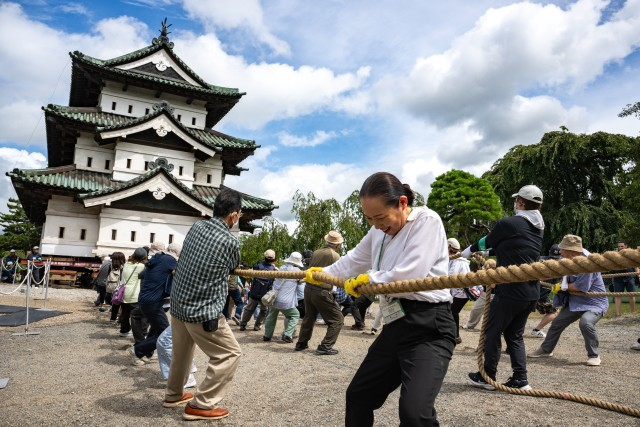
Around 1,800 people in northern Japan have come together to help move the massive Hirosaki Castle, using a centuries-old Japanese technique that allows traditional wooden structures to be relocated without dismantling them.
The 396-ton castle was moved slightly more than two meters toward its original position as restoration work nears completion. The unusual operation has turned the historic landmark’s preservation into a community event, drawing thousands of people who wanted to take part.
According to Hirosaki city officials, about 8,000 people applied for only 1,800 available volunteer places.
The interest extended well beyond the local community, with applications reportedly arriving from other parts of Japan as well as Southeast Asia, Europe and North America.
What is the hikiya technique?
Hikiya is a traditional Japanese building-relocation method in which an entire structure is moved rather than dismantled.
The building is carefully placed on a system of rollers and supports and then gradually pulled toward a new location.
The technique has existed in Japan for centuries and has been used to preserve historic structures while allowing restoration or construction work to take place underneath or around them.
In the case of Hirosaki Castle, the method has allowed the keep to remain largely intact during a major restoration project.
Why was Hirosaki Castle moved?
The castle was first moved in 2015.
At the time, the three-story keep was shifted approximately 78 meters from its original location so workers could carry out extensive restoration work safely.
Moving the building created enough space for the underlying stone foundations and other structural elements to be repaired.
The restoration was completed in 2024, including the painstaking reconstruction of the castle’s stonework.
All 2,185 stones were reportedly placed back in their original positions.
With the major restoration work finished, the castle now has to be moved back toward its original position.
Why did so many people want to pull the castle?
The project was designed not only as a preservation effort but also as a community event.
Hirosaki authorities opened a limited number of volunteer slots for people who wanted to participate directly in the traditional process.
The response was overwhelming.
Around 8,000 applications were received for 1,800 positions, making the opportunity roughly four times oversubscribed.
Kensuke Hayasaka, head of the city’s parks and green spaces division, said applications came from across Japan and overseas.
The participation has effectively turned an engineering and preservation project into a shared cultural experience.
How did 1,800 people move a 396-ton castle?
The volunteers did not move the entire structure simultaneously.
Instead, rotating groups of approximately 80 people pulled on ropes attached to the castle.
The ropes stretch roughly 30 meters.
As the teams pull, the castle moves slowly across the prepared support system.
Participants reportedly chant “so-re, so-re” as they pull together.
The synchronized effort allows the structure to be moved gradually and safely.
The distance covered by the human-powered operation is small, but the symbolism is enormous.
How far will people move the castle?
The current volunteer operation is expected to continue through the end of August.
Approximately 4,100 people are scheduled to participate in moving the castle a total of about five meters through the citizen-led effort.
The remainder of the relocation will be completed using machinery.
The source material says approximately 73 meters of the original 78-meter relocation distance will ultimately be handled mechanically.
That means the public pulling exercise represents only a small portion of the total movement but serves as a highly visible demonstration of traditional preservation techniques and community participation.
Why not move the entire castle using people?
The structure weighs hundreds of tons.
Human-powered movement is therefore extremely slow and practical only for carefully controlled distances.
Modern machinery will handle the majority of the relocation because it can provide the precision and force required to move such a massive structure safely over a much longer distance.
The volunteer operation is primarily symbolic and cultural.
It allows people to participate in the preservation of a historic building while demonstrating how the traditional hikiya method works.
How old is Hirosaki Castle?
Hirosaki Castle was originally completed in 1611.
It was built as the seat of the Tsugaru clan and became an important center of regional power.
The original structure was destroyed in 1627 when lightning reportedly struck the castle and caused a fire that reached a gunpowder store.
The keep was rebuilt in 1810.
The surviving structure is therefore a reconstruction dating to the Edo period rather than the original early 17th-century building.
Why is Hirosaki Castle important?
Hirosaki Castle is one of only 12 surviving castle keeps in Japan that retain their historic structures.
That makes it particularly valuable from a cultural and architectural perspective.
The castle is also closely associated with Hirosaki’s identity and is one of the region’s most prominent tourist attractions.
Its surroundings are especially famous during cherry blossom season.
The castle grounds reportedly attract around two million visitors during the peak cherry blossom period.
Why was the stonework restoration so difficult?
Traditional Japanese castles rely heavily on carefully constructed stone foundations.
The stones are not simply piled together.
Their individual positions and shapes are part of the structure’s stability.
During the restoration, workers had to carefully dismantle and reconstruct the stone base.
According to the supplied report, all 2,185 stones were returned to their original positions after the reconstruction was completed in 2024.
That level of precision is one reason the castle had to be moved before restoration and carefully repositioned afterward.
What makes the citizen-led hikiya operation unusual?
The original move in 2015 was reportedly the first time the hikiya technique was carried out at Hirosaki Castle with direct participation from members of the public.
That created a distinctive link between preservation and community involvement.
Rather than watching the restoration from behind barriers, ordinary residents and visitors can physically participate in the relocation.
For the organizers, the event therefore serves two purposes.
It helps move the castle while also allowing people to take part in preserving an important piece of Japan’s cultural heritage.
Why is the “so-re, so-re” chant important?
The synchronized chant helps the volunteers coordinate their movements.
Moving a huge structure requires people pulling together at the same time.
The chant provides a common rhythm and helps transform what would otherwise be a difficult physical task into a coordinated group effort.
It also contributes to the ceremonial nature of the event.
The operation is therefore as much a public cultural experience as it is a technical exercise.
Why is the castle being returned to its original position?
The castle was moved away from its original location to provide space for restoration work.
Once the restoration was completed, the structure needed to be brought back toward where it had originally stood.
The return is therefore the final stage of a project that began more than a decade ago.
The operation demonstrates how traditional Japanese preservation methods can be combined with modern engineering and restoration techniques.
What does this say about Japanese heritage preservation?
The Hirosaki project is an example of how historic structures can be preserved without treating them simply as museum objects.
The castle remains an important part of the city’s living cultural landscape.
By involving residents and visitors in the relocation, officials have turned the restoration into a public event.
It also demonstrates that ancient construction and relocation techniques still have practical value.
Rather than abandoning traditional methods, preservation specialists can adapt them alongside modern equipment.
Why is the project attracting international attention?
Moving a 396-ton historic castle with the participation of thousands of people is an unusual spectacle.
The combination of traditional engineering, community involvement and Japanese cultural heritage makes the event particularly visual.
The large number of applications also shows that the idea has appeal far beyond Hirosaki.
People from other parts of Japan and overseas reportedly wanted the opportunity to take part.
That interest has turned a highly specialized restoration project into an international curiosity.
What happens after the volunteer operation?
The remaining relocation work will be completed using machinery.
Officials expect the castle to be moved the rest of the distance toward its original location by the end of the year.
Once fully repositioned, the castle will stand on its restored foundation and continue serving as one of Hirosaki’s most important cultural landmarks.
The completion of the process will mark the end of a restoration project that has required the castle to be physically relocated twice.
The bigger picture
Hirosaki Castle’s journey is remarkable even before the latest community effort.
The historic keep was moved around 78 meters in 2015 so restoration work could be carried out safely. After the stone foundation was painstakingly reconstructed, the 396-ton structure now has to be moved back.
This time, thousands of people are helping.
Around 1,800 volunteers were selected from about 8,000 applicants, while rotating groups of 80 pull on long ropes and move the castle a few meters using the traditional hikiya technique.
The human-powered effort will cover only a small part of the total relocation.
But that is not really the point.
The spectacle is a demonstration of how an ancient Japanese technique can still bring people together around the preservation of a historic structure.
Hirosaki Castle has survived fire, centuries of political change and major restoration work.
Now, as 1,800 people pull together to move it back toward its historic position, its preservation has become a shared experience between generations.