More than 17 years after one of the deadliest aviation disasters in modern history, a French appeals court has found Air France and Airbus guilty of manslaughter over the 2009 crash of Flight AF447.
The ruling overturns a previous 2023 acquittal and marks a major legal and symbolic moment for the families of the 228 victims who died when the flight plunged into the Atlantic Ocean en route from Rio de Janeiro to Paris.
What happened to Air France Flight AF447?
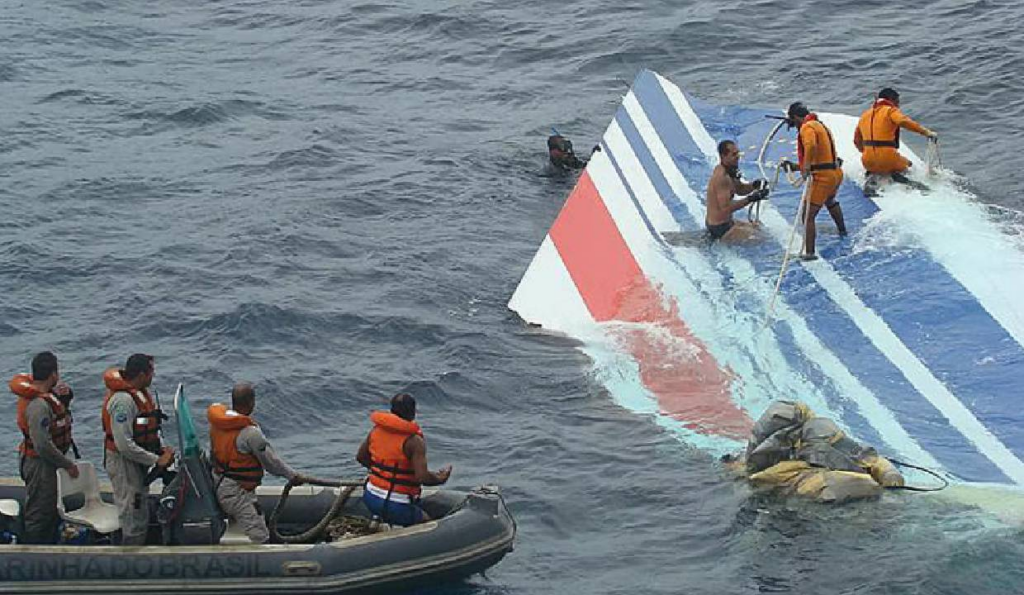
Air France Flight AF447 crash and recovery
On June 1, 2009, Air France Flight AF447 departed from Rio de Janeiro bound for Paris.
The aircraft, an Airbus A330, encountered severe weather over the Atlantic before disappearing from radar.
What caused the crash?
Investigators later determined that:
- The aircraft stalled at high altitude
- Pilots lost critical speed data during a storm
- The plane entered an aerodynamic stall from which it never recovered
The jet ultimately plunged into the Atlantic Ocean from around 38,000 feet, killing everyone on board.
Why the investigation took so long
The crash occurred in a remote part of the Atlantic Ocean, complicating recovery efforts.
Key challenges included:
- Searching more than 10,000 square kilometers of ocean floor
- Recovering wreckage from deep waters
- Locating the black boxes, which were only found in 2011
The incident became one of the most technically complex aviation investigations in history.
What did the court rule?
The Paris Appeals Court ruled that Air France and Airbus were:
- “Solely and entirely responsible” for the crash
This reversed an earlier ruling from 2023 that had cleared both companies of criminal responsibility.
Why the companies were found guilty
The court concluded there were failures involving:
- Aircraft safety systems
- Risk awareness
- Operational handling and oversight
During proceedings, prosecutors criticized the conduct of both companies, describing their behavior as “unacceptable.”
Penalties imposed
The companies were ordered to pay:
- €225,000 each—the maximum fine allowed under French law
However, several victims’ families argued the financial penalties were too small given the scale of the tragedy.
Why the verdict matters to victims’ families
For many relatives, the ruling was about accountability more than money.
A long fight for justice
The legal process stretched across:
- Multiple investigations
- Years of technical analysis
- Two major court proceedings
Daniele Lamy, president of the AF447 victims’ association, said the ruling finally acknowledged the suffering endured by families.
The emotional toll
Many families faced years of uncertainty because:
- Bodies were recovered slowly
- Some remains were identified years later
- The crash site remained inaccessible for long periods
For some relatives, proper burials happened more than two years after the disaster.
Who were the victims?
The crash claimed the lives of:
- 216 passengers
- 12 crew members
Passengers came from 33 countries.
Nationalities on board included:
- 61 French nationals
- 58 Brazilians
- 26 Germans
- Several British, Irish, and American passengers
Among those killed were:
- Doctors returning from holiday
- Families traveling internationally
- Brazilian royal family member Pedro Luiz de Orleans e Bragança
A tragedy spanning generations
The victims included:
- Men and women of various professions
- Seven children
- One infant
The global makeup of the passenger list turned the disaster into an international tragedy.
What role did Airbus and Air France play?
Airbus A330 and aviation safety scrutiny
The legal case focused on whether the companies failed to adequately address known risks.
Questions surrounding Airbus
Investigators examined issues related to:
- Aircraft sensors
- Stall warnings
- Technical design and communication
Questions surrounding Air France
The airline faced scrutiny over:
- Pilot training
- Operational procedures
- Crisis response preparedness
Both companies had repeatedly denied criminal responsibility before the latest ruling.
Will Airbus and Air France appeal?
Airbus has already indicated it plans to seek a judicial review.
What happens next?
Potential next steps include:
- Further appeals
- Additional legal examination of the ruling
- Ongoing compensation and civil claims discussions
The case may continue to evolve despite Thursday’s verdict.
How did AF447 change aviation safety?
The disaster led to major reforms in the aviation industry.
Changes introduced after the crash
Following the investigation:
- Pilot training on high-altitude stalls was expanded
- Aircraft sensor systems received greater scrutiny
- Airlines improved procedures for handling unreliable speed data
Broader impact on aviation
AF447 reshaped industry understanding of:
- Human-machine interaction
- Pilot response under stress
- Automation dependency in modern aircraft
Many aviation experts consider the crash a turning point in commercial flight safety training.
Why this remains one of aviation’s defining tragedies
The AF447 crash continues to resonate because it combined:
- Advanced technology failure
- Human decision-making under pressure
- A prolonged and painful search for answers
The court ruling closes one chapter of the story—but not necessarily the emotional impact on those affected.
TL;DR
- A French appeals court found Air France and Airbus guilty of manslaughter over the 2009 AF447 crash
- The Airbus A330 crashed into the Atlantic Ocean, killing all 228 people on board
- The ruling overturns a 2023 acquittal
- Both companies were fined €225,000 each
- The case reshaped aviation safety standards worldwide