
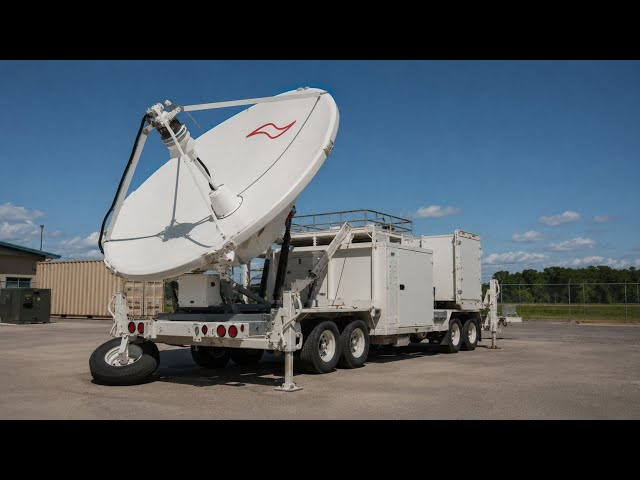
The United States has taken another step toward treating space as an active military domain with the deployment of Meadowlands, a new electromagnetic warfare system designed to disrupt enemy satellite communications without physically destroying spacecraft. Developed by defence contractor L3Harris for the U.S. Space Force, the system reflects a growing shift toward “non-kinetic” warfare—using electronic attacks instead of missiles to disable an adversary’s capabilities.
While Meadowlands does not destroy satellites, defence experts say its ability to interrupt communications, navigation, and intelligence networks could make it one of the most significant electronic warfare systems fielded by the United States. The development comes amid rising geopolitical competition in space involving the U.S., China, and Russia.
What is the Meadowlands satellite jamming system?
Meadowlands is a mobile electromagnetic warfare platform developed to interfere with communications between satellites and ground stations.
Instead of attacking satellites physically, the system uses powerful radio frequency signals to:
- Jam satellite communications.
- Disrupt command-and-control links.
- Prevent data transmission.
- Deny adversaries access to satellite-enabled military capabilities.
The U.S. Space Force describes Meadowlands as part of its growing “toolkit for spectrum dominance,” emphasizing the increasing importance of controlling the electromagnetic spectrum during military operations.
Unlike anti-satellite missiles, which permanently destroy spacecraft and generate dangerous orbital debris, Meadowlands aims to temporarily neutralize satellites through electronic means.
Consider adding an infographic comparing kinetic anti-satellite weapons with non-kinetic electromagnetic warfare systems.
How does Meadowlands work?
Although many technical details remain classified, publicly available information suggests Meadowlands consists of a large satellite communications antenna mounted on a mobile trailer.
The system can be:
- Transported by road.
- Airlifted using military cargo aircraft.
- Rapidly deployed near operational theaters.
Once positioned, it directs powerful radio-frequency signals toward enemy satellite links, interrupting communications between orbiting satellites and military units on the ground.
Because no physical impact occurs, satellites themselves remain intact while their communications become unreliable or unusable for a period of time.
Why is electronic warfare becoming so important in space?
Modern militaries rely heavily on satellites.
They provide:
- GPS navigation.
- Secure communications.
- Missile warning.
- Battlefield intelligence.
- Weather monitoring.
- Target tracking.
Disabling those services—even temporarily—can significantly affect military operations.
Electronic warfare offers several advantages over physically destroying satellites:
- No orbital debris.
- Lower risk of escalating into direct kinetic conflict.
- Reversible effects.
- Faster deployment.
- Greater operational flexibility.
This has made electromagnetic warfare an increasingly attractive option for major military powers.
How does Meadowlands fit into U.S. space strategy?
The U.S. government has steadily expanded its military focus on space over the past decade.
The creation of the U.S. Space Force reflected the belief that future conflicts could extend beyond land, sea, air, and cyberspace into orbit.
President Donald Trump has repeatedly emphasized achieving what his administration calls “space superiority,” describing space as a warfighting domain rather than simply an area for exploration.
Within that strategy, systems like Meadowlands are intended to give military commanders options that stop short of destroying satellites while still degrading an opponent’s capabilities.
What role has the Space Force described for Meadowlands?
According to the U.S. Space Force, electromagnetic warfare capabilities have already been integrated into recent military operations.
Officials said similar systems supported Operation Midnight Hammer by creating what they described as a “silence zone,” limiting adversary communications and protecting U.S. bomber operations.
The Space Force also said electromagnetic warfare units disrupted enemy air defense sensors and military communications during Operation Epic Fury, demonstrating how non-kinetic systems are becoming part of modern combat operations.
Colonel Angelo Fernandez, commander of Mission Delta 3 – Space Electromagnetic Warfare, said continued investment in electromagnetic warfare technology and training is essential for future military operations.
Does Meadowlands violate international space law?
Not necessarily.
Current international treaties—including the 1967 Outer Space Treaty—primarily prohibit the placement of weapons of mass destruction in space.
Electronic warfare systems like Meadowlands generally operate from Earth rather than from orbit.
Because they:
- Do not destroy satellites.
- Do not place weapons in orbit.
- Produce no long-term orbital debris.
they occupy a legal gray area that existing treaties do not explicitly prohibit.
However, experts argue that international rules governing electronic attacks in space remain underdeveloped compared with traditional arms control agreements.
How does Meadowlands compare with anti-satellite weapons?
Several countries—including the United States, China, India, and Russia—have demonstrated anti-satellite (ASAT) weapons capable of physically destroying satellites.
Those systems can create thousands of debris fragments that threaten spacecraft for years.
Meadowlands represents a different approach.
| Capability | Meadowlands | Traditional ASAT Weapon |
|---|---|---|
| Physical destruction | No | Yes |
| Creates space debris | No | Yes |
| Reversible effects | Usually | No |
| Targets communications | Yes | Indirectly |
| Escalation risk | Lower | Higher |
Many defense analysts believe future conflicts will increasingly rely on electronic attacks before kinetic options are considered.
Why does this matter?
Military satellites have become essential infrastructure for modern warfare.
A successful electronic attack could affect:
- Battlefield communications.
- Precision-guided weapons.
- Intelligence gathering.
- Navigation systems.
- Early missile warning.
- Drone operations.
As more military capabilities depend on satellites, protecting and disrupting space-based communications is becoming just as important as protecting aircraft or naval fleets.
Is this the beginning of “space wars”?
Not in the cinematic sense.
Meadowlands does not represent combat between spacecraft or weapons firing in orbit.
Instead, it reflects the growing militarization of space infrastructure.
Rather than destroying satellites, countries are investing in technologies that:
- Jam signals.
- Spoof navigation.
- Disrupt communications.
- Interfere with radar.
- Conduct cyber operations against space systems.
Many analysts believe future conflicts involving major powers will feature these non-destructive electronic attacks before—or instead of—traditional anti-satellite strikes.
TL;DR
- Meadowlands is a new U.S. Space Force electromagnetic warfare system developed by L3Harris.
- It disrupts enemy satellite communications without physically destroying satellites.
- The system is mobile and can be rapidly deployed by road or aircraft.
- Electronic warfare is becoming a central element of modern military strategy because satellites support communications, navigation, and intelligence.
- Unlike anti-satellite missiles, Meadowlands does not create dangerous orbital debris, making it a less destructive but strategically significant capability.