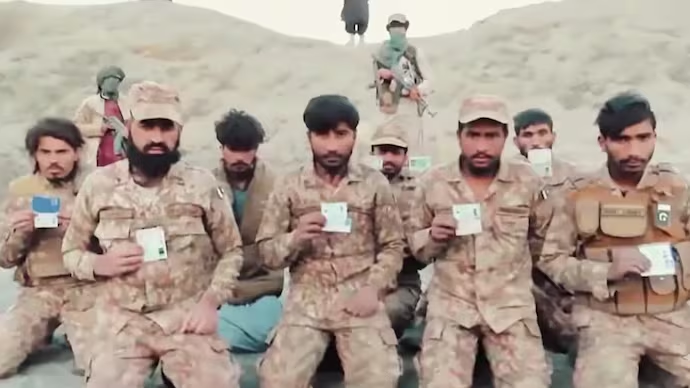
A newly released video by the Baloch Liberation Army (BLA) has reignited a volatile debate in Pakistan: what happens when soldiers fall into militant hands, and how transparent is the state about it?
The footage, circulated by the BLA’s media wing, purportedly shows Pakistani soldiers kneeling in rugged terrain, flanked by armed militants. The men appear to display service cards and identity documents. In the clip, one detainee emotionally questions why the Army is denying his identity and deployment.
Pakistan’s military establishment has reportedly maintained that no serving personnel are missing or in militant custody. International agencies, including Reuters, have not independently verified the authenticity of the video.
The timing is critical. The BLA has set a February 22 deadline for what it calls negotiations over a prisoner exchange.
What does the new BLA video claim?
The Baloch Liberation Army, an armed separatist group seeking independence for Balochistan, claims it captured multiple Pakistani soldiers during recent operations in the province.
According to the group’s statement:
• The detainees were formally recruited Army personnel
• A seven-day ultimatum was issued for talks
• Failure to negotiate could result in execution
Earlier reports suggested seven personnel were captured. The latest footage appears to show eight individuals.
Pakistan designates the BLA as a terrorist organization. The state has long rejected the group’s claims and maintains that security operations in Balochistan target militant infrastructure, not civilians.
Why is Balochistan central to this conflict?
Balochistan is Pakistan’s largest province by area, but it is its least populated and economically underdeveloped. It borders Afghanistan and Iran and holds significant natural gas and mineral reserves.
Separatist groups argue that Islamabad exploits the province’s resources without equitable revenue sharing. The federal government disputes this, citing development projects, including those under the China-Pakistan Economic Corridor.
Attacks in the region have escalated in recent years. The BLA has claimed responsibility for:
• Ambushes on military convoys
• Targeted attacks on infrastructure linked to CPEC
• High-profile hostage operations
One such incident involved the hijacking of the Jaffar Express train, where hundreds were reportedly taken hostage.
Has Pakistan faced similar controversies before?
The release of the BLA video has revived older debates about how Pakistan has handled captured or fallen soldiers in past conflicts.
The Kargil War narrative
During the 1999 Kargil conflict between India and Pakistan, Indian authorities reported recovering bodies of Pakistani soldiers and stated that identity documents were found on several of them. At the time, Pakistan described the fighters as irregulars.
Later, Pakistan acknowledged and posthumously honored some personnel.
Coverage from The Hindu, BBC, and official Indian and Pakistani military archives would be appropriate external sources to cite here.
The 1971 war and the surrender
In the 1971 Indo-Pak war, Pakistani forces surrendered in large numbers in what became one of the most significant capitulations in modern military history. Images of abandoned equipment and tanks during specific battles became symbolic of the broader defeat.
The formal surrender ceremony in Dhaka remains a defining moment in South Asian military history.
South Waziristan 2008
According to reporting by the Long War Journal, around 250 Pakistani security personnel surrendered to militants linked to Baitullah Mehsud in South Waziristan in 2008 after being surrounded. The Pakistani government described the episode as a hostage situation.
Critics argued the event exposed weaknesses in morale and coordination.
Each of these episodes reflects the complexity of irregular warfare, where information battles can be as consequential as ground operations.
Why might a state deny captivity claims?
Governments confronting insurgencies often face a strategic dilemma.
Acknowledging captured soldiers can:
• Boost insurgent propaganda
• Damage troop morale
• Invite domestic political criticism
• Strengthen militant bargaining leverage
On the other hand, denial risks eroding public trust if contradictory evidence surfaces.
Security analysts often describe this as a “narrative control” challenge. A relevant external source here would be academic research on information warfare and state communication strategy from institutions such as the RAND Corporation.
What is the BLA’s strategic objective?
By releasing the video, the BLA appears to be pursuing multiple goals:
• Demonstrating tactical capability
• Forcing negotiations
• Undermining state credibility
• Amplifying international visibility
Hostage-taking shifts the conflict from remote skirmishes to emotionally charged public pressure.
If verified, the detainees’ pleas introduce a human dimension that complicates Islamabad’s messaging strategy.
What options does Islamabad have?
Pakistan has historically avoided public prisoner exchanges with separatist groups. Its approach has typically included:
• Sustained military operations
• Intelligence-led targeting
• Quiet backchannel negotiations
Engaging publicly with the BLA risks legitimizing it. Refusing engagement risks escalation.
The February 22 deadline increases pressure. However, insurgent ultimatums often function as leverage tools rather than fixed timelines.
Why this moment matters
The BLA video of captured Pakistani soldiers is not only about one incident. It touches on deeper themes:
• Civil-military transparency
• Information warfare
• Morale in asymmetric conflict
• The unresolved political question of Balochistan
For families of the alleged detainees, the issue is immediate and personal. For the Pakistani state, it is strategic.
For the broader region, it is a reminder that the insurgency in Balochistan remains active and capable of shaping national headlines.
TL;DR
• The BLA has released a video claiming to show Pakistani soldiers in captivity.
• Pakistan’s military reportedly denies that serving personnel are missing.
• The group has set a February 22 deadline for negotiations.
• The episode revives past debates about how Pakistan has handled captured soldiers.
• The situation highlights the continuing instability in Balochistan.