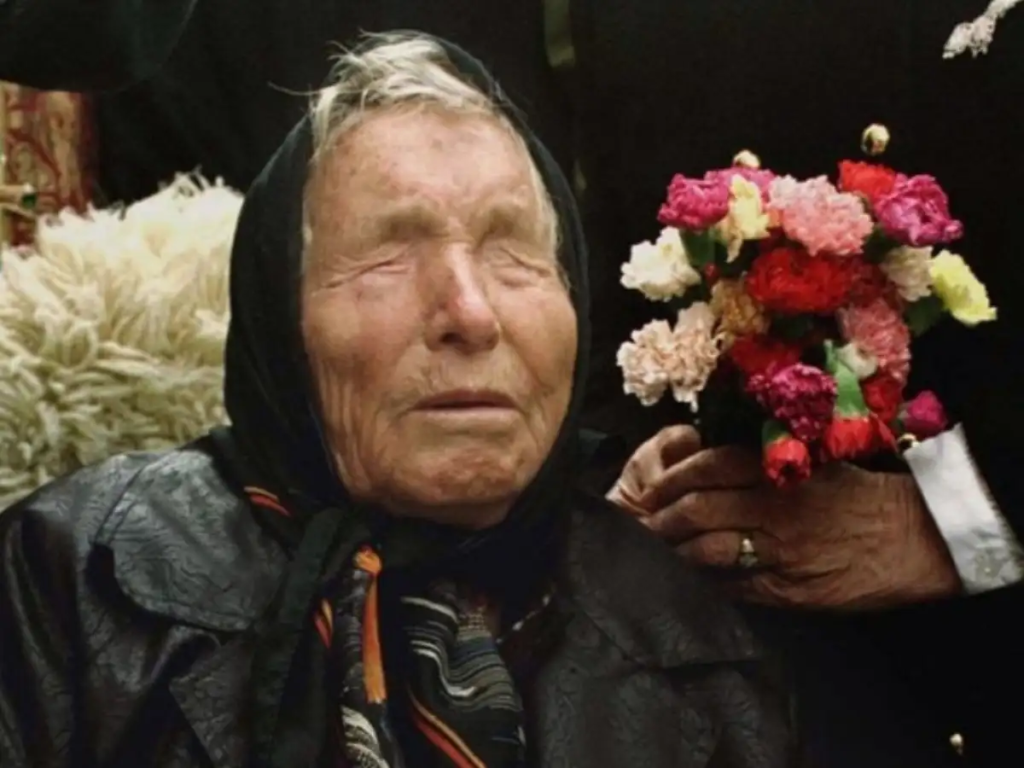
A bizarre prediction attributed to the late Bulgarian mystic Baba Vanga is making the rounds ahead of 2027, with her followers claiming that a mysterious disease or genetic experiment could give a small number of people superhuman abilities. The alleged prophecy sounds more like a science-fiction plot than a traditional prediction. According to reports circulating online, some kind of illness or experiment will affect humans in 2027, with only a few people supposedly emerging with extraordinary powers.
There is, however, a major catch: there is no verified written record showing that Baba Vanga ever made this prediction.
That caveat applies to many of the dramatic forecasts attributed to her after her death in 1996. Researchers and fact-checkers have repeatedly noted that most of the supposed annual predictions come from second-hand accounts, later interpretations and internet circulation rather than original documents.
What is Baba Vanga’s alleged 2027 prediction?
The latest claim says that 2027 could bring a mysterious disease or genetic experiment capable of producing “superhuman” abilities in a small number of people.
There are few details attached to the prediction. It does not identify a particular disease, scientific technology, laboratory or country. It also does not explain what these supposed powers would be.
That vagueness is significant.
A prediction containing only broad concepts such as disease, experiments and extraordinary human abilities can be interpreted in many different ways after events occur. It also makes the claim impossible to test scientifically in advance with any precision.
Did Baba Vanga actually predict superhumans?
There is no reliable primary evidence establishing that she did.
Baba Vanga, whose real name was Vangeliya Pandeva Gushterova, died in 1996. Unlike a prophet who left behind dated books or recordings, she did not leave a verified collection of written predictions that can be checked against claims circulating online today.
A 2026 fact-checking review found that many annual lists attributed to her have no confirmed earliest source, while research and reporting have repeatedly pointed out that later storytellers and publications played a major role in shaping the predictions now associated with her name.
So the 2027 “superhuman” prophecy should be described as an alleged prediction attributed to Baba Vanga, not as an authenticated statement made by her.
Why do Baba Vanga’s predictions keep going viral?
Her name has become a recurring fixture of internet prediction culture.
Whenever wars, natural disasters, economic turmoil or technological breakthroughs dominate the headlines, lists of predictions supposedly made by Baba Vanga tend to resurface.
The formula is remarkably effective: attach a vague prediction to a famous mystic, connect it to a major current event and wait for people to compare the two.
A prediction about “war in the East,” for example, can potentially be matched with numerous conflicts. A prediction about technological upheaval can be linked to everything from artificial intelligence to biotechnology.
This flexibility makes such claims easy to recycle.
Did Baba Vanga really predict COVID-19 and 9/11?
She is frequently credited online with predicting both.
However, there is no authenticated written document from Vanga that clearly contains those predictions in their viral modern form.
The problem is not merely that the original documents are missing. Many claims emerged or became popular through accounts published years after the events they supposedly predicted.
That makes retrospective interpretation particularly vulnerable to what is known as hindsight bias: once an event has happened, people can find similarities between it and an older, vague statement that may not have seemed significant beforehand.
What are Baba Vanga’s alleged 2026 predictions?
The lists circulating for 2026 have included claims about a major global war, natural disasters, artificial intelligence, an economic crisis and an encounter with extraterrestrial life.
Some versions also claim that Russian President Vladimir Putin would rise to become a dominant global figure.
These predictions have repeatedly been connected to events occurring during 2026, including wars, earthquakes, floods and the rapid expansion of AI.
But again, the underlying source problem remains.
Because there is no verified master list written by Vanga herself, different websites often publish different versions of what she supposedly predicted for the same year.
Does a prediction become credible when something similar happens?
Not necessarily.
A prediction needs to be specific enough to be tested before the event occurs.
Consider a statement such as “a major disaster will strike.” Almost any year contains enough earthquakes, storms, floods or fires to make that statement appear successful.
A much stronger prediction would identify a specific event, location, date and outcome, and the wording would need to be independently documented before the event happened.
Most of the Baba Vanga claims circulating online do not meet that standard.
Could science actually create ‘superhumans’?
The science-fiction version of the claim is far more dramatic than what current biotechnology can demonstrate.
Researchers are already exploring gene editing, personalized medicine, neural implants and other technologies that can alter or enhance particular biological functions.
But giving ordinary humans extraordinary abilities comparable to fictional superheroes is an entirely different proposition.
Scientists can modify or treat particular genetic conditions, and some technologies can enhance specific functions. That is not evidence that a disease or experiment could suddenly produce a small group of humans with generalized superhuman powers.
There is currently no established scientific mechanism that resembles the alleged Baba Vanga scenario.
Could a disease cause unusual biological abilities?
Diseases can certainly alter human biology, sometimes in unexpected ways.
Mutations can affect physical characteristics, metabolism, immune responses and susceptibility to particular conditions. But calling these changes “superpowers” would be misleading.
A biological mutation that produces one unusual characteristic is not the same as a coordinated enhancement of strength, intelligence, healing ability or other fictional traits.
The alleged 2027 prediction offers no biological mechanism for how such an outcome could occur.
Could genetic engineering produce enhanced humans?
Genetic engineering is advancing rapidly, but the technology has significant scientific and ethical limitations.
Gene editing can be used to modify specific sequences associated with disease or biological functions. Researchers are also investigating ways to engineer cells and tissues for medical applications.
That does not mean scientists can safely design a person with a menu of enhanced abilities.
Human traits such as intelligence, athletic performance and disease resistance are influenced by many genes and environmental factors. Changing one part of that system can also have unintended consequences.
So while human enhancement is a genuine scientific and ethical debate, it is nowhere near the comic-book scenario suggested by the viral prediction.
Why does the ‘superhuman’ prediction sound believable to some people?
Because it borrows from technology that genuinely exists.
Gene editing, artificial intelligence, brain-computer interfaces and advanced medicine all sound futuristic, even though researchers are already working with them.
That creates fertile ground for sensational predictions.
A vague claim about a scientific experiment can be retrofitted onto almost any future breakthrough. If researchers announce a major genetic discovery in 2027, for instance, someone could point back to the “superhuman” prediction and declare it fulfilled.
But that would not establish that Baba Vanga accurately foresaw the discovery.
What about the other famous Baba Vanga predictions?
Her alleged predictions have included a long list of extraordinary events, from world wars and economic collapse to alien contact and the eventual end of humanity.
The problem is that the predictions vary significantly depending on the source.
Some annual lists appear to emerge only after years of circulation, while other claims cannot be traced to a clear primary source at all.
A 2026 review of the phenomenon concluded that the earliest source for many of the annual Baba Vanga predictions remains unconfirmed.
That makes it difficult to distinguish anything Vanga may actually have said from statements subsequently attributed to her.
Why is 2027 already being discussed?
The timing is partly driven by the annual cycle of prophecy stories.
As one year approaches its final months, websites and social media accounts begin publishing lists of what famous mystics supposedly predicted for the following year.
Baba Vanga is particularly useful for this kind of content because her reputation is already associated with dramatic claims involving war, technology and disasters.
The 2027 “superhuman” story adds a new twist because it combines two subjects that attract enormous attention online: futuristic biotechnology and prophecy.
Will the 2027 prediction come true?
There is no scientific basis for predicting that a disease or genetic experiment will create humans with superhuman abilities in 2027.
More importantly, there is no reliable evidence that Baba Vanga herself made such a forecast.
That does not prevent the claim from being entertaining or intriguing. It simply places it in the correct category: an unverified prophecy circulating through modern media, rather than a documented prediction from a historical source.
And that distinction becomes especially important when the claim involves real scientific technologies.
Gene editing is real. Human enhancement research is real. Superhuman powers are not.