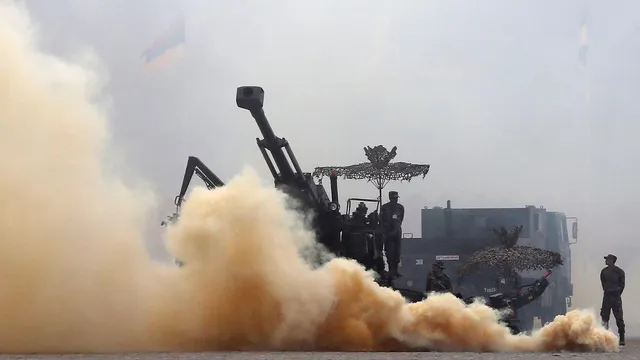
China’s military ambitions and its rapidly expanding weapons ecosystem are again under scrutiny, this time due to a startling claim by a bipartisan US commission. A new report suggests that Beijing used the India-Pakistan conflict in May, triggered by the Pahalgam terror attack, as an opportunity to test and showcase its latest weapons.
The allegation that China deployed its modern, indigenously built systems under real combat conditions for the first time raises larger questions about Beijing’s regional strategies, its expanding defence industry, and the growing influence it exerts on arms markets from South Asia to Southeast Asia.
This article breaks down the claims, explores their implications, and explains why the findings matter for India, Pakistan, and the global military balance.
What did the US report claim about China’s role in the conflict?
The US-China Economic and Security Review Commission (USCC), which reports directly to the US Congress, published an annual report stating that China viewed the India-Pakistan clash as a live opportunity to test, validate, and later promote its defense systems.
According to the report, Chinese systems such as
- HQ-9 air defence system
- PL-15 air-to-air missiles
- J-10 fighter aircraft
…were allegedly used in wartime conditions for the first time.
The commission said these deployments allowed China to evaluate the performance of its frontline equipment in real, not simulated, scenarios. Such testing is valuable because it helps refine future versions, improve export pitches, and showcase reliability to potential buyers.
This claim, if accurate, marks a significant shift. China has long been accused of using proxy regions or exercises to test weapons. But testing during an active India-Pakistan engagement raises geopolitical stakes dramatically.
Why would China test weapons during an India-Pakistan clash?
The report outlines two motives:
1. To strengthen its position against India
China’s border standoff with India, from Doklam to Ladakh, has pushed Beijing to accelerate deployments along the Line of Actual Control. Testing weapons in a conflict involving India provides data directly relevant to future Sino-Indian confrontations.
2. To boost China’s global defence exports
China is aggressively expanding its presence in the global arms market. Demonstrating battlefield-tested systems dramatically increases their sale value.
The report states that following the May conflict, China offered Pakistan:
- Ballistic missile defence systems
- 40 J-35 fifth-generation fighter jets
- KJ-500 airborne early warning aircraft
The timing, the commission says, was not coincidental. Beijing appeared ready to market equipment whose effectiveness had just been trialed under combat-like conditions.
Did China act as an instigator in the conflict?
Despite the alarming nature of the claims, the US report cautions against assuming China triggered or escalated the crisis.
It stated that the idea of the conflict being a “proxy war” orchestrated by China is an overstatement. Instead, Beijing used the situation opportunistically, not provocatively, to serve strategic and commercial interests.
This is a subtle but important distinction. It signals that while China may not have fanned the flames, it certainly made use of the smoke.
How China allegedly ran a disinformation campaign around Rafale jets
One of the report’s most striking allegations involves a disinformation campaign targeting French-made Rafale fighters, the crown jewel of India’s air power.
What China allegedly did
French intelligence told US investigators that China:
- Used fake social media accounts
- Circulated AI-generated and video game–based “debris images”
- Claimed Rafales were destroyed by Chinese equipment
The goal? Undermine confidence in the Rafale and push potential buyers toward China’s own J-35 stealth fighter.
Visual suggestion: Add a side-by-side comparison of AI-generated fake images vs. real fighter jet debris to explain how disinformation spreads.
Did the campaign work?
According to the commission, Chinese embassies successfully pressured Indonesia to reconsider its Rafale purchase. Indonesia had earlier announced plans to acquire the jets but reportedly shifted interest toward the J-35 following China’s persuasion.
Beijing denied these allegations, calling them “false and politically motivated.”
Why the report matters for India
India faces a dual challenge:
- An aggressive China is expanding its military presence along the Himalayan frontier
- A Pakistan with increasing access to Chinese frontline aircraft and missile systems
If Pakistan acquires a fleet of J-35s, a stealth fighter designed to rival the F-35, the air balance in South Asia would shift significantly.
India would need accelerated modernization of its air force, including procurement of:
- Additional Rafales
- Indigenous Tejas Mk2 variants
- The upcoming AMCA fifth-generation program
For policy readers, consider linking to an article exploring India’s defence modernization roadmap.
Why it matters for global arms markets
China is positioning itself as the world’s largest supplier of mid-cost, modern weapons. Battlefield testing is a powerful marketing tool, especially against Western competitors like France, the US, and Sweden.
Countries like Indonesia, Egypt, Iraq, and Malaysia, long considered swing buyers, are increasingly weighing Chinese alternatives.
If disinformation becomes part of the sales toolkit, arms competition may shift from engineering superiority to narrative warfare.
How reliable is the US Commission’s claim?
The USCC uses:
- Committee hearings
- Academic research
- Open-source intelligence
- Media reports
It does not rely on classified intelligence.
This means:
- The report has credibility due to bipartisan oversight
- But its claims need independent verification from governments or neutral military experts
For publication, cite primary sources like the USCC’s official report and French intelligence assessments reported by outlets such as Reuters or The Economist.
What this reveals about modern warfare
Three major themes emerge from the findings:
1. War is becoming a testing ground
Major powers are leveraging regional conflicts to validate weaponry without directly entering combat.
2. Disinformation is the new battlefield
AI-generated fabrication is now sophisticated enough to influence billion-dollar defence decisions.
3. India sits at the intersection of two rival defence ecosystems
Russia–India collaboration on one side and China–Pakistan on the other create an increasingly polarized region.
TL;DR
A US bipartisan report claims China used the May India-Pakistan conflict to test its advanced weapons and later promote them for export. Beijing allegedly ran a disinformation campaign to undermine France’s Rafale jets and boost interest in its J-35 fighters. The report stops short of calling China an instigator but highlights how Beijing leveraged the crisis to expand its defense footprint. The findings carry significant implications for India’s security, Pakistan’s capabilities, and global arms markets.