
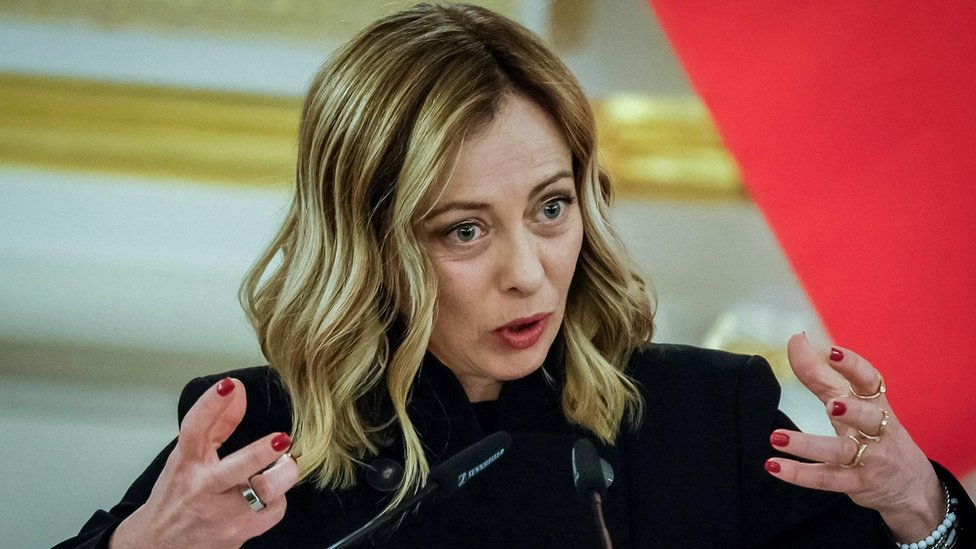
What happened with Giorgia Meloni’s doctored image?
A political storm has erupted in Italy after doctored pornographic images of Prime Minister Giorgia Meloni surfaced on a popular adult website. The platform, known as Phica—a misspelled play on an Italian slang term for vagina—published altered photos of Meloni alongside other prominent women, including her sister Arianna Meloni.
The manipulated images were accompanied by vulgar captions and placed in the site’s “VIP section,” which caters to its more than 700,000 subscribers. Investigators suspect the images were sourced from women’s public appearances, rallies, or personal social media before being digitally altered to sexualize them.
Who else was targeted?
The scandal extends beyond Giorgia Meloni. Other women whose images appeared on the site include:
- Paola Cortellesi, acclaimed actor and director of the domestic violence-themed film C’è Ancora Domani (There’s Still Tomorrow)
- Chiara Ferragni, high-profile fashion influencer and entrepreneur
- Valeria Campagna, a Democratic Party (PD) politician who was among the first to file a legal complaint
Many of the doctored images reportedly zoomed in on women’s bodies or altered their posture to imply sexual behavior. For many Italians, the scandal feels like an escalation of ongoing issues of online misogyny.
Why does this scandal matter?
This controversy is not just about digital harassment—it touches on deeper cultural and political debates in Italy:
- Gendered violence online: The incident highlights how women in public life remain vulnerable to sexualized attacks designed to humiliate or silence them.
- Political impact: Giorgia Meloni, Italy’s first female prime minister, has often been a target of sexist rhetoric. This episode reinforces concerns about the intersection of politics, gender, and digital abuse.
- Public trust and regulation: The fact that Phica operated relatively unhindered since 2005 raises questions about gaps in Italian law and enforcement against online exploitation.
How are victims responding?
Valeria Campagna voiced outrage in a public Facebook post, calling the discovery of her photos “disgusting, angry, and disappointing.” She wrote:
“Not just photos in a swimsuit but moments from my public and private life. Beneath them there were sexist, vulgar and violent comments. I can’t stay silent because this story isn’t just about me. It’s about our right to be free, respected and to live without fear.”
This response underscores the broader dimension of the scandal: many victims see it not only as a personal violation but also as a threat to women’s rights in Italy.
Connection to previous scandals
The uproar comes only a week after Meta shut down an Italian Facebook group named Mia Moglie (“My Wife”), where men exchanged intimate photos of women—sometimes without their consent. The group’s takedown and now the Phica revelations suggest a troubling trend of online platforms being used to exploit women under the guise of community or entertainment.
What happens next?
Italian police have launched an investigation into Phica. Several center-left Democratic Party members have already submitted official complaints, demanding swift legal action. Lawmakers and women’s rights activists are calling for:
- Stronger regulation of online platforms hosting exploitative or doctored content
- Harsher penalties for those who manipulate and distribute non-consensual images
- Public awareness campaigns about the harms of “deepfake” and AI-generated sexual content
If the investigation leads to criminal charges, it could set an important precedent for tackling digital abuse in Italy.
Broader implications: deepfakes and democracy
The scandal resonates beyond Italy, tapping into global debates about digital ethics. AI-driven image manipulation and “deepfake” technology are making it increasingly easy to produce realistic but fabricated images. While some uses are harmless or satirical, in the political and personal context, they pose severe risks:
- For democracy: Disinformation campaigns using doctored visuals can undermine trust in leaders and institutions.
- For women: Studies consistently show that women are disproportionately targeted with non-consensual sexual deepfakes.
- For online safety: Platforms that profit from such content often hide behind legal loopholes, leaving victims with little recourse.
Conclusion
The doctored images of Giorgia Meloni and other women are not just a scandal—they’re a warning signal. As technology evolves, so do the tools of harassment and political manipulation. Italy’s handling of this case will be closely watched, not only for justice for the women involved but also for what it says about protecting digital dignity in the 21st century.