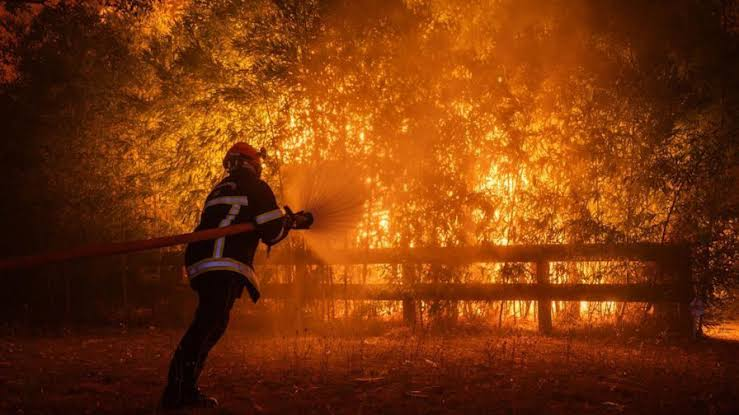
A massive wildfire burning near Bordeaux in southwestern France has generated a rare pyrocumulonimbus (PyroCb) cloud, a towering, thunderstorm-like cloud created by the intense heat of large fires.
The phenomenon, which can produce its own lightning, powerful winds, and unpredictable weather, has complicated firefighting efforts as France battles one of its most severe wildfire emergencies in recent years. Authorities have deployed thousands of firefighters and emergency personnel while hundreds of thousands of residents have been forced to evacuate affected areas.
What Is Happening in Bordeaux?
Wildfires burning across the Gironde region near Bordeaux have expanded rapidly amid extreme heat, dry vegetation, and challenging weather conditions.
The intensity of the blaze has led to the formation of a pyrocumulonimbus cloud—a rare atmospheric phenomenon associated with exceptionally large wildfires and some volcanic eruptions.
Officials say the fires have damaged forests, threatened communities, and prompted large-scale evacuations while emergency crews continue efforts to contain the blaze.
What Is a Pyrocumulonimbus Cloud?
A pyrocumulonimbus (PyroCb) is a thunderstorm-like cloud created by the enormous heat generated by an intense wildfire or volcanic eruption.
NASA has described PyroCb clouds as among the most dramatic weather phenomena associated with extreme fires because they can significantly alter fire behaviour.
The process begins when:
- Intense heat rapidly warms the surrounding air.
- Hot air, smoke, ash, and water vapor rise at high speed.
- As the air cools at higher altitudes, water vapor condenses into clouds.
- Ice crystals form within the cloud, allowing electrical charges to build.
- The cloud may begin producing lightning, much like a conventional thunderstorm.
In some cases, these clouds can also generate strong downdrafts and localized weather systems.
Why Are PyroCb Clouds Dangerous?
Pyrocumulonimbus clouds can make already dangerous wildfires even more difficult to control.
Potential impacts include the following:
- Lightning that can ignite new fires.
- Powerful and rapidly changing winds.
- Sudden changes in fire direction.
- Reduced visibility from smoke and ash.
- Increased turbulence for aircraft involved in firefighting.
Although rare, PyroCb events have been documented during major wildfires in countries including Australia, Canada, and the United States.
Why Are the France Wildfires So Severe?
Several factors have contributed to the rapid spread of the fires, including:
- High temperatures approaching 38°C (100°F).
- Prolonged dry conditions.
- Low humidity.
- Dry forests and vegetation.
- Wind that helps spread flames.
France has experienced multiple heatwaves this year, creating conditions favorable for large and fast-moving wildfires.
Emergency Response
French authorities have mounted a large emergency response to combat the fires.
According to officials, resources deployed include:
- Nearly 2,500 firefighters.
- Approximately 1,500 military personnel.
- Around 1,200 police officers.
Emergency crews continue working to protect communities, contain active fire fronts, and assist evacuated residents.
French President Emmanuel Macron is expected to coordinate the government’s response through emergency meetings with senior officials.
Impact on Communities and Agriculture
Beyond threatening homes and infrastructure, the fires are also affecting agriculture.
Reports indicate that thousands of tonnes of crops have been destroyed, raising concerns about economic losses and disruptions to local food production.
Authorities continue to assess the full extent of the damage as firefighting operations remain underway.
Why This Matters
Climate scientists have warned that hotter temperatures, prolonged droughts, and more frequent heatwaves can increase the likelihood of large, high-intensity wildfires.
While no single wildfire can be attributed solely to climate change, warming conditions in many regions are creating environments that allow fires to burn more intensely and produce rare phenomena such as pyrocumulonimbus clouds.
Researchers continue to study how these extreme fire-weather interactions may evolve in the future.
The Bottom Line
The wildfire near Bordeaux has produced a rare pyrocumulonimbus cloud, underscoring the extraordinary intensity of the blaze. These fire-generated storm clouds can create their own lightning and winds, making wildfires more unpredictable and difficult to contain. As firefighters continue battling the flames, authorities remain focused on protecting communities while assessing the broader environmental and economic impact of one of France’s most significant wildfire events.
TL;DR
- A large wildfire near Bordeaux has produced a rare pyrocumulonimbus (PyroCb) cloud.
- PyroCb clouds can generate lightning, strong winds, and erratic fire behavior.
- More than 325,000 people have reportedly been displaced or evacuated due to the fires.
- Thousands of firefighters, military personnel, and police officers are responding across the Gironde region.
- Extreme heat and dry conditions continue to fuel the wildfire.