
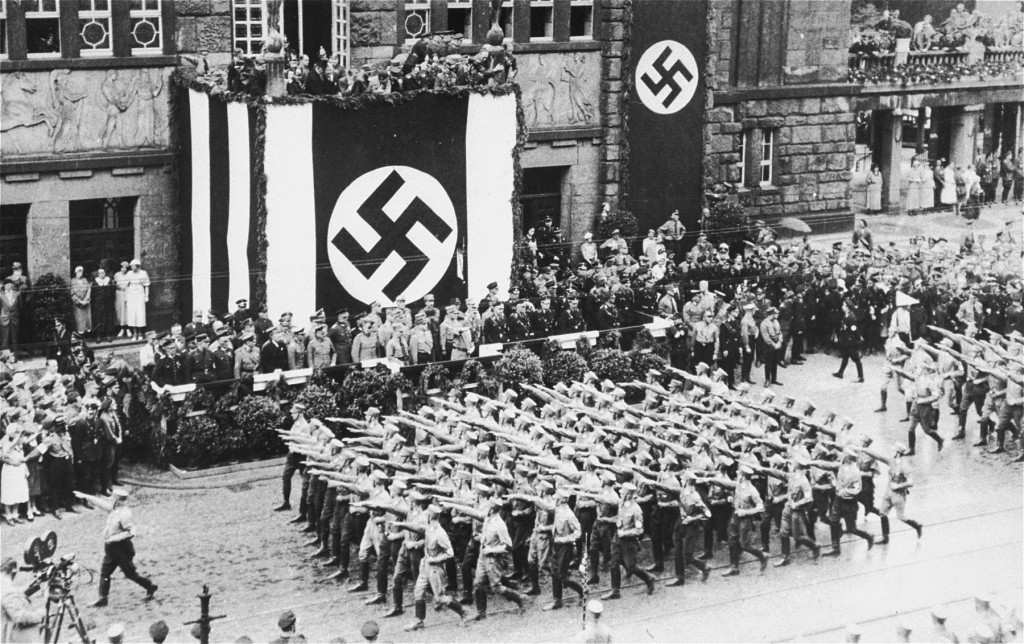
A newly accessible online archive in Germany is triggering deeply personal reckonings across the country, as thousands of people search for traces of their families inside the membership records of the Nazi Party.
The searchable database, launched by German newspaper Die Zeit, allows users to look through historical records of the National Socialist German Workers’ Party, commonly known as the NSDAP. What began as a historical project has quickly evolved into something far more intimate: a nationwide confrontation with buried family histories, inherited silence, and unresolved questions about complicity during one of history’s darkest periods.
According to the publication, the archive has already generated millions of searches and widespread public discussion, revealing just how strong the demand remains for understanding Germany’s relationship with its Nazi-era past.
Why the database is generating such intense public interest
For decades after World War II, many German families avoided detailed conversations about what parents, grandparents, or relatives did during the Nazi era.
In countless households, the stories followed familiar patterns:
- Claims of political neutrality
- Assertions of ignorance
- Descriptions of survival rather than participation
- Silence around wartime roles
The new database is challenging many of those narratives with documentary evidence.
Users can search names directly through archived Nazi Party membership records, often discovering information that had never been discussed openly within their families.
Christian Staas, history editor at Die Zeit, said the tool was accessed “millions of times” and widely shared after launch, reflecting a growing willingness among Germans to examine family histories more critically.
That timing matters.
The generation with direct memory of Nazi Germany is rapidly disappearing. As witnesses die, descendants are increasingly turning to archives, documents, and institutional records to answer questions once left unspoken.
The story of a son discovering his father’s Nazi Party membership
Among the people profoundly affected by the archive is Olaf Kondgen, a 64-year-old German human rights expert.
Using the database, Kondgen discovered that his father, Ernst, had joined the Nazi Party on September 1, 1939, the same day Germany invaded Poland and World War II began.
That date transformed the discovery from a distant historical fact into something emotionally charged and symbolic.
For Kondgen, the revelation reshaped how he understood his father’s character and motivations. Like many descendants of that era, he was forced to reconcile personal memories of a parent with historical evidence tied to one of the world’s most brutal regimes.
Stories like his explain why the database has resonated so strongly. These searches are not abstract historical exercises. They are personal excavations into identity, morality, and inherited memory.
What the database reveals about Nazi Party membership
The records show the enormous scale of Nazi Party participation in Germany between 1925 and 1945.
Roughly 10.2 million Germans were members of the NSDAP during that period.
That figure complicates postwar narratives, suggesting only a narrow segment of society actively supported the regime.
The archive also highlights patterns often overlooked in public memory.
Women’s participation increased during the war
Women represented a minority within the Nazi Party overall, but their membership numbers rose significantly after World War II began in 1939.
Historians say motivations varied widely, including the following:
- Ideological support
- Nationalism
- Career advancement
- Social pressure
- Opportunism
Importantly, historians have repeatedly noted there is little evidence supporting widespread claims made after the war that people unknowingly joined the Nazi Party or were broadly forced into membership.
That historical reality remains uncomfortable because it challenges the idea that ordinary Germans were merely passive bystanders.
How the records survived the collapse of Nazi Germany
The existence of the database itself is remarkable given the chaos surrounding Nazi Germany’s collapse in 1945.
As the war neared its end, Nazi officials attempted to move and potentially destroy massive quantities of records from party headquarters in Munich.
An estimated 50 tons of documents were reportedly transported to a paper mill.
But instead of being destroyed, the membership index cards were saved by the mill’s manager. After the war, American forces transferred the records to the Berlin Document Center, where they became part of denazification efforts aimed at identifying former Nazi Party members.
In the 1990s, responsibility for the records shifted to Germany’s federal archives. More recently, microfilm copies became digitally available through the US National Archives, helping make projects like Die Zeit’s searchable database possible.
The survival of those documents means history that might once have vanished into ash now exists in searchable form online, available within seconds to descendants around the world.
Why Germany’s “culture of remembrance” is being reexamined
The database has reignited discussion around Germany’s Erinnerungskultur, or “culture of remembrance.”
Germany is often viewed internationally as a model for publicly confronting historical wrongdoing through:
- Holocaust education
- Memorials and museums
- School curricula
- Public acknowledgments of Nazi crimes
Yet the database is exposing tensions beneath that reputation.
Many historians and commentators argue that while Germany has collectively confronted Nazi history, individual families often maintained myths or avoided difficult truths about their own relatives.
Susanne Beyer, senior editor at Der Spiegel, suggested many Germans still hold comforting illusions about their family histories.
The archive is puncturing some of those assumptions.
The psychological impact of inherited historical silence
The revelations are not only historical. They are psychological.
Louis Lewitan, who has studied the long-term effects of the Holocaust on survivors and descendants, said family secrets tied to the Nazi era can leave “invisible scars.”
That idea reflects growing academic interest in intergenerational trauma and inherited memory.
Even in families where events were never openly discussed, silence itself often shaped relationships, identities, and emotional dynamics.
Children and grandchildren sometimes sensed hidden tensions without fully understanding their origins.
The database is now turning vague suspicions into documented facts.
For some families, that may bring painful clarity. For others, it could deepen unresolved questions.
Why digital archives are changing historical accountability
The Die Zeit database also demonstrates how digitization is transforming historical research.
What once required travel to archives, formal applications, and expertise can now happen with a simple online search.
That accessibility changes public engagement with history dramatically.
Instead of history remaining confined to scholars and institutions, digital tools allow ordinary people to investigate their own connections to major historical events directly.
The emotional impact becomes far more immediate when historical records contain your family name.
At the same time, historians caution that documents alone cannot fully explain individual motivations, beliefs, or actions. Party membership records provide evidence of affiliation, but not necessarily the complete story of a person’s conduct during the Nazi era.
Still, the archive is making one thing harder to sustain: collective amnesia.
TL;DR
A new online database launched by German newspaper Die Zeit allows users to search Nazi Party membership records, prompting thousands of Germans to uncover painful truths about their families’ pasts. The archive has generated millions of searches and renewed debate about Germany’s reckoning with Nazi history, inherited silence, and the psychological legacy of World War II.