
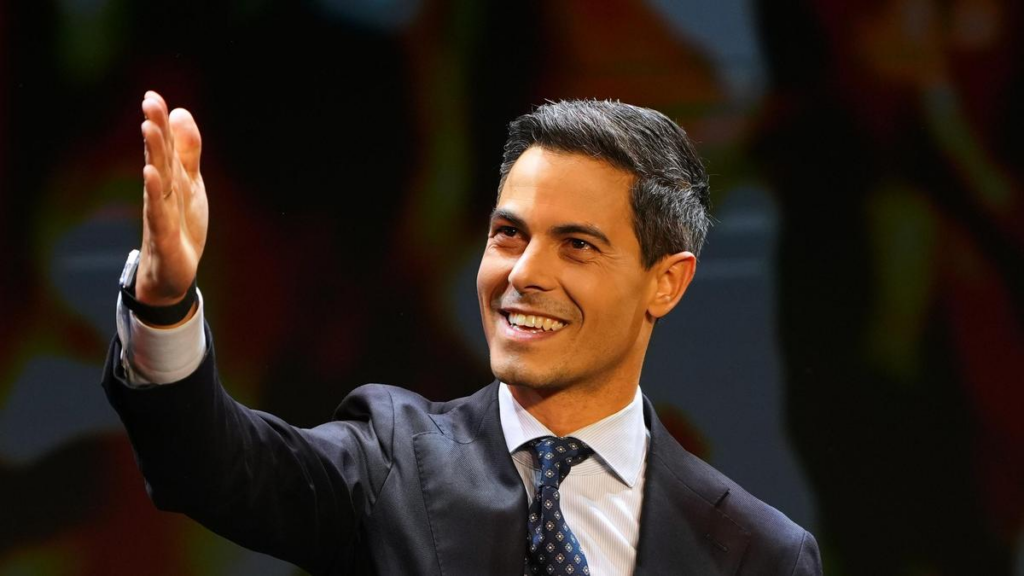
The Netherlands has a new leader — and a political first.
Rob Jetten, 38, was sworn in Monday as the country’s youngest-ever prime minister and its first openly gay leader. His rise marks a sharp turn in Dutch politics after a narrow election win that unseated the far-right Party for Freedom.
“It is an enormous honour to be able to get to work as prime minister,” Jetten said following the ceremony, according to AFP.
Here’s what his appointment means for the Netherlands — and why it resonates beyond its borders.
Who Is Rob Jetten and Why Is His Win Significant?
Jetten’s election represents both generational change and a shift back toward centrist governance.
A leader of the pro-European Democrats’ 66 (D66), Jetten built his campaign around fiscal reform, defence investment, and restoring political stability after years of polarisation.
At 38, he is:
- The youngest prime minister in Dutch history
- The first openly gay prime minister of the Netherlands
- A centrist leader replacing a far-right party in power
His victory was narrow but consequential, signalling that a slim majority of voters preferred coalition-building over populist governance.
How Did the Coalition Come Together?
Jetten’s D66 did not win an outright majority. Instead, it formed a coalition with:
- Christian Democratic Appeal (CDA), a center-right party
- People’s Party for Freedom and Democracy (VVD), a liberal-conservative party
Together, the coalition controls 66 of the 150 seats in the Dutch lower house — nine short of a majority.
That means:
- Every major policy will require cross-party negotiation
- Opposition lawmakers will hold significant leverage
- Legislative gridlock is a real possibility
In practical terms, Jetten begins his tenure with a built-in constraint: compromise is not optional.
Why His Appointment Matters for LGBTQ+ Representation
Jetten’s swearing-in carries symbolic weight.
The Netherlands was the first country in the world to legalize same-sex marriage in 2001. Still, openly LGBTQ+ leaders at the highest level of government remain rare globally.
The country’s main LGBTQI organisation, COC Netherlands, welcomed his appointment, calling him a role model “for people from the rainbow community.”
In a statement cited by AFP, the organization said his leadership shows that sexual orientation “doesn’t have to matter” when pursuing any profession — including prime minister.
Representation doesn’t automatically translate into policy change. But it can reshape public perception and political possibility.
What Are Jetten’s Policy Priorities?
During the campaign, Jetten signaled a focus on fiscal discipline and national security.
Defense Spending
He pledged to:
- Increase military investment
- Strengthen national defense capabilities
- Align spending more closely with NATO expectations
The Netherlands, like many European nations, has faced pressure to boost defense budgets amid heightened geopolitical tensions.
Social Benefit Reforms
To finance those investments, Jetten proposed cutting certain social benefits, including unemployment support.
That position could prove controversial.
Reducing benefits may appeal to fiscally conservative voters but risks backlash from social democrats and labor groups — especially in a fragile coalition.
Pro-European Orientation
As leader of D66, Jetten is firmly pro-European Union. His government is expected to maintain close alignment with Brussels on trade, climate, and foreign policy.
Who Is Rob Jetten Outside Politics?
Jetten entered parliament in 2017 and climbed quickly within D66, becoming party leader less than a decade into his national political career.
Born in Uden, in the southeastern Netherlands, he studied business administration before working at a government-owned railway infrastructure company.
He is also known for being unusually open about his personal life.
Jetten frequently posts photos with his partner, Nicolas Keenan, an Argentine field hockey player who won a bronze medal at the 2024 Summer Olympics in Paris.
That openness reflects a broader generational shift in European political leadership, where personal transparency often replaces the rigid formality of earlier eras.
What Challenges Lie Ahead?
Governing Without a Majority
With only 66 seats in parliament, Jetten’s coalition must win over opposition lawmakers to pass legislation.
This means:
- Policy concessions are likely
- Smaller parties may wield outsized influence
- Long negotiations could slow reforms
Minority governments in the Netherlands have functioned before, but they demand constant political calibration.
Economic Pressures
The Dutch economy faces:
- Ongoing inflation concerns
- EU-wide fiscal debates
- Energy and climate transition costs
Balancing defense spending with social protections will test the coalition’s cohesion.
Political Polarization
Although the far-right Freedom Party is out of government, it remains influential. Any perceived missteps could quickly become campaign ammunition.
Jetten’s ability to maintain public confidence will hinge on delivering tangible results — not just historic symbolism.
What Does This Mean for Europe?
Jetten’s rise comes at a time when European politics is deeply fragmented.
Across the continent:
- Far-right parties have gained ground
- Coalition governments are increasingly common
- Generational turnover is accelerating
His election suggests that centrist coalitions remain viable — but only narrowly.
If his government succeeds, it could strengthen the case for moderate, pro-European governance in a volatile political climate. If it falters, it may reinforce populist narratives about establishment fragility.
TL;DR
- Rob Jetten, 38, is now the Netherlands’ youngest and first openly gay prime minister.
- His D66 party formed a minority coalition with CDA and VVD.
- The coalition holds 66 of 150 parliamentary seats.
- Jetten campaigned on boosting defense spending and cutting some social benefits.
- His leadership carries symbolic weight for LGBTQ+ representation and generational change in Europe.