
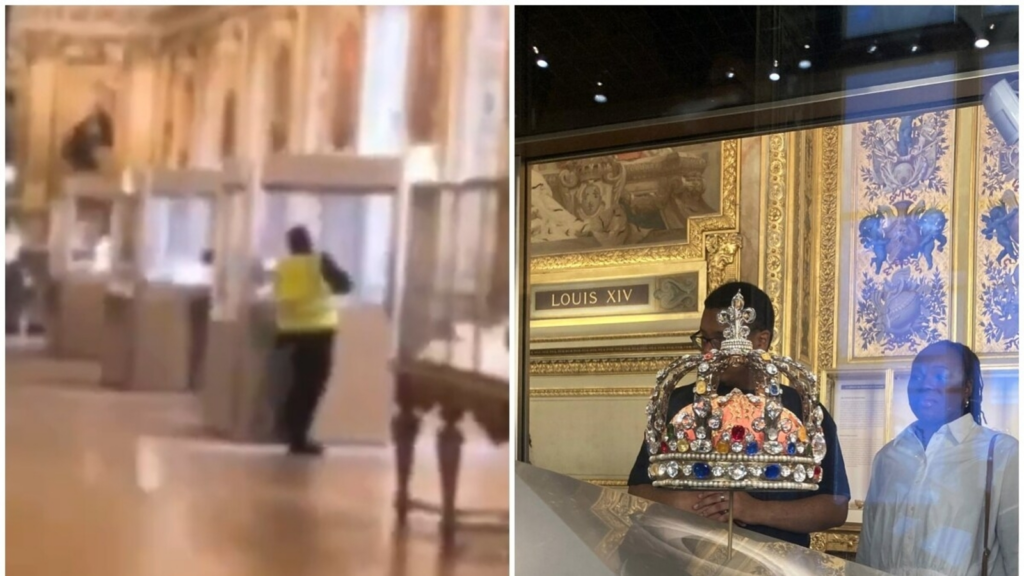
Months after one of the most audacious museum thefts in recent European history, newly surfaced surveillance footage is offering the clearest picture yet of how thieves struck inside the world-famous Louvre Museum.
The video, retrieved from the museum’s security system, captures the decisive moments of the October 2025 robbery in which jewels worth an estimated $102 million were stolen in broad daylight. The images are brief, unsettling, and precise, showing how quickly cultural heritage can vanish when security gaps collide with planning and nerve.
What does the newly released Louvre video show?
The footage shows two individuals operating in tight coordination inside a gallery housing historic royal jewels.
One person is seen forcefully punching through a glass display unit with a bare fist, immediately reaching inside to grab the jewels. The second accomplice stands close, acting as a lookout and facilitator. The entire operation unfolds in seconds, with no visible hesitation or confusion.
What stands out is not just the violence of the act but also its efficiency. There is no frantic movement, no visible panic. The thieves appear to know exactly where to strike and how much time they have.
This new video contradicts early assumptions that the heist may have involved sophisticated tools or insider access. Instead, it suggests a bold, almost reckless confidence that relied on speed rather than stealth.
When did the Louvre heist happen, and why did it shock France?
The robbery took place in October 2025, during visiting hours, when tourists were present inside the museum. That detail alone made the incident extraordinary.
The Louvre is not just another museum. It is the most visited museum in the world, attracting millions each year and housing some of the most closely guarded artworks on the planet, including Leonardo da Vinci’s Mona Lisa.
While the iconic painting was untouched, the idea that thieves could walk into the Louvre in daylight and escape with royal jewels sent shockwaves through France’s cultural and political circles.
In less than ten minutes, one of France’s most prestigious institutions went from a symbol of artistic permanence to a case study in security failure.
Which artifacts were stolen from the Louvre?
According to reporting by Bloomberg and French authorities, the thieves made off with eight royal artifacts of immense historical and monetary value.
The stolen items include
A sapphire diadem, necklace, and a single earring from a matching set associated with 19th-century French queens Marie-Amélie and Hortense
An emerald necklace and earrings belonging to Empress Marie-Louise, the second wife of Napoleon Bonaparte
A reliquary brooch
Empress Eugénie’s diadem
Empress Eugénie’s large corsage-bow brooch
What about the crown of Empress Eugénie?
One crucial detail emerged after the robbery: not everything made it out cleanly.
The crown of Empress Eugénie, wife of Napoleon III, was later found by authorities near the museum in damaged condition. The crown is among the most elaborate pieces in the Louvre’s jewelry collection.
According to the museum’s own records, the crown contains 1,354 diamonds, 56 emeralds, and decorative golden eagles. Investigators believe it was dropped during the escape, possibly because of its size or weight.
Museum officials have said the crown can be restored, but conservation experts note that even repairable damage can permanently alter an artifact’s historical integrity.
How did the thieves bypass Louvre security?
That question has become the heart of the controversy.
The museum director’s admission
For the first time since the robbery, Louvre director Laurence des Cars publicly acknowledged serious security shortcomings while speaking before French lawmakers.
She said that despite daily efforts, the museum failed to prevent the break-in. Most notably, she admitted that the only camera installed in the relevant area was directed westward and did not cover the balcony used by the thieves.
In plain terms, there was a blind spot in one of the world’s most surveilled buildings.
This admission has intensified scrutiny of how historic institutions balance architectural preservation with modern security needs.
Why the CCTV footage matters now
The release of the video months later is significant for several reasons.
First, it reshapes the narrative. Early reports left room for speculation about elaborate planning or inside help. The footage suggests a different reality: confidence rooted in knowing exactly where surveillance failed.
Second, it strengthens the investigation. Visual confirmation of the thieves’ movements, posture, and coordination gives law enforcement more data to analyze, from body language to possible prior reconnaissance.
Third, it raises uncomfortable questions for museums worldwide. If this can happen at the Louvre, what does that say about smaller institutions with fewer resources?
What does this mean for the Louvre’s global reputation?
The Louvre remains synonymous with artistic greatness. Tourists still line up daily to glimpse the Mona Lisa, often crowding around the painting under layers of protective glass.
But reputation is not just about collections. It is also about trust.
This heist has triggered internal reviews, public criticism, and renewed debates about whether major museums have become too reliant on deterrence rather than prevention.
The incident has also reopened discussions about funding. Security upgrades are expensive, and historic buildings were not designed with modern threats in mind.
Are the stolen jewels likely to be recovered?
History offers mixed answers.
High-profile art and jewelry thefts often take years to resolve. Items this distinctive are difficult to sell on the open market, which increases the chances of recovery but also raises the risk of damage as thieves attempt to dismantle or hide them.
French authorities have not disclosed details of ongoing leads, citing the sensitivity of the investigation. The recovered crown suggests the escape was not flawless, but it does not guarantee the rest will resurface soon.
Why this heist resonates beyond France
This was not just a theft of objects. It was a symbolic breach.
Museums like the Louvre are guardians of shared human history. When they are violated, it raises questions about how societies value and protect cultural memory.
The newly released video strips away mystique and replaces it with something more troubling: How vulnerable even the most iconic institutions can be when systems fail.
TL;DR
Newly surfaced CCTV footage from the Louvre shows two thieves smashing a glass case and stealing royal jewels in broad daylight during the October 2025 heist. The robbery lasted minutes, exploited a surveillance blind spot, and resulted in the theft of artifacts worth about $102 million. While the crown of Empress Eugénie was recovered in damaged condition, most items remain missing, prompting renewed scrutiny of museum security worldwide.