Lava flows, tourist evacuations, and rising seismic concerns in Reykjanes Peninsula
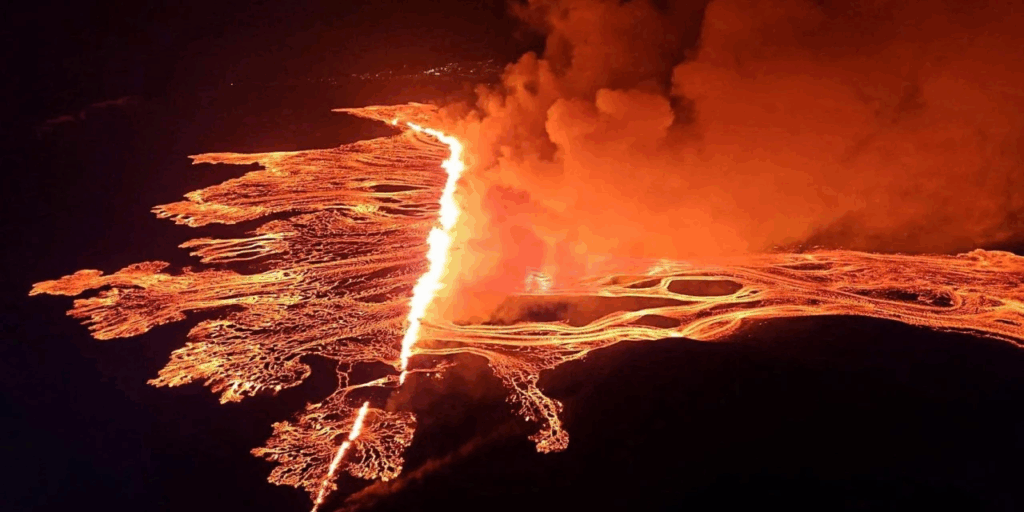
An Icelandic volcano eruption early Wednesday forced evacuations of the famed Blue Lagoon geothermal spa and nearby areas after lava began pouring from a newly formed fissure on the Reykjanes Peninsula, about 30 miles southwest of Reykjavík.
The eruption began shortly after 4 a.m. local time, following an intense seismic swarm detected by the Icelandic Meteorological Office. Lava is now flowing southeast from a fissure estimated to be between 700 and 1,000 meters (2,296 to 3,280 feet) in length.
Icelandic Volcano Eruption: What happened, and where?
The eruption took place in the Svartsengi volcanic system, just north of Grindavík, a small coastal town that had already been mostly evacuated in recent months due to repeated volcanic threats. Emergency alerts were triggered when seismologists observed an unusual clustering of earthquakes—a precursor often associated with magma movement underground.
Authorities quickly issued evacuation orders for:
- The Blue Lagoon Spa, one of Iceland’s top tourist attractions
- The nearby town of Grindavík
- Rochford Hundred Golf Club and Westcliff Rugby Club, due to proximity
Dramatic videos shared on social media showed a massive fireball-like explosion and plumes of black smoke billowing across the rugged landscape.
Was anyone hurt?
As of Wednesday afternoon, no injuries had been reported. Emergency responders, including air ambulance units, paramedic teams, and civil protection authorities, remain stationed in the region as a precaution.
A government statement said:
“In an abundance of caution, the town of Grindavík and the Blue Lagoon were successfully evacuated. Travelers in the area are advised to monitor air quality, as gas pollution from the eruption site may occur.”
Despite the eruption, international flights to and from Iceland remain unaffected, and the capital Reykjavík continues to operate normally.
Why is this region so active?
The Reykjanes Peninsula lies atop the Mid-Atlantic Ridge, a tectonic boundary where the North American and Eurasian plates are moving apart. This geological location makes Iceland one of the most volcanically active countries in the world.
This latest eruption marks the 12th volcanic event on the Reykjanes Peninsula since 2021, following centuries of dormancy before the region reawakened in 2020.
Volcanologist Kristín Jónsdóttir from the Icelandic Meteorological Office noted:
“Volcanic activity here is cyclical and increasingly frequent. Though these events are disruptive, they rarely pose a nationwide threat because of Iceland’s readiness and data-driven forecasting.”
Icelandic Volcano Eruption: Are there risks to travelers?
Tourists currently in Iceland are largely safe if they stay informed and avoid restricted zones. While the Blue Lagoon remains closed, other areas of the country are open for travel. The Icelandic government emphasized that this is a highly localized event and that Iceland remains safe for visitors.
Authorities advise the public and tourists to:
- Monitor air quality alerts, particularly for sulfur dioxide
- Respect restricted zones and emergency signage
- Follow updates from the Icelandic Meteorological Office and the Department of Civil Protection
What’s next?
Scientists and civil protection teams are monitoring lava flow, seismic activity, and atmospheric gas levels. Though it’s unclear how long this eruption will last, data suggests magma activity is still active but stable.
Officials reiterated that while it is impossible to predict the exact scope or duration, all developments are being tracked in real time using satellite and seismic monitoring systems.
Why it matters
The Icelandic volcano eruption is yet another reminder of the climatic and geological complexity of the North Atlantic region. It underscores Iceland’s unique role in balancing its booming tourism economy with the unpredictable realities of living atop a tectonic rift.
As Iceland continues to harness geothermal energy from these same volcanic systems, events like these reflect the country’s remarkable adaptability and investment in emergency preparedness.