

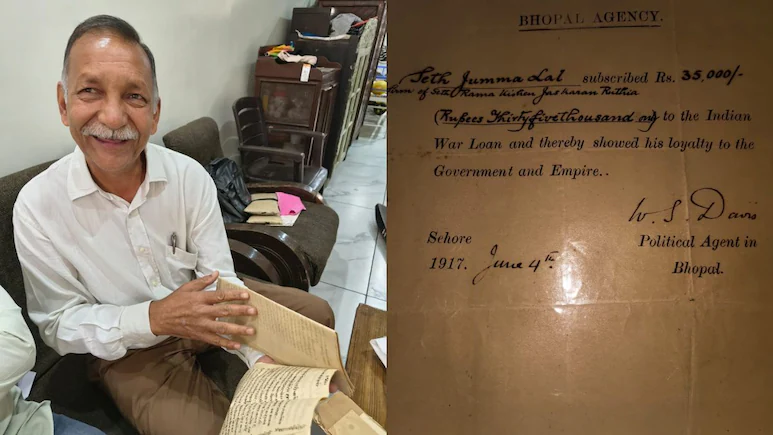
In 1917, as World War I strained imperial budgets across the globe, the British colonial administration in India reportedly borrowed Rs 35,000 from a wealthy businessman in central India. More than a century later, his descendants say the debt was never repaid, and they want it back.
The claim centers on Seth Jummalal Ruthia, a prominent financier in Sehore, in present-day Madhya Pradesh. His grandson now says the family has documentary proof of what they describe as an unpaid sovereign loan to the British government.
If true, the story isn’t just a family dispute. It raises bigger questions about colonial-era financial obligations, sovereign debt, and whether historical claims can survive the passage of time and empires.
What Is the 1917 British Loan to Seth Jummalal Ruthia?
According to the Ruthia family, the British government borrowed Rs 35,000 in 1917 from Seth Jummalal Ruthia, a leading businessman in Sehore during the colonial period.
At the time, Sehore was part of the Bhopal princely state, which functioned under British oversight. The family says the loan was categorized as a “war loan,” allegedly used to streamline administrative management during World War I.
To understand the scale of Rs 35,000 in 1917, consider this:
- It could buy large tracts of agricultural land.
- It represented the annual income of multiple elite households.
- It was substantial enough to shape local political and administrative relationships.
Adjusting for inflation is tricky over a century. A gold-price comparison, something the family reportedly references, could push the amount into several crores in today’s currency.
What makes the story compelling is not the loan itself, but the alleged absence of repayment.
Who Was Seth Jummalal Ruthia?
Before Independence, the Ruthia family was among the most influential in Sehore and the Bhopal state. Seth Jummalal Ruthia was known for his financial clout and landholdings.
Family accounts suggest:
- The Ruthias owned significant agricultural and urban land.
- A substantial portion of Sehore’s settlements—estimated between 20% and 30%—stand on land once controlled by the family.
- The family maintained influence in trade, property, and administration.
Seth Jummalal died in 1937, two decades after the alleged loan. The claim of non-repayment appears to have faded into the background until recently, when descendants say they rediscovered documents among family records and a will.
For readers, this is where the story shifts from anecdote to legal argument: documentation matters. Without primary records—loan certificates, promissory notes, official seals—any claim would struggle in court.
An investigative follow-up could request archival verification from the British National Archives or the Madhya Pradesh State Archives.
How Much Is Rs 35,000 from 1917 Worth Today?
The modern value of Rs 35,000 in 1917 depends on the method used.
Inflation-Based Estimate
Using long-term inflation models, the amount could translate into tens of crores of rupees. However, consistent CPI data for colonial India is limited. Economists would need to rely on reconstructed price indices.
Gold-Based Estimate
Gold is often used as a historical benchmark because it preserves value over long periods.
If:
- Gold in 1917 cost roughly Rs 18–20 per 10 grams (historical estimates; requires sourcing from RBI or academic economic history texts),
- And today it costs upwards of Rs 60,000 per 10 grams,
The multiplier effect becomes dramatic.
A chart comparing 1917 gold prices to 2026 prices would add clarity here.
Still, courts don’t automatically accept gold-based appreciation as a legal standard. Legal recovery would depend on the original terms of the loan—interest rate, repayment clause, and maturity period.
Can a Family Legally Recover a Colonial-Era Sovereign Debt?
This is the central question.
The Ruthia family reportedly plans to issue a legal notice to the British government, invoking principles of sovereign obligation. But international law in cases like this is complex.
Key Legal Challenges
- Statute of Limitations: Most legal systems impose strict time limits on debt recovery.
- Sovereign Immunity: Governments are often protected from being sued without consent.
- State Succession Issues: Does the modern-day United Kingdom legally inherit every colonial administrative liability?
- Proof of Claim: Original documents must withstand forensic and archival scrutiny.
The modern British government is the successor state to the British Empire. However, many colonial liabilities were either resolved during decolonization or absorbed into independence settlements.
Why This Case Matters Beyond One Family
At first glance, the 1917 British loan dispute might seem like a private inheritance matter. But it taps into broader debates:
- Financial extraction during colonial rule.
- Whether colonial administrations left unpaid obligations.
- Moral versus legal responsibility.
Over the past decade, there have been renewed conversations around reparations, artifact repatriation, and historical accountability. While this case is not framed as reparations, it intersects with similar themes.
If courts were to entertain such claims, it could open the door to:
- Other colonial-era financial disputes.
- Archival reexaminations of princely state transactions.
- Legal scrutiny of war loans raised locally.
That’s why legal experts are likely to treat this as more than a curiosity.
What Evidence Would Strengthen the Claim?
For the family to succeed, they would likely need:
- Certified copies of original loan certificates.
- Proof of British government acknowledgment.
- Evidence that the loan was not repaid or settled.
- Clear terms outlining interest and repayment structure.
Without these, the claim risks being symbolic rather than actionable.
The Broader Context: War Loans in British India
During World War I, the British government mobilized resources across the empire. India played a significant financial role, contributing funds, troops, and supplies.
War loans were commonly raised from:
- Indian princes.
- Wealthy merchants.
- Industrialists.
Many were structured as bonds or certificates. Whether the Ruthia loan fits this formal framework remains an open question.
What Happens Next?
If the Ruthia family proceeds with legal action, several scenarios are possible:
- The British government could formally respond and request documentation.
- Courts may dismiss the claim based on time limitations.
- The matter could become symbolic, generating diplomatic attention but no financial recovery.
Even if the claim fails legally, it highlights how colonial financial entanglements can resurface generations later.
TL;DR
- In 1917, the British government allegedly borrowed Rs 35,000 from Seth Jummalal Ruthia in Sehore.
- The family claims the amount was never repaid.
- Adjusted to today’s value, the sum could reach into crores.
- Recovering a colonial-era sovereign debt faces major legal hurdles.
- The case revives larger debates about colonial financial accountability.


