
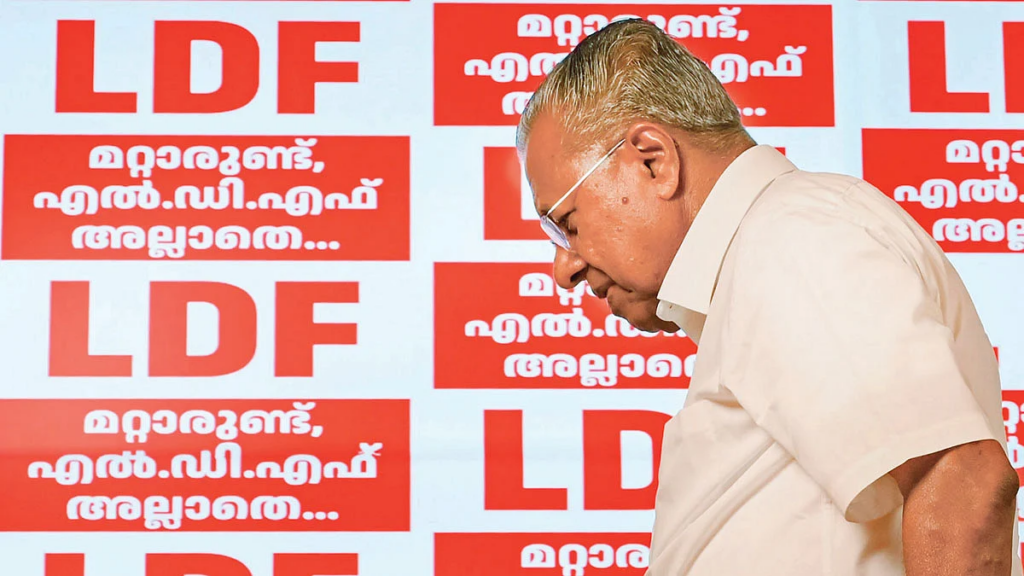
For the first time in nearly five decades, India may be on the verge of having no state governed by a communist party. Early trends from the 2026 Kerala Assembly election show the Left Democratic Front (LDF) losing ground to the Congress-led United Democratic Front (UDF)—a shift that could mark the end of an era that began in 1977.
If the results hold, the exit of the LDF government led by Pinarayi Vijayan would leave India without a single communist-led state government—a milestone with both symbolic and political weight.
What happened in Kerala and why it matters
Kerala has long been one of the last strongholds of Left politics in India. The LDF, led by the Communist Party of India (Marxist) (CPI-M), had defied the state’s tradition of alternating governments by winning consecutive terms in 2021.
That streak now appears to have ended.
Why this election is different
This isn’t just a routine change of government. It potentially marks the following:
- The first time since 1977 that no Indian state has a communist government
- A symbolic decline of institutional Left power in electoral politics
- A reset in Kerala’s long-standing political cycle
A brief history of communism in Indian politics
Communist parties in India have never dominated national politics, but they have played a significant supporting role.
From ideological force to political ally
The Communist Party of India (CPI) and CPI-M emerged as key voices for labor rights, agrarian reform, and social justice.
Their national influence peaked during coalition eras:
- 1996–1998: CPI-M supported the United Front government
- 2004–2008: CPI-M backed the Congress-led UPA government after winning 43 Lok Sabha seats
During this period, veteran leader Jyoti Basu famously described the party’s earlier refusal to lead a central government as a “Himalayan blunder.”
Despite these moments, the Left remained more influential at the state level than nationally.
Where communists held power: Key state strongholds
Kerala: The birthplace of electoral communism
Kerala holds a unique place in global political history. In 1957, it elected the world’s first democratically chosen communist government under E. M. S. Namboodiripad.
Since then, power has alternated between the LDF and the Congress-led UDF—until 2021, when the LDF broke the pattern with consecutive wins.
That continuity now appears to have ended.
West Bengal: The longest communist rule
From 1977 to 2011, the CPI-M-led Left Front governed West Bengal uninterrupted for 34 years—the longest democratically elected communist rule anywhere in the world.
This era was largely shaped by Jyoti Basu, who served for over two decades as chief minister.
The streak ended in 2011 when Mamata Banerjee and her Trinamool Congress swept to power.
Tripura: A quieter stronghold
Tripura saw 25 years of Left Front rule from 1993 to 2018 before being unseated by a BJP-led alliance.
Since then, the Left has struggled to regain its footing.
Why the decline now?
The potential disappearance of communist governments isn’t the result of a single election. It reflects broader political and social shifts.
Changing voter priorities
- Development and welfare delivery now dominate electoral narratives
- Identity politics and nationalism have gained prominence
- Younger voters may feel less connected to traditional Left ideologies
Organizational challenges
- Declining grassroots cadre strength in key states
- Limited expansion beyond traditional strongholds
- Internal fragmentation and leadership gaps
Rise of national parties
The expansion of parties like the BJP and the resilience of Congress-led alliances have squeezed political space for the Left.
Does this mean the end of Left politics in India?
Not quite.
Even without state governments, Left parties continue to influence:
- Trade unions
- Student organizations
- Local governance bodies
- Parliamentary debates
Their ideological footprint remains, even if electoral success has declined.
Could the Left make a comeback?
Kerala’s political history suggests that no defeat is permanent.
Why a comeback is possible
- Kerala voters have historically alternated between LDF and UDF
- Strong party infrastructure still exists
- Policy-driven governance models retain appeal among sections of voters
However, regaining power in states like West Bengal or Tripura appears far more challenging in the near term.
Why this moment matters beyond politics
The possible absence of communist governments in India is not just a political statistic—it reflects a deeper shift in how voters engage with ideology.
For decades, the Left represented the following:
- Organized labor
- Land reform movements
- Welfare-driven governance
Its decline raises questions about:
- The future of ideological politics
- Representation of working-class issues
- The balance between welfare and market-driven policies
TL;DR
- Kerala election trends suggest LDF may lose power in 2026
- This could leave India with no communist-led state for the first time since 1977
- Communist parties once held strong positions in Kerala, West Bengal, and Tripura
- Their decline reflects changing voter priorities and political competition
- The Left still retains influence outside of state governments