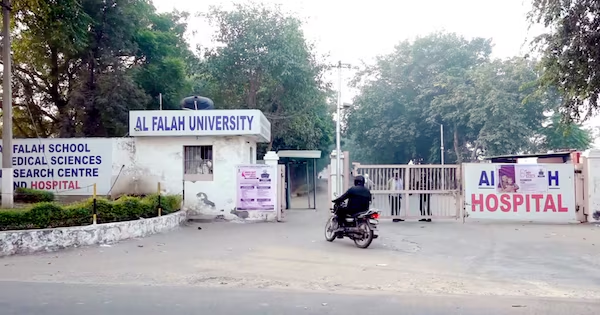
Room 13 in Building 17 at Al-Falah University, Faridabad, has emerged as a central piece in investigators’ reconstruction of the Red Fort blast investigation. Authorities say the room was used by a small, radicalized network of doctors for planning, coordination, and storage of materials linked to multiple planned attacks across the Delhi-NCR region.
What happened in room 13?
Police allege that room 13 served as a clandestine command post for a “white-collar” terror module. According to investigators, the room was occupied by Dr. Muzammil Shakeel, a doctor from Pulwama, and was regularly visited by other accused personnel, including medical staff and associates now in custody.
Officers say the group used the space for meetings, to exchange digital materials, and to discuss logistics such as transport routes and device handling. During searches, police recovered electronic devices, pen drives, and traces of chemical residues from the room. The room has since been sealed as part of the ongoing probe.
Who are the suspects, and what were they accused of planning?
Authorities have named several suspects who allegedly used the room for coordination:
- Dr. Muzammil Shakeel (Pulwama) — reported occupant of room 13.
- Umar Un Nabi — accused of receiving funds and driving a vehicle that later exploded near the Red Fort.
- Dr. Shaheen Shahid (Lucknow) and Dr. Adeel — named by police as part of the cell.
Police briefings and media reporting indicate the module planned synchronized blasts in four cities and intended to split into pairs carrying improvised explosive devices (IEDs). Investigators say the suspects raised roughly ₹20 lakh to fund operations, with funds funnelled through intermediaries.
How did investigators link the room to explosive material?
The probe suggests the group procured large quantities of commercial fertilizer (NPK) from markets near Gurugram and Nuh—items later found tied to bulk explosive preparations. Police say small amounts of ammonium compounds and oxidizers were obtained over time, possibly sourced from the university’s biochemistry and pathology labs.
Materials reportedly stored in rented rooms at Dhauj and Fatehpur Taga yielded approximately 2,900 kg of explosive and flammable substances during police seizures. Forensic teams also found chemical residues inside room 13 consistent with mixes used to create ANFO (ammonium nitrate fuel oil), which preliminary findings link to the Red Fort blast.
What did witnesses and students report?
Neighbors and students described unusual patterns around room 13 before the arrests. One student told reporters the door “was always closed” and that unknown people visited at night and in the early morning. Unlike other rooms, it seldom appeared open and rarely produced casual interactions, the student said.
Such accounts helped investigators prioritize the room during raids and contributed to a wider timeline of suspicious activity within Building 17.
What are the legal and institutional implications for the university?
Al-Falah University initially stated it had “no connection with the said persons apart from them working in their official capacities.” That position faces fresh scrutiny now that investigators suspect university facilities may have been a source of small quantities of chemical precursors.
Key legal questions include whether university controls and inventory protocols for lab chemicals were followed, and if internal safeguards could have prevented unauthorized removal. If evidence shows materials were taken from labs without proper records, the case could prompt administrative and criminal inquiries into institutional oversight.
What do investigators say about motive and scale?
Officials have characterized the group as a targeted tactical cell aiming to carry out multiple coordinated blasts. The scale of materials recovered and the alleged fundraising suggest planning beyond a single isolated attack. Police briefings indicate the suspects intended both disruption and physical harm across multiple urban centers.
Investigators are continuing to analyze digital evidence and financial trails to determine exact roles, chain of command and whether external networks or handlers were involved.
What happens next in the investigation?
The immediate priorities for law enforcement are:
- Forensic analysis of seized devices and chemical samples.
- Tracing procurement routes and financial transactions linked to the alleged ₹20 lakh.
- Interviewing additional witnesses and university staff to establish timelines.
- Reviewing university lab logs and access records for potential lapses.
Courts will hear charges as investigators finalize their case file. The probe remains active and evolving; authorities caution that public details may change as prosecutions proceed.
Why this matters beyond one campus
The alleged use of university facilities as a planning hub raises broader policy issues: campus security, inventory control of lab reagents, and the vulnerability of educational institutions to exploitation. Universities routinely balance open academic access with safety—this episode highlights the operational and ethical questions that arise when that balance fails.
For the public, the case underscores the importance of rapid reporting of unusual behaviour and robust record-keeping for potentially hazardous materials in academic settings.
TL;DR
Room 13 in Building 17 at Al-Falah University is accused of being a secret planning hub for a doctor-led terror module tied to the Red Fort blast. Police recovered electronic evidence, chemical residues, and links to bulk procurement of fertilizer and other materials allegedly used to make ANFO. The university’s lab controls and the group’s fundraising are central to ongoing investigations.