
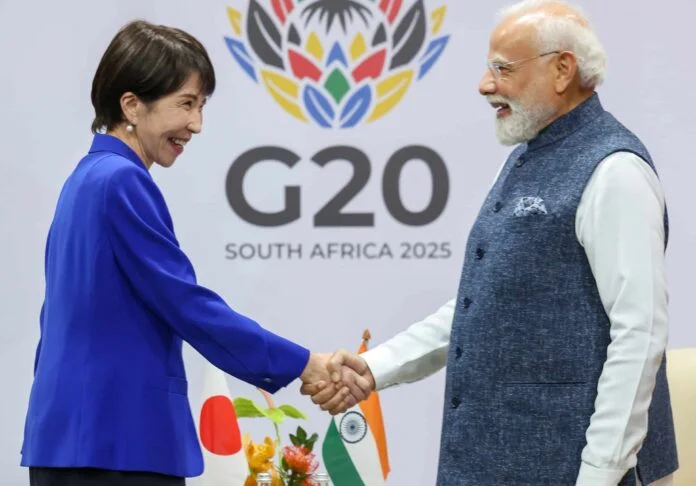
Japan’s Prime Minister Sanae Takaichi arrived in New Delhi on Wednesday for a three-day visit to attend the 16th India-Japan Annual Summit, marking her first official trip to India since taking office. While the summit is expected to focus on strategic issues such as defense cooperation, semiconductors, critical minerals, economic security, and the Indo-Pacific, Takaichi’s visit is also drawing attention for another reason: the woman leading one of Asia’s most influential economies has an unexpected passion for heavy metal music, motorcycles, and classic sports cars.
As India and Japan deepen an already robust strategic partnership, Takaichi’s visit reflects both the geopolitical importance of the relationship and the personality of a leader who has consistently broken convention throughout her career.
TL;DR
- Japanese Prime Minister Sanae Takaichi is on her first official visit to India.
- She will attend the 16th India-Japan Annual Summit with Prime Minister Narendra Modi.
- The two countries are expected to discuss:
- Defense cooperation
- Economic security
- Semiconductor supply chains
- Critical minerals
- Indo-Pacific security
- Japan remains one of India’s largest investors, with nearly 1,400 Japanese companies operating in the country.
- Outside politics, Takaichi is known for her love of heavy metal music, motorcycles, and iconic Toyota sports cars.
Why is Sanae Takaichi’s visit to India important?
Takaichi’s three-day visit comes at a time when India and Japan are strengthening cooperation across multiple strategic sectors.
The annual summit is expected to cover issues that have become increasingly important amid shifting global supply chains and growing geopolitical competition in the Indo-Pacific. Discussions are likely to include:
- Defense and security cooperation
- Economic security
- Semiconductor manufacturing
- Critical mineral partnerships
- Infrastructure investments
- Clean energy collaboration
- Indo-Pacific maritime security
The visit also reinforces the growing political alignment between New Delhi and Tokyo, two countries that increasingly view each other as indispensable partners in maintaining a free, open, and rules-based Indo-Pacific.
India and Japan’s economic partnership continues to expand
The India-Japan relationship extends well beyond diplomacy.
Japan has long been among India’s largest foreign investors, with approximately 1,400 Japanese companies operating across sectors, including:
- Manufacturing
- Infrastructure
- Automotive
- Finance
- Renewable energy
- Electronics
- Logistics
Bilateral trade reached approximately US$27.5 billion during FY 2025-26, underscoring the depth of commercial engagement between the two economies.
Japanese investments have played a significant role in India’s infrastructure transformation, from metro rail systems to industrial corridors and high-speed rail initiatives.
Why semiconductors and critical minerals matter
One of the biggest priorities for both countries is reducing dependence on vulnerable global supply chains.
Semiconductors power everything from smartphones and automobiles to defense systems. Meanwhile, critical minerals such as lithium, cobalt, and rare earth elements have become essential for electric vehicles, batteries, and renewable energy technologies.
Greater cooperation in these sectors could help both nations strengthen supply chain resilience while reducing strategic dependence on a handful of global suppliers.
Who is Sanae Takaichi?
Born on March 7, 1961, in Yamatokōriyama, Japan, Sanae Takaichi did not begin her career in politics.
Before entering public office, she worked as:
- A television presenter
- An author
- A legislative aide
She entered politics in the early 1990s and steadily rose through the ranks of Japan’s ruling Liberal Democratic Party (LDP), eventually becoming one of the country’s most recognizable conservative leaders.
Her rise to Japan’s highest political office represents a historic milestone, making her the country’s first woman prime minister.
The heavy metal fan behind Japan’s top office
Political leaders are often defined by policy positions and diplomatic engagements.
Takaichi, however, has another side that frequently surprises people.
She played drums in a heavy metal band
During her university years, Takaichi was deeply involved in Japan’s rock and heavy metal scene.
Rather than simply listening to music, she actually played drums in a heavy metal band, a hobby she has spoken about in interviews over the years.
Her interest in music has remained consistent throughout her political career.
Her favourite bands include rock legends
Among the artists Takaichi reportedly enjoys are:
- X Japan
- B’z
- Demon Kakka
- Deep Purple
- Black Sabbath
The list spans both Japanese rock icons and internationally renowned heavy metal pioneers, reflecting musical tastes that are rarely associated with senior political leaders.
A lifelong motorcycle enthusiast
Music isn’t Takaichi’s only unconventional passion.
She is also known as an avid motorcycle enthusiast.
According to previous interviews, she once owned a Kawasaki Z400GP, a popular Japanese sport motorcycle from the 1980s that has since become something of a collector’s item.
Her enthusiasm for motorcycles has frequently appeared in Japanese media profiles, contributing to an image that differs from the traditionally reserved public persona often associated with senior politicians.
Her love for the Toyota Supra has become part of automotive history
Perhaps Takaichi’s best-known hobby involves cars.
She purchased a 1991 Toyota Supra brand new and reportedly drove it for around 22 years.
For many automotive enthusiasts, the Supra is regarded as one of Japan’s most iconic performance cars, making her long-term ownership particularly notable.
Before the Supra came another classic
Before buying the Supra, Takaichi owned a Toyota Celica XX, the Japanese-market predecessor to the Supra.
Her appreciation for Japanese sports cars wasn’t a passing interest—it has been part of her personal life for decades.
Her Supra now belongs in a museum
After years of ownership, Takaichi’s Toyota Supra was preserved rather than retired.
Today, the vehicle is displayed at an automobile museum in Japan, giving automotive fans an unusual glimpse into the personal life of one of the country’s most influential political figures.
What vehicle does Japan’s prime minister use today?
Although Takaichi remains associated with her classic sports cars, her official responsibilities require a different kind of vehicle.
For government duties, she travels in a Toyota Century SUV, Japan’s flagship luxury vehicle commonly used by senior government officials.
The Century prioritises comfort, security, and official protocol rather than performance, reflecting the practical demands of national leadership.
Why this visit matters beyond diplomacy
Takaichi’s India visit represents more than another diplomatic engagement.
It highlights the continued evolution of one of Asia’s most significant strategic partnerships at a time when both countries are seeking greater resilience in technology, manufacturing, energy, and regional security.
For India, stronger cooperation with Japan brings investment, advanced technology, and infrastructure expertise.
For Japan, India represents an increasingly important economic partner, manufacturing destination, and geopolitical ally in the Indo-Pacific.
As global supply chains continue to shift and regional security challenges evolve, the India-Japan partnership is expected to play an increasingly prominent role in shaping Asia’s economic and strategic future.
What’s next after the India-Japan Annual Summit?
Observers will be watching for announcements related to:
- New investment commitments
- Semiconductor partnerships
- Critical mineral cooperation
- Defense collaboration
- Infrastructure projects
- Clean energy initiatives
- Supply chain resilience measures
Even if no major agreements are announced immediately, the summit is expected to reinforce the long-term strategic alignment between the two democracies.