
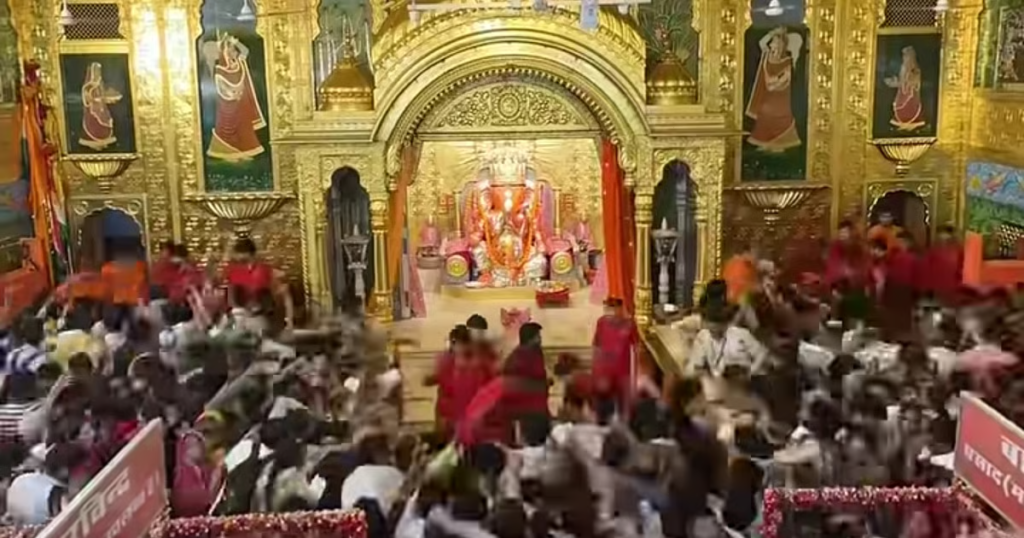
An old wedding-related religious tradition in Jaipur suddenly turned into a massive nationwide attraction this year, drawing an estimated 18 lakh devotees to the Moti Dungri Ganesh Temple. The crowds gathered on September 13 for the annual Mehndi Utsav, also known as the Sinjara festival, when henna is offered to Lord Ganesha and later distributed to devotees as prasad.
The tradition is believed to be around 200 years old. But this year’s unprecedented turnout was fueled in large part by viral social media posts claiming that applying the temple’s blessed henna could help unmarried people find a marriage partner within a year.
What is the Moti Dungri mehndi tradition?
The ceremony centers on special henna brought to the Moti Dungri Ganesh Temple in Jaipur.
Before it is distributed, the mehndi is offered to Lord Ganesha during a religious ceremony. It is then handed out to devotees as prasad, giving the otherwise ordinary cosmetic material a sacred significance for those participating in the tradition.
According to the belief associated with the festival, applying the blessed henna is considered auspicious for marriage and is particularly sought after by unmarried men and women hoping to find a suitable partner.
Reports differ on how precisely the custom began, but local accounts place its origins roughly two centuries ago. What was once a comparatively localized religious practice has grown into a much larger annual gathering.
Why did 18 lakh people turn up this year?
Social media appears to have dramatically expanded the festival’s reach.
Videos and reels circulated online portraying the temple’s mehndi as something that could help unmarried devotees get married within a year. That message reached audiences far beyond Jaipur and prompted people from cities including Indore, Bhopal, and Agra to travel to the temple.
The scale of the response was striking. Some devotees reportedly began arriving the night before the event, while others waited for hours in the September heat and humidity.
The temple administration estimated the single-day footfall at around 18 lakh, describing it as an unprecedented turnout for the event.
3,500 kg of henna disappeared within hours
The temple had prepared about 3,500 kilograms of mehndi, sourced from Sojat in Rajasthan’s Pali district, a major center of henna production.
The henna was first offered during the religious ceremony and then distributed to devotees as prasad.
The demand was so high that the distribution schedule had to be brought forward. According to the New Indian Express, distribution began at around 5 pm rather than the originally planned 7:30 pm, and the entire supply was exhausted in approximately three hours.
By the evening, the temple administration reportedly appealed to people who had not received the prasad to return home.
Queues stretched for miles
The enormous turnout created major crowds around the temple and caused traffic disruption on roads in the surrounding area.
Devotees reportedly waited six to seven hours, with queues extending toward major roads around Moti Dungri. Police officers and temple volunteers were deployed to manage the gathering, while additional personnel were brought in as the crowd grew.
Some people who arrived early reportedly spent the night outside the temple to avoid missing the distribution.
The unusually high temperatures did little to reduce the demand, illustrating just how strongly the online claims had resonated with visitors.
Does the mehndi guarantee marriage within a year?
That is a matter of religious belief, not a fact.
Devotees who participate in the tradition regard the mehndi as blessed and associate it with good fortune, the removal of obstacles, and marriage prospects. The widely circulated claim that it guarantees marriage within a year is part of the belief surrounding the ritual.
There is no scientific evidence establishing that applying the temple’s henna causes someone to marry within a particular period.
That distinction matters as the tradition reaches much larger audiences through social media. A centuries-old religious custom can travel widely online, but its spiritual meaning and its viral claims should not be treated as the same thing.
The festival became an internet phenomenon
The sudden popularity of the event also generated debate online.
Videos showing packed streets, long queues, and devotees scrambling for the mehndi spread widely across social platforms. Some users credited Instagram and viral reels for turning a traditional Jaipur event into a nationwide attraction, while others questioned the intensity of the crowds.
The phenomenon highlights how social media can amplify local religious practices at remarkable speed.
A tradition that might previously have attracted devotees primarily from Jaipur and nearby areas can now reach millions of people through short videos, recommendations, and reposts, potentially transforming attendance within a single festival cycle.
From a local ritual to a national pilgrimage
The Moti Dungri Mehndi Utsav illustrates a broader shift in how India’s traditional festivals are experienced.
Religious customs have long travelled through word of mouth, family networks, and local communities. Social media adds another layer, allowing a belief, ritual or festival to become widely known almost overnight.
In this case, the combination of an old tradition, the emotional appeal of marriage, and viral social media content produced a turnout far beyond the temple’s normal expectations.
For devotees, the mehndi remains a religious offering associated with blessings and hope. For observers, the event has also become a striking example of how digital culture can magnify traditional practices.
Trending Stories
The massive turnout has sparked a variety of reactions online. One X user credited social media for the tradition’s growing popularity, writing, “Thanks to the Instagram craze, expect double the number next year.”
Another user described the scenes as “disturbing,” while a different X user remarked, “Faith really works in mysterious ways.”
The tradition has also prompted humorous discussions about India’s unmarried population. One user joked, “When there are so many unmarried people, one has to wonder who is increasing India’s population.”
The Mehndi Utsav has grown increasingly popular beyond Jaipur, attracting devotees from different parts of the country who travel to the city in hopes of taking home the temple’s sacred henna.