
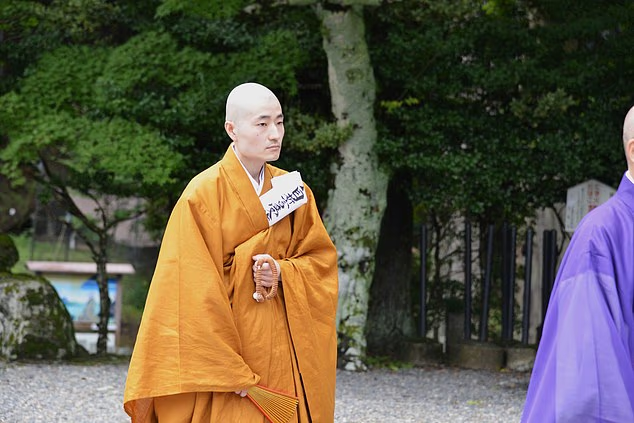
A 31-year-old Japanese Buddhist monk has begun 12 years of isolation on Mount Hiei, undertaking one of the most demanding forms of spiritual training in Japan.
Sogaku Taguchi, chief monk of Nanzambo Temple in Otsu, entered seclusion on September 11. If he completes the practice as planned, he will remain isolated until September 11, 2038, without meeting another person or leaving the temple complex.
The extraordinary training is part of the Tendai Buddhist tradition associated with Enryakuji Temple on Mount Hiei, northeast of Kyoto. Taguchi will live at the Jodo-in hall, a site dedicated to Saicho, the ninth-century monk who founded the Tendai school of Buddhism in Japan.
For more than a decade, his world will be deliberately reduced to the temple grounds, his religious practice and a highly structured daily routine.
Why is the Japanese monk spending 12 years in isolation?
Taguchi’s isolation is part of the path toward becoming what the Enryakuji Temple tradition calls a Jishin.
According to Enryakuji, Taguchi is the 118th person since 1699 to undertake the demanding practice. He is also reportedly the eighth person to do so since the end of World War II.
The training is not simply a retreat or an extended period of meditation.
It is designed around strict religious discipline, physical endurance and repeated devotional practices. During his seclusion, Taguchi is expected to:
- Remain within the designated temple grounds
- Avoid contact with other people
- Have no access to information about the outside world
- Maintain a strict daily routine
- Perform religious rites and chanting
- Clean the hall himself
- Prepare food to be offered before the tomb of Saicho
The purpose is spiritual rather than academic or psychological isolation. The practice is rooted in the belief that sustained discipline and devotion can bring a monk closer to the teachings and spiritual example of Saicho.
Suggested visual: Mount Hiei and the Enryakuji temple complex, where Taguchi is undertaking his seclusion.
What is Taguchi’s daily life expected to look like?
Life during the 12-year period will be highly regimented.
Taguchi will live at Jodo-in, a hall associated with Saicho. His responsibilities will include religious observances as well as basic domestic tasks.
Even ordinary activities such as cooking and cleaning become part of the discipline.
His meals will be prepared and presented as offerings before the tomb, rather than representing a normal private routine. The emphasis is on service, ritual and continuity with the temple’s religious tradition.
The isolation also means Taguchi will be cut off from developments beyond the temple grounds.
He will not simply avoid social gatherings. He is expected to remain unaware of what is happening in the outside world throughout the period.
That means the 2038 endpoint represents more than 12 years on a calendar. It marks the completion of a deliberately maintained separation from ordinary life.
What is Kosogyo?
Before beginning his 12-year seclusion, Taguchi spent a year undertaking Kosogyo, another demanding practice in the Tendai tradition.
The practice involves repeated devotional acts directed toward the Buddhas.
According to accounts of the tradition, a monk undertaking Kosogyo is expected to:
- Offer incense to each of the Buddhas 3,000 times a day
- Chant their names repeatedly
- Perform repeated prostrations
- Maintain the practice despite severe physical exhaustion
Taguchi began practicing Kosogyo around September 2025.
The repetition is intentional. Rather than being designed to demonstrate physical strength alone, the practice seeks to cultivate intense concentration and devotion through sustained physical and spiritual discipline.
Accounts of the practice say that the extreme exhaustion can produce a vivid spiritual experience in which the practitioner sees a figure of the Buddha.
That experience should be understood within the religious framework of the practice rather than presented as a medically established phenomenon.
What happened before Taguchi entered isolation?
Before beginning his long seclusion, Taguchi took part in a Jisei Jukai, or self-avowed ordination ceremony, at the Kaidan-in hall.
The ceremony marked the transition into the next stage of his religious training.
Speaking to reporters before entering isolation, Taguchi reportedly described himself as being filled with joy at reaching the starting point of the journey.
He said his desire to live according to the teachings of Dengyodaishi—a title associated with Saicho—had grown within him and had guided his life as a monk.
His comments offer a glimpse into how he views the practice: not as punishment or simply an endurance test, but as the fulfillment of a religious goal he has pursued for years.
What is Mount Hiei’s connection to extreme Buddhist training?
Mount Hiei is one of Japan’s most important centers of Tendai Buddhism.
The mountain is home to the Enryakuji temple complex, which was founded by Saicho and became a major center of Japanese Buddhist scholarship and practice.
It is also associated with another famously demanding practice known as kaihogyo.
While Taguchi’s 12-year isolation and kaihogyo are separate practices, both are associated with the extreme physical and spiritual discipline historically practiced by monks on Mount Hiei.
What is kaihogyo?
Kaihogyo is often described as a form of marathon-like religious training in which monks walk extraordinary distances around Mount Hiei over a period of years.
The full practice lasts approximately 1,000 days spread across seven years.
Its schedule becomes progressively more demanding.
The first three years
For the first three years, practitioners walk approximately 30 kilometers a day for 100 consecutive days each year.
The distance is repeated day after day, requiring the monks to maintain the practice while navigating the mountain’s terrain and changing weather.
The fourth and fifth years
The demands increase significantly.
During each of the fourth and fifth years, the monk walks every day for 200 consecutive days.
At this stage, the practice requires not only physical endurance but an extraordinary degree of consistency.
The ninth-day fast
One of the most severe stages follows the fifth year.
The monk undertakes a nine-day period during which he traditionally abstains from:
- Food
- Water
- Sleep
- Lying down
He continues reciting mantras while other monks monitor him.
This stage illustrates why kaihogyo has historically been regarded as an exceptionally dangerous form of ascetic training.
The final two years
The distances then increase again.
In the sixth year, the monk walks approximately 60 kilometers a day for 100 days.
In the seventh year, the distance rises to approximately 84 kilometers a day for 100 days, followed by a final period involving roughly 30 kilometers a day.
The practice places extraordinary demands on the body.
Why have monks died during these practices?
The extreme nature of Mount Hiei’s ascetic traditions has carried serious physical risks.
Historical accounts have documented monks becoming severely ill or dying during demanding periods of training.
The danger is particularly evident in practices involving prolonged fasting, dehydration, sleep deprivation and sustained physical exertion.
It is therefore important not to frame these traditions simply as unusual forms of exercise.
Their purpose is religious, and their physical hardship is understood by practitioners as part of a broader process of spiritual discipline.
How rare is Taguchi’s journey?
The rarity of Taguchi’s training is one of the most striking aspects of the story.
Enryakuji Temple says he is the 118th Jishin since 1699, meaning the practice has been undertaken by only a small number of monks over more than three centuries.
He is also only the eighth practitioner since the end of World War II.
Those figures put his 12-year isolation into context.
This is not a standard stage through which every Tendai monk passes. It represents an exceptionally demanding religious path undertaken by a very small number of practitioners.
What happens when the 12 years are over?
Taguchi’s current period of isolation is scheduled to conclude on September 11, 2038.
Until then, he is expected to remain within the designated premises and continue the prescribed practices without contact with the outside world.
The endpoint will mark the completion of a journey that began years before his seclusion, including his preparation and the demanding Kosogyo practice.
For observers outside the tradition, the sheer length of the isolation can be difficult to comprehend.
Twelve years is long enough to span major changes in technology, politics, culture and everyday life. Taguchi has deliberately chosen to set all of that aside in pursuit of a religious objective.
Why Taguchi’s isolation stands out
Extreme religious practices exist in many traditions, but Taguchi’s training is unusual even within the world of Buddhist asceticism.
Its defining feature is not simply physical hardship. It is the combination of:
- Duration: 12 years of seclusion
- Isolation: No contact with other people or the outside world
- Repetition: Daily religious practices performed according to strict rules
- Self-sufficiency: Cooking and cleaning as part of temple life
- Physical discipline: Demanding practices performed through difficult conditions
- Religious continuity: A tradition connected to Saicho and centuries of Tendai practice
The result is a form of training that removes many of the distractions of ordinary life and places nearly every aspect of the monk’s existence inside a religious framework.
For Taguchi, September 11, 2038, is not simply a date on a calendar. It is the planned end of one of the longest and most demanding chapters of his life.
TL;DR
- Sogaku Taguchi, 31, began a 12-year period of isolation on September 11.
- He will remain at Jodo-in hall on Mount Hiei until September 11, 2038.
- The practice is connected to the Tendai Buddhist tradition and the legacy of Saicho.
- Taguchi is reportedly the 118th Jishin since 1699 and the eighth since World War II.
- Before entering isolation, he spent a year practicing Kosogyo, involving thousands of daily devotional acts.
- Mount Hiei is also famous for kaihogyo, a seven-year, 1,000-day walking practice involving increasingly extreme distances and a nine-day fast.
- The practices are deeply religious traditions rather than endurance challenges, and some historically have involved serious health risks.