
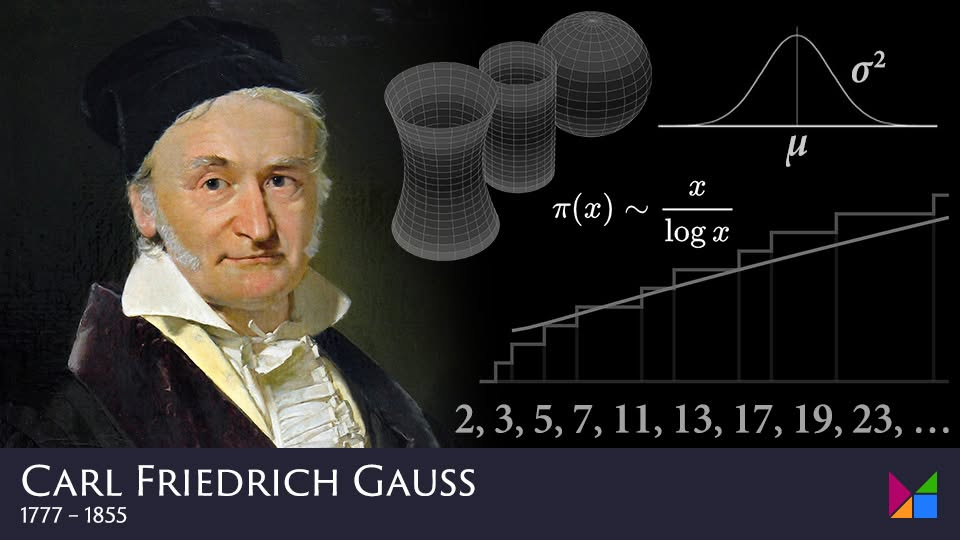
More than 200 years after legendary mathematician Carl Friedrich Gauss first described a mysterious pattern in quadratic forms, researchers have made a significant breakthrough that sheds light on one of number theory’s enduring questions.
The advance resolves part of the Cohen-Lenstra conjecture, a famous mathematical hypothesis that has puzzled researchers since the 1980s and is deeply connected to Gauss’ work on quadratic forms. While it does not solve every aspect of the original mystery, mathematicians say it provides a major step toward understanding hidden patterns in algebraic structures that underpin modern number theory.
The result highlights how questions posed centuries ago can continue to shape cutting-edge mathematical research today. Now Harvard University mathematician Aaron Landesman and Institute for Advanced Study Clay Research Fellow Ishan Levy have found a new framework that goes a long way toward proving it.
What was Gauss’ 200-year-old riddle?
In his landmark 1801 book Disquisitiones Arithmeticae, Carl Friedrich Gauss studied objects known as quadratic forms, mathematical expressions of the form:
ax² + bxy + cy²
Although the formula may look familiar from high school algebra, Gauss discovered something remarkable about these expressions.
He developed a method, called composition, that allows two quadratic forms to be combined to produce another quadratic form.
If one starts with a quadratic form, Q, and repeatedly composes it with itself, the sequence eventually cycles back to the original form.
For example:
- Q → Q²
- Q² → Q³
- Q³ → Q⁴
- Eventually → Q again
Gauss proved this repeating cycle always occurs.
What he could not determine was why some cycles are short while others are much longer, or whether there was a general rule governing their lengths.
That unanswered question has fascinated mathematicians for more than two centuries.
What are quadratic forms?
Quadratic forms are algebraic expressions involving variables raised to the second power.
A common example is:
ax² + bxy + cy²
Far from being abstract curiosities, quadratic forms appear throughout mathematics and have applications in:
- Number theory.
- Cryptography.
- Algebraic geometry.
- Computer science.
- Coding theory.
They help mathematicians understand how numbers relate to one another and how certain equations can or cannot be solved.
What is the Cohen-Lenstra conjecture?
Proposed in the 1980s by mathematicians Henri Cohen and Hendrik Lenstra, the Cohen-Lenstra conjecture attempts to predict how often particular algebraic structures appear within number theory.
Rather than studying one equation at a time, the conjecture asks a statistical question:
If mathematicians examine enormous numbers of quadratic forms, do hidden probability patterns emerge?
The conjecture predicts that certain mathematical structures should occur much more frequently than others according to precise probability distributions.
Although supported by extensive computational evidence, proving the conjecture has remained extraordinarily difficult.
What breakthrough did mathematicians make?
Researchers have now solved an important portion of the Cohen-Lenstra conjecture, providing new insight into the statistical behavior of quadratic forms.
The result does not completely prove the entire conjecture.
Instead, it establishes one of its major components, helping explain why the cycles Gauss observed behave according to predictable mathematical patterns.
The proof gives researchers a stronger theoretical foundation for understanding how these algebraic objects are distributed and why some structures appear more often than others.
In mathematics, partial solutions to longstanding conjectures are often considered major milestones because they provide techniques that can unlock further progress.
Why is this discovery important?
At first glance, studying centuries-old algebraic puzzles may seem disconnected from everyday life.
However, breakthroughs in pure mathematics often become the foundation for future technologies.
Number theory, for example, underpins:
- Internet encryption.
- Digital signatures.
- Secure banking systems.
- Cryptocurrency algorithms.
- Error-correcting codes used in communications.
Although this particular breakthrough is not expected to immediately change consumer technology, it expands the mathematical toolkit available to researchers working across these areas.
History has repeatedly shown that ideas developed purely out of curiosity can later become essential technologies.
Why do mathematicians spend decades on problems like this?
Unlike many scientific discoveries, mathematical truths never become outdated.
Once a theorem is proven correctly, it remains true forever.
That is why researchers continue working on questions posed centuries ago.
Solving difficult conjectures often:
- Reveals unexpected mathematical connections.
- Creates entirely new proof techniques.
- Opens previously inaccessible research areas.
- Inspires solutions to other longstanding problems.
Many of today’s major mathematical advances build upon ideas introduced by Gauss, whose work continues to influence modern research more than two centuries after it was published.
Does this solve Gauss’ original problem completely?
No.
The new work answers an important piece of the broader puzzle rather than resolving every question raised by Gauss.
Mathematics frequently progresses in stages.
Researchers first prove special cases, then broader versions, gradually assembling a complete understanding over many years or even decades.
This breakthrough is considered significant because it advances one of the central conjectures connected to Gauss’ observations and provides new methods that may help solve the remaining open questions.
TL;DR
Mathematicians have solved an important part of the Cohen-Lenstra conjecture, a major number theory problem connected to a mystery first described by Carl Friedrich Gauss in 1801. The breakthrough helps explain statistical patterns in quadratic forms, bringing researchers closer to understanding a mathematical puzzle that has remained unresolved for more than 200 years. While it does not completely solve the original problem, it represents a significant advance in pure mathematics.