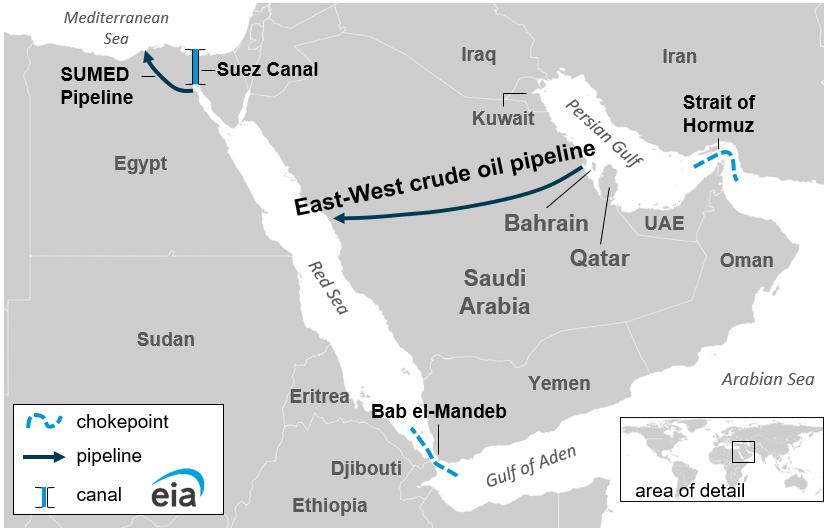
The Strait of Hormuz has long functioned as the narrow valve through which a fifth of the world’s oil supply flows. But the ongoing tensions involving Iran, the United States, and regional players have exposed just how fragile that valve can be. Now, Gulf producers are racing to redraw the map of global energy flows. Pipelines, rail corridors, and new export terminals are being fast-tracked to bypass Hormuz entirely. The ambition is clear. The execution remains complex.
Why is the Strait of Hormuz so critical to global oil trade
At its narrowest point, the Strait of Hormuz is just 33 kilometers wide, yet it handles an estimated 17–21 million barrels per day (mbpd) of crude oil and condensates.
A single point of failure
This makes it:
- The most important oil transit chokepoint in the world
- A high-risk zone during geopolitical conflicts
- A pressure point that can disrupt global markets within hours
Recent tensions have reinforced a long-standing concern that Iran could restrict or disrupt passage, even temporarily, with outsized consequences.
What alternatives already exist?
Gulf states are not starting from scratch. Some bypass routes already exist, though they are limited.
Saudi Arabia’s East-West Petroline
- Runs from Abqaiq to Yanbu on the Red Sea
- Capacity: about 7 million barrels per day
- Currently operating at full capacity
UAE’s Abu Dhabi Crude Oil Pipeline (ADCOP)
- Connects the inland oil fields to Fujairah, outside Hormuz
- Capacity: about 1.8 million barrels per day
- Also running at maximum capacity
Together, these routes handle roughly 8–9 mbpd, less than half the volume that typically passes through Hormuz.
What new pipeline projects are being considered?
To close the gap, Gulf nations are accelerating a range of projects that have been under discussion for years.
UAE’s Fujairah expansion
Plans include:
- Additional pipelines to boost capacity by about 1.5 mbpd
- Direct links from offshore oil fields to export terminals
Fujairah’s location outside Hormuz makes it strategically valuable.
UAE–Oman Duqm pipeline
A proposed project estimated at around $10 billion:
- Would connect the Gulf oil fields to Duqm Port on the Arabian Sea
- Offers a direct export route to bypass Hormuz
Iraq–Turkey pipeline expansion
- Existing route from Kirkuk to Ceyhan Port
- Capacity: about 1.6 mbpd
- Potential expansion to include southern Iraqi or Gulf-linked oil
Revival of the IPSA pipeline
- A dormant Iraq–Saudi Arabia pipeline to the Red Sea
- Could be reactivated to provide additional export flexibility
Are overland energy corridors the next big shift?
Beyond pipelines, Gulf states are exploring ambitious cross-border corridors.
Multi-country pipeline networks
Proposals include routes that:
- Cross Saudi Arabia into Jordan or Iraq
- Extend to terminals in Israel or Egypt
- Potentially connect to European markets
These corridors could bypass not just Hormuz but also the Bab el-Mandeb Strait and even the Suez Canal.
Integration with trade megaprojects
Initiatives like the India–Middle East–Europe Economic corridors aim to combine the following:
- Energy transport
- Rail logistics
- Digital infrastructure
If realized, they could reshape global trade flows beyond oil.
Can rail and logistics networks help?
Pipelines carry crude, but refined products and supporting logistics require flexibility.
Emerging rail projects
- Saudi Arabia’s landbridge project
- The UAE’s Etihad Rail network
These systems could:
- Transport refined fuels to alternative ports
- Support distribution from inland refineries
- Reduce reliance on maritime routes
They act as supporting systems that strengthen the broader energy network.
What are the biggest challenges?
If bypassing Hormuz were simple, it would already be done. The obstacles remain significant.
1. Capacity gap
- Hormuz handles up to 21 mbpd
- Existing alternatives cover less than half
- Even new projects will take years to close the gap
2. Political complexity
Many routes would cross.
- Rival states
- Politically sensitive regions
- Areas with unresolved conflicts
Securing long-term agreements is a major challenge.
3. Cost and timelines
- Projects could cost tens of billions of dollars
- Construction timelines extend over several years
- Investment depends on sustained geopolitical risk
4. Security risks
Pipelines themselves can become targets:
- Vulnerable to sabotage or attacks
- Require continuous monitoring and protection
5. Terrain and engineering constraints
From deserts to mountainous regions, geography adds the following:
- Technical complexity
- Higher construction costs
- Maintenance challenges
Will the world move away from Hormuz dependence?
The short answer: not quickly, but gradually.
A phased transition
Even with aggressive investment:
- Hormuz will remain central in the near term
- Alternative routes will expand incrementally
- Markets will adapt to a more diversified system
A changing energy map
The current crisis has triggered a shift in strategy:
- Contingency planning is now essential
- Energy security is driving infrastructure decisions
- Redundancy is becoming as important as efficiency
Over time, the Strait of Hormuz may no longer be the single chokepoint defining global oil trade. Instead, it will become one of several routes in a more resilient network.
TL;DR
The Iran conflict has exposed the vulnerability of the Strait of Hormuz, prompting Gulf states to accelerate alternative pipelines and transport corridors. While several projects are underway, major challenges such as cost, politics, and capacity gaps mean Hormuz will remain critical for years even as its dominance gradually declines.