
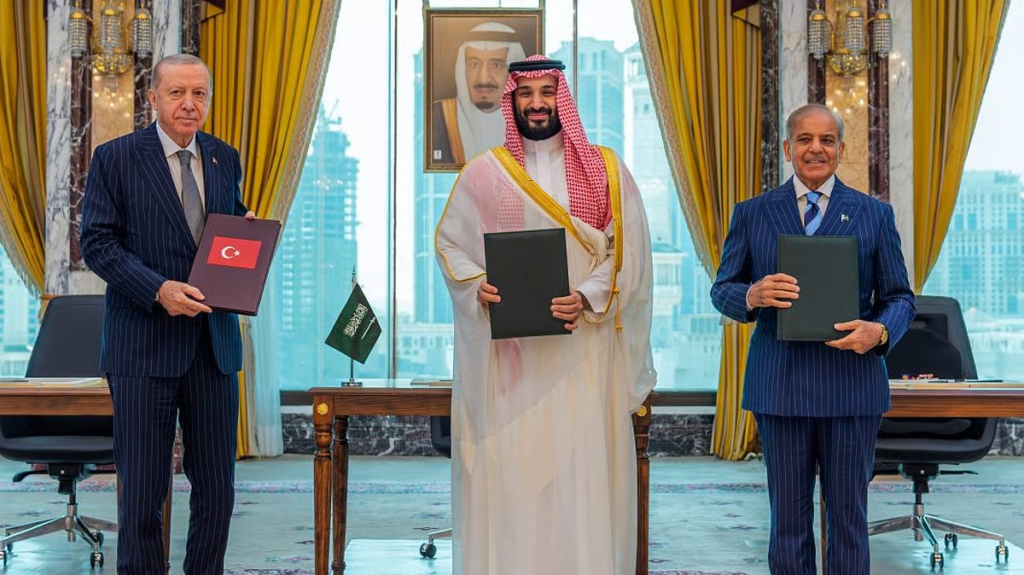
Saudi Arabia’s newest military partnership is facing an early test after alerts were issued around Mecca, Jeddah and Taif amid a fresh wave of attacks by Iran-aligned Houthi forces from Yemen.
The episode is particularly striking because Saudi Arabia signed a joint defense agreement with Turkey and Pakistan in Mecca just weeks ago. The pact states that an armed attack on any one of the three countries will be regarded as an attack on all three.
Yet so far, Pakistan and Turkey have responded primarily with statements of support and condemnation rather than announcing a joint military operation against the Houthis.
The contrast is fueling questions over how the new alliance would actually function during a sustained conflict.
Why did alerts sound around Mecca?
Saudi authorities issued security alerts in several cities on September 15 as Houthi attacks intensified.
The warnings included Mecca, Jeddah and Taif, with the Mecca alert carrying particular symbolic weight because the city is home to the Kaaba and Islam’s holiest sites. Reuters reported that Mecca was targeted in the alert system for the first time during the current escalation.
Saudi Civil Defence also issued alerts for other locations, including Abha, Khamis Mushait, Jazan, AlUla and Yanbu, as the security situation deteriorated.
The alerts did not necessarily mean that every location was struck directly. They indicate that Saudi authorities detected or assessed an aerial threat serious enough to trigger public warnings.
What happened in the latest Houthi attacks?
The escalation follows a rapid expansion of the Yemen conflict.
Saudi-led forces have been carrying out strikes against Houthi positions, while the Houthis have responded with missile and drone attacks against Saudi territory and infrastructure.
Saudi coalition spokesman Turki al-Maliki said attacks on Khamis Mushait, Abha and Taif on Monday injured 13 civilians and damaged seven homes and two vehicles.
The wider conflict has also reached critical energy and shipping infrastructure. A separate attack attributed to an Iran-aligned group operating from Iraq damaged Saudi Arabia’s East-West oil pipeline, which has been largely shut for repairs.
What is the Saudi-Turkey-Pakistan defence pact?
Saudi Arabia, Turkey and Pakistan signed the Makkah Joint Defence Agreement on August 7, 2026, during a trilateral summit in Mecca.
The agreement is intended to strengthen collective deterrence and states that an armed attack against any one of the three countries will be regarded as an attack against all. It also calls for broader defence cooperation.
The pact is significant because it brings together three militaries with long-standing strategic relationships with Saudi Arabia but very different regional priorities.
Turkey is a major NATO military power. Pakistan has longstanding defense ties with Saudi Arabia and has maintained a significant relationship with the kingdom’s security establishment.
The agreement is designed to deepen cooperation rather than formally replace the countries’ existing alliances. Reuters has reported that the three sides are also considering mechanisms covering joint exercises, air defense, unmanned systems and electronic warfare.
Why hasn’t the alliance launched a military response?
This is where the wording of the pact meets the realities of diplomacy.
Pakistan has already said that no military response under the agreement had been discussed following the Houthi attacks. Its foreign ministry has nevertheless reiterated Islamabad’s commitment to the pact.
Pakistan is also trying to maintain a diplomatic channel with Iran, making direct intervention against an Iran-aligned group particularly complicated.
Turkey, meanwhile, has condemned attacks on Saudi territory and expressed support for Riyadh, but has not announced direct military participation in the fighting.
The defense agreement establishes a collective-security principle, but the publicly available text does not mean that every attack automatically triggers an identical military response from all three governments.
Is the Mecca pact already failing?
It is too early to make that judgment.
The agreement was signed only on August 7 and is still a new framework. Its real value will depend on how its provisions are interpreted, what mechanisms are activated during a crisis and whether the three governments are willing to commit military assets when their interests diverge.
The current response does, however, expose a potential gap between collective-defense language and immediate military action.
Pakistan has specifically clarified that no military response has been discussed, even while the Houthis continue attacking Saudi targets.
That does not invalidate the agreement, but it shows that political consultation remains crucial.
Why are the Houthi advances in Yemen so important?
The threat to Saudi Arabia is growing alongside major Houthi territorial gains inside Yemen.
In recent days, the group has seized the port city of Mokha, Perim Island and additional islands in the southern Red Sea, strengthening its position around the Bab el-Mandeb Strait.
Bab el-Mandeb is one of the world’s critical maritime chokepoints, connecting the Red Sea with the Gulf of Aden and providing an important route between the Indian Ocean and the Suez Canal.
Control of territory around the strait gives the Houthis greater leverage over shipping and increases the strategic pressure on Saudi Arabia at a time when the Strait of Hormuz is also under severe disruption.
Why is Saudi Arabia under pressure on two fronts?
Saudi Arabia’s strategic position has become more difficult because its conventional export routes are being squeezed simultaneously.
Iran-related disruption around the Strait of Hormuz threatens Gulf energy shipments, while Houthi control around Bab el-Mandeb creates another risk on the Red Sea side.
That makes the kingdom’s East-West pipeline particularly important because it can provide an alternative route for moving Saudi crude toward the Red Sea.
Damage to that infrastructure therefore has consequences beyond the immediate battlefield. Reuters reported that Saudi oil production had fallen sharply as attacks and transportation disruptions intensified.
Has Saudi Arabia sought help beyond the new alliance?
Yes.
Saudi Crown Prince Mohammed bin Salman held talks with Egyptian President Abdel Fattah al-Sisi on September 15, with the two leaders emphasizing the importance of securing navigation in the Red Sea and Bab el-Mandeb. Sisi also expressed support for Saudi efforts to protect its national security.
The outreach suggests Riyadh is looking beyond the three-country defense pact as the crisis expands.
Egypt is particularly important because of its direct strategic interest in the Red Sea and the Suez Canal.
What role could missile defense play?
The immediate challenge for Saudi Arabia is not necessarily launching an offensive campaign deep into Yemen. It is also protecting cities, military bases and critical infrastructure from incoming missiles and drones.
This is where missile-defense capacity becomes central.
Israeli security analyst Yoel Guzansky has argued that Israel could potentially provide Saudi Arabia with discreet assistance, particularly in missile defense, without directly entering the war.
His proposal is an expert opinion, not an indication that Israel is currently providing such assistance. The political sensitivity would also be enormous, especially given the regional context.
Why is Mecca’s proximity to the conflict so significant?
Mecca carries an importance that extends far beyond Saudi Arabia’s borders.
Any security alert affecting the city immediately has religious and political implications across the Muslim world. The fact that the warnings came so soon after the Saudi-Turkey-Pakistan agreement was signed in Mecca makes the timing especially uncomfortable for Riyadh.
The pact was presented as a mechanism for collective deterrence.
Now Saudi Arabia is confronting attacks while its partners have so far emphasized political support rather than publicly announcing direct combat assistance.
That is precisely the sort of situation in which the credibility of a new alliance is tested.
How bad is the humanitarian situation in Yemen?
The fighting is also producing a rapidly worsening humanitarian crisis.
The United Nations refugee agency said on September 15 that more than 100,000 people had been internally displaced by the renewed fighting in Yemen, while thousands more had crossed the sea to Djibouti. Humanitarian access has been complicated by insecurity, damaged roads, disrupted communications and restrictions on movement.
The renewed fighting threatens to reverse the relative reduction in hostilities that had prevailed in Yemen since the 2022 UN-brokered truce.
The longer the conflict continues, the greater the risk that territorial gains and regional intervention turn the conflict into another prolonged war.
What does the crisis mean for the new alliance?
The immediate lesson is that a defense treaty’s political language is only the first layer of deterrence.
Saudi Arabia, Turkey and Pakistan have formally committed to treating an armed attack against one member as an attack against all.
But translating that commitment into air-defense deployments, military operations or other forms of assistance requires political decisions that are far more complicated.
Pakistan’s balancing act with Iran, Turkey’s wider regional priorities and Saudi Arabia’s desire to avoid an even broader war all shape what the alliance can realistically do.
For now, the attacks around Mecca, Jeddah and Taif have exposed that gap.
The Makkah pact has not necessarily failed. It simply has not yet faced the kind of sustained military test that would reveal how far “an attack on one is an attack on all” extends in practice.
And with more than 100,000 Yemenis already displaced and the Houthis tightening their hold around Bab el-Mandeb, that test may arrive sooner than its three signatories expected.