
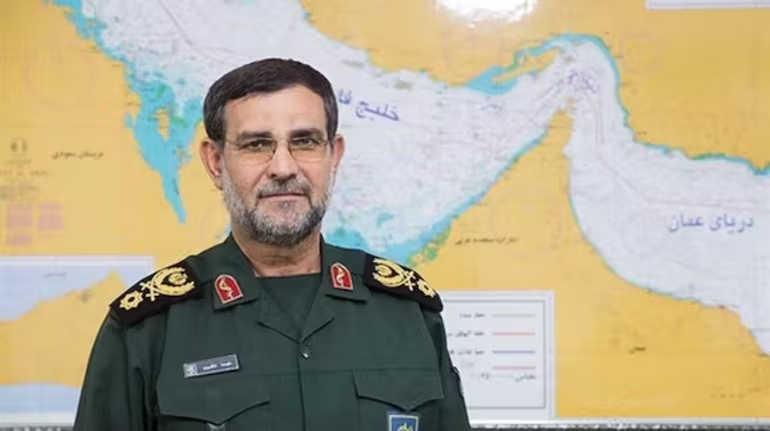
The reported killing of Alireza Tangsiri, head of Iran’s Islamic Revolutionary Guard Corps Navy, marks a potentially pivotal moment in the escalating conflict between Iran, Israel, and the United States. According to Israeli media reports, Tangsiri was killed in a strike in Bandar Abbas, a critical port city overlooking the strategically vital Strait of Hormuz.
The development comes at a time when the strait’s closure has already rattled global energy markets, sending oil prices sharply higher and raising fears of prolonged disruption.
Who was Alireza Tangsiri?
Tangsiri was not just a military commander. He was one of the most influential figures shaping Iran’s naval strategy in the Gulf.
Appointed in 2018 as the chief of the Islamic Revolutionary Guard Corps Navy, he oversaw asymmetric maritime operations designed to counter superior Western naval forces. His leadership style leaned heavily toward aggressive deterrence, often backed by public warnings and calculated shows of force.
His role in recent tensions
In the weeks leading up to his reported death, Tangsiri had:
- Issued direct threats against US-linked oil infrastructure
- Warned civilians to stay away from potential targets
- Overseen enforcement of Iran’s blockade in the Strait of Hormuz
His rhetoric mirrored Iran’s broader posture: escalate pressure without triggering full-scale war.
Why is the Strait of Hormuz so important?
The Strait of Hormuz is not just another waterway. It is the narrow artery through which a significant share of the world’s oil supply flows.
Key facts about the strait
- Connects the Persian Gulf to the Arabian Sea
- Handles roughly 20% of global oil shipments
- Serves as the only sea route for major Gulf exporters
Even minor disruptions here can send shockwaves through global markets.
What happens when it’s blocked?
Iran’s recent move to shut down the strait has already triggered:
- A spike in global oil prices
- Shipping delays and rerouting
- Increased insurance costs for tankers
- Heightened military presence in the region
What do we know about the strike?
Details remain murky. Reports suggest that Tangsiri was killed in an Israeli strike in Bandar Abbas, but it is unclear:
- Whether the operation was carried out solely by Israel or with US involvement
- The specific method used (airstrike, missile, or covert operation)
- Whether other senior officials were also targeted
The lack of confirmation underscores the fog of war, where information is often partial, delayed, or contested.
How could Iran respond?
Tangsiri’s death, if confirmed, would be a major blow to Iran’s naval command. But it could also trigger retaliation.
Possible responses
Iran may choose from several options:
- Escalation in the Strait of Hormuz
Increased attacks on commercial vessels or naval patrols - Targeting US or allied assets
Especially oil facilities or military bases in the Gulf - Proxy actions
Leveraging regional groups to strike indirectly - Cyber or asymmetric warfare
Disrupting infrastructure without conventional military engagement
Each option carries risks, particularly the possibility of drawing the US deeper into the conflict.
What does this mean for global energy markets?
Markets react quickly to uncertainty, and this situation offers plenty of it.
Immediate impact
- Oil prices have surged amid fears of supply disruption
- Traders are factoring in prolonged instability
- Energy-importing countries are bracing for higher costs
Longer-term risks
If tensions persist or escalate:
- Supply chains could face sustained disruption
- Strategic reserves may be tapped more frequently
- Alternative routes and suppliers could gain importance
Is this a turning point in the Iran-Israel conflict?
It might be. Targeting a figure like Tangsiri suggests a shift toward higher-value strikes.
What makes this significant?
- He was directly tied to Iran’s maritime strategy
- His actions had immediate global economic consequences
- His death could disrupt command structures, at least temporarily
However, history shows that such strikes often lead to retaliation rather than de-escalation.
The role of the United States
The US has already been deeply involved in countering Iran’s naval capabilities.
Reports indicate that American forces have targeted dozens of vessels linked to Iran’s navy and IRGC in recent operations.
Why the US matters here
- Maintains a strong naval presence in the Gulf
- Has a direct interest in keeping the Strait of Hormuz open
- Could be drawn into a broader conflict if tensions escalate
TL;DR
- IRGC Navy chief Alireza Tangsiri has reportedly been killed in a strike in Bandar Abbas
- He played a central role in Iran’s blockade of the Strait of Hormuz
- The strait’s closure has already triggered a global energy shock
- His death could escalate tensions further, with potential retaliation from Iran
- Oil markets and global supply chains remain on edge