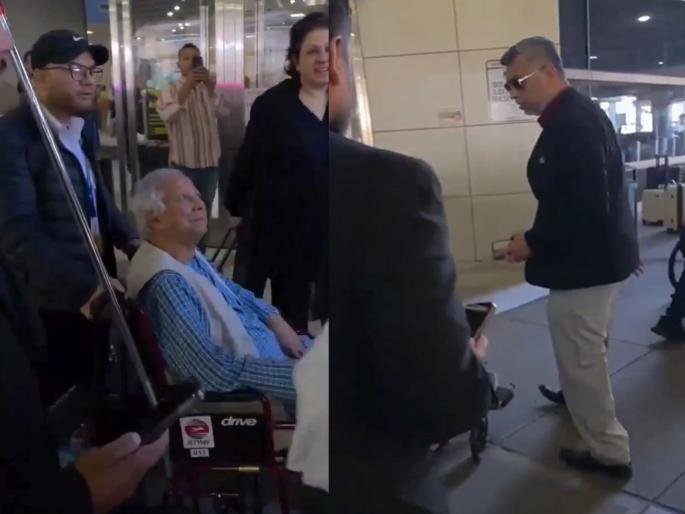
Muhammad Yunus, the former head of Bangladesh’s interim government, faced a hostile reception from Bangladeshi expatriates at New York’s John F. Kennedy International Airport on Monday. Protesters accused him of political violence, deaths during his administration, and undermining democracy, according to a video circulating on social media.
Yunus arrived at Terminal 8 on a Qatar Airways flight from Doha. As he was escorted from the airport in a wheelchair, several protesters confronted him with angry questions and accusations. Yunus and his aide, Lamia Morshed, subsequently moved back inside the airport before security personnel escorted him away.
“You are a terrorist. You have killed people in Bangladesh. Why have you come here? Tell us, why have you come?” a man can be heard shouting in the video.
The confrontation highlights continuing divisions within the Bangladeshi diaspora over the country’s political transition, allegations of human rights violations, and the handling of violence following the removal of former Prime Minister Sheikh Hasina from power.
The allegations made by protesters have not been independently established by the airport footage. There was no immediate response from Yunus or his representatives to the incident or the accusations.
What happened to Muhammad Yunus at JFK Airport?
The confrontation occurred after Yunus arrived in New York on Monday. Several Bangladeshi expatriates gathered at the airport and shouted accusations at the former interim government chief as he was being escorted in a wheelchair.
The protesters alleged that his administration was responsible for deaths among police personnel and claimed that approximately 200,000 innocent people had been arrested in Bangladesh. These figures were allegations made during the confrontation and require independent verification.
Yunus and Morshed moved back into the airport during the exchange. Security personnel then escorted him away from the protesters.
The identities of those involved in the confrontation have not been confirmed publicly in the supplied reporting. Bangladesh Prime Minister’s Information and Communications Adviser Zahed Ur Rahman said Tuesday that the government would pursue legal action against the protesters.
It remains unclear what specific legal provisions the government intends to invoke or whether formal proceedings have begun.
Why are some Bangladeshi expatriates angry with Yunus?
The protest reflects broader disagreements over Bangladesh’s political transition and the interim administration’s response to violence and alleged abuses.
Yunus took charge of the interim government after Sheikh Hasina left office in August 2024 amid a mass uprising. His administration faced the challenge of restoring order, addressing demands for accountability, and preparing the country for a return to elected government.
However, the period was also marked by allegations of arbitrary arrests, deaths in custody, attacks on minority communities, and questions about the accountability of security agencies and political actors.
Critics have argued that the interim administration did not do enough to prevent violence or ensure that alleged abuses were investigated through credible legal processes. Others have demanded investigations into alleged corruption involving Yunus and institutions associated with the Grameen Group.
These are separate allegations that require evidence and should not be treated as established findings merely because protesters repeated them at the airport.
Allegations of arbitrary arrests and custodial deaths
Arbitrary detention and deaths in custody are serious human rights concerns because they raise questions about due process, police conduct, access to legal representation, and the independence of investigations.
The claims raised by protesters at JFK would require verification against court records, official arrest figures, police data, and reporting by credible human rights organizations. In particular, the allegation that around 200,000 innocent people were arrested should not be presented as a confirmed statistic without reliable supporting evidence.
The same standard applies to allegations concerning deaths among police personnel. Establishing responsibility requires information about individual incidents, the circumstances of the deaths, and the findings of any investigations.
Concerns about attacks on religious minorities
Reports of attacks on Hindu communities and places of worship also contributed to scrutiny of the interim administration.
The protection of religious minorities became an important issue in domestic political debate and in Bangladesh’s relations with neighboring India. Critics called for stronger measures to prevent attacks and hold those responsible accountable.
Assessing the scale of the violence requires distinguishing between verified incidents, allegations under investigation, and claims circulated by political groups. Reliable reporting should identify the dates and locations of documented attacks and explain what authorities did in response.
Why did a January 2026 ordinance raise human rights concerns?
Another source of controversy cited in the supplied report was a January 2026 ordinance concerning the handling of alleged offenses committed during the July–August 2024 uprising.
According to the report, the measure restricted police and other law enforcement agencies from conducting routine criminal investigations into actions by participants in the uprising. It also referred allegations of killings, including those involving police personnel, to the National Human Rights Commission (NHRC) to assess whether the conduct constituted political resistance or criminal activity.
If accurately described, such a change would raise important questions about the relationship between political accountability and ordinary criminal justice procedures.
Human rights advocates generally stress that allegations of unlawful killings must be investigated independently, regardless of whether the people involved were protesters, police officers, or other actors. Victims and their families also need access to effective remedies.
However, the precise legal effect of the ordinance cannot be established from the supplied description alone. Its official text, scope, exceptions, implementation, and subsequent legal developments should be checked before drawing conclusions about whether it prevented investigations or created immunity from prosecution.
The distinction matters: changing which institution initially examines a complaint is not necessarily the same as eliminating criminal liability. A careful assessment must establish whether the ordinance transferred investigative responsibility, limited police powers, altered prosecution procedures, or introduced broader protections.
How did Yunus’s tenure affect India-Bangladesh relations?
Relations between India and Bangladesh faced renewed strain during Yunus’s tenure, with disagreements over regional security, minority protection, and public statements adding to existing tensions.
One flashpoint came in March 2025, when Yunus made remarks in China about India’s northeastern states and their geographic relationship with Bangladesh. The comments drew criticism in India and added to concerns about the direction of bilateral relations.
The region is strategically important to India because its northeastern states connect to the rest of the country through a narrow corridor and share borders with several neighboring countries, including Bangladesh. Statements about regional connectivity and access therefore carry political and security implications.
Minority safety also remained a point of disagreement. Indian officials called for the protection of minorities in Bangladesh, while tensions over public rhetoric and other bilateral grievances complicated diplomatic engagement.
These disputes should be understood within the wider context of the political transition in Dhaka. Changes in leadership can affect diplomatic priorities, but individual statements and policy decisions need to be assessed separately rather than treated as proof of a complete shift in bilateral policy.
What happens next after the JFK confrontation?
The announced prospect of legal action adds another dimension to the airport incident. Zahed Ur Rahman’s statement indicates that Bangladesh’s government intends to pursue the matter, although further details about the legal basis and status of any case were not immediately available in the supplied reporting.
Several questions remain unanswered:
- Who were the protesters? Their identities and affiliations have not been confirmed publicly in the available account.
- What evidence supports their accusations? The circulating video documents a confrontation, but it does not establish the truth of the allegations shouted at Yunus.
- What legal action will Bangladesh pursue? The specific charges, jurisdiction, and procedural status require confirmation.
- Will Yunus or his representatives respond? No immediate comment was reported following the incident.
The episode also illustrates how political disputes can continue beyond national borders. For expatriate communities, events in their home countries can remain deeply personal, particularly when they involve allegations of violence, political repression, or failures to protect vulnerable groups.
At the same time, public anger and viral footage cannot substitute for evidence. Establishing responsibility for alleged abuses requires independent investigations, verifiable records, and due process.
Yunus’s reception at JFK has brought those unresolved questions back into public view. The lasting significance of the confrontation will depend less on the slogans shouted at the airport than on the evidence behind the allegations and the steps taken by relevant authorities to address them.