
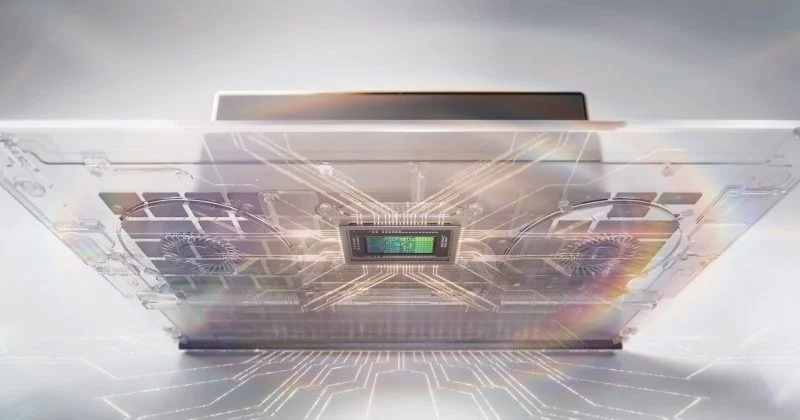
NVIDIA is making its boldest move into personal computing in years.
At the Computex technology conference on Monday, Nvidia unveiled a new AI-focused laptop processor for Windows devices, signaling a major expansion beyond its dominant data center business and into the increasingly competitive market for AI-powered PCs.
The announcement positions Nvidia directly against long-established chipmakers, including Intel, Advanced Micro Devices, Qualcomm, and even Apple, whose in-house silicon has reshaped expectations for laptop performance and efficiency.
The company’s new chip — called the RTX Spark Superchip — reflects a broader shift happening across the tech industry: the race to turn laptops into AI-native machines capable of running advanced artificial intelligence models directly on-device.
What Did Nvidia Announce?
Nvidia introduced the RTX Spark Superchip during CEO Jensen Huang’s keynote presentation at Computex.
The company described the processor as a next-generation AI computing platform designed specifically for Windows laptops.
According to Huang, the chip is intended to handle:
- AI agents
- Scientific computing
- Advanced graphics workloads
- Local AI model processing
- High-end productivity tasks
Huang framed the launch as more than just another laptop processor announcement.
“Microsoft and Nvidia are going to reinvent the PC,” he said during the presentation. “This is going to be the new PC.”
Why Nvidia’s Entry Matters
Nvidia already dominates the AI chip market, powering large-scale data centers used by companies like:
- OpenAI
- Microsoft
- Meta
- Amazon
But the personal computing market represents a different challenge entirely.
Unlike data centers, consumer PCs require:
- Energy efficiency
- Thermal optimization
- Battery performance
- Competitive pricing
- Broad software compatibility
This is an area where Intel, AMD, Apple, and Qualcomm have years of experience.
Nvidia’s move suggests the company believes AI capabilities will fundamentally reshape what consumers expect from laptops — much like smartphones evolved into AI-powered devices over the last decade.
What Is an AI PC?
The term “AI PC” has quickly become one of the tech industry’s biggest buzzwords, but companies are increasingly defining it in practical terms.
Generally, AI-powered PCs are designed to:
- Run AI models locally without relying entirely on cloud servers
- Power real-time AI assistants
- Improve productivity tools
- Generate images, code, or text directly on-device
- Handle complex workloads faster and more efficiently
The idea is to reduce dependence on internet-based AI processing while improving speed, privacy, and responsiveness.
Nvidia’s strategy appears focused on turning high-performance laptops into portable AI workstations.
Nvidia Is Betting Big on Local AI Computing
One of the most important parts of Nvidia’s announcement is its emphasis on running advanced workloads directly from a laptop.
During the presentation, Huang highlighted applications including:
- Digital biology
- Seismic analysis
- Astrophysics research
- AI agents
- Scientific simulations
“If you want to run digital biology, no problem. If you want to do seismic processing, no problem. You want astrophysics, no problem,” Huang said.
That messaging matters because it signals Nvidia is targeting not only gamers and creators, but also:
- Researchers
- Engineers
- Scientists
- Developers
- Enterprise professionals
The company appears to be positioning the AI PC as a serious productivity and research tool — not just a consumer gadget.
Why Microsoft Is Central to Nvidia’s Plan
Huang repeatedly emphasized Nvidia’s partnership with Microsoft during the launch.
According to Nvidia, years of collaboration between the two companies helped optimise Windows software compatibility for the new platform.
That matters because software compatibility remains one of the biggest challenges for new processor architectures.
Apple succeeded partly because it tightly controls both hardware and software. Nvidia, by contrast, must ensure compatibility across the massive Windows ecosystem.
Huang claimed the new platform could:
- Run existing Windows software
- Support next-generation AI applications
- Power AI agents
- Handle intensive workloads simultaneously
“Microsoft and Nvidia meticulously optimized everything so that this computer literally runs everything the world has ever created,” Huang said.
That’s an ambitious claim — and one Nvidia will now need to prove in real-world testing.
Can Nvidia Compete With Apple, Intel and AMD?
Nvidia enters the PC processor race at a difficult but potentially transformative moment.
Apple Changed the Industry
Apple’s transition to its custom M-series chips dramatically raised expectations for:
- Battery life
- AI performance
- Heat efficiency
- Unified memory architecture
Many analysts now see AI acceleration as the next major battleground in personal computing.
Intel and AMD Still Dominate Windows PCs
Despite growing competition, Intel and AMD still control most of the Windows laptop market.
Both companies have already introduced AI-focused chips with built-in neural processing units (NPUs) aimed at powering AI tasks locally.
That means Nvidia is entering an already crowded race.
Qualcomm Is Also Targeting AI PCs
Qualcomm has aggressively promoted AI-focused Windows laptops powered by Snapdragon chips, especially after Microsoft expanded support for Arm-based Windows devices.
Nvidia will need to differentiate itself through:
- Raw AI performance
- Software integration
- Graphics capabilities
- Developer adoption
Will AI PCs Be Expensive?
Analysts expect Nvidia’s first wave of AI-powered laptops to launch at premium price points.
That likely means:
- High-end creator laptops
- Enterprise AI workstations
- Gaming-performance devices
- Professional productivity machines
However, Nvidia reportedly plans to introduce lower-cost versions over time as the technology matures and manufacturing scales up.
This mirrors how many advanced technologies — including gaming GPUs and AI accelerators — initially launch at the premium end before becoming more mainstream.
Why This Matters for the Future of Computing
Nvidia’s announcement highlights a broader industry shift: AI is no longer confined to cloud servers and massive data centers.
Tech companies increasingly believe AI processing will move directly onto consumer devices.
That shift could reshape:
- Laptop design
- Operating systems
- Productivity software
- Gaming
- Enterprise workflows
- Creative industries
If Nvidia succeeds, the AI PC market could become one of the company’s next major growth engines beyond data centers.
And with the AI boom continuing to fuel investor enthusiasm, Nvidia is clearly betting that the next frontier of artificial intelligence won’t just live in the cloud — it will sit on people’s desks and backpacks.
TL;DR
- Nvidia unveiled the RTX Spark Superchip for Windows laptops at Computex.
- The move marks Nvidia’s biggest push into personal computing in years.
- The company is entering the AI PC market dominated by Intel, AMD, Qualcomm, and Apple.
- CEO Jensen Huang said Nvidia and Microsoft are “reinventing the PC.”
- The platform is designed for AI agents, scientific computing, and local AI processing.
- Analysts expect the first devices to launch at premium prices.