
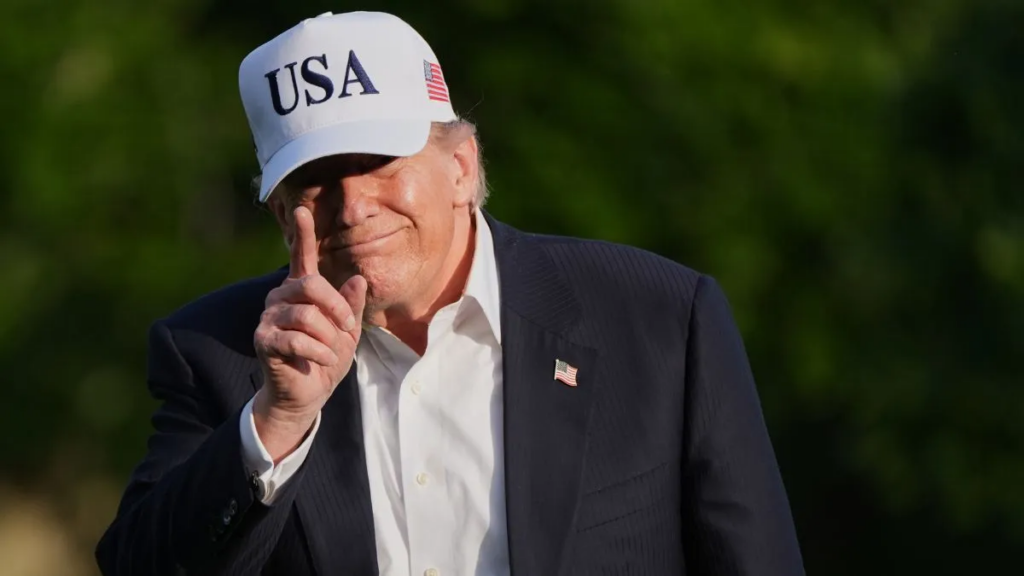
The Donald Trump administration is reportedly preparing contingency plans for a possible renewed military offensive against Iran if the current fragile ceasefire collapses, with officials discussing a potential new operational name: “Operation Sledgehammer.”
The reported planning comes just days after Trump returned from a closely watched summit in Beijing with Xi Jinping, where Iran and regional stability emerged as major topics of discussion.
According to multiple reports citing US officials, Washington and Israel have begun extensive military preparations amid fears that diplomatic negotiations with Tehran may be nearing another breakdown.
The developments suggest the White House is increasingly preparing for the possibility that the current pause in fighting may not last.
What is ‘Operation Sledgehammer’?
Reports indicate “Operation Sledgehammer” is one of several names being considered for a potential renewed military campaign against Iran.
The proposed operation would reportedly follow the earlier US campaign known as Operation Epic Fury
That operation was paused earlier this year after Washington shifted toward a naval blockade strategy and later agreed to a ceasefire framework intended to create space for diplomatic negotiations.
Now, according to reports citing American officials, Pentagon planners are again discussing large-scale military options if diplomacy fails.
The consideration of a new operational name may seem symbolic, but in military planning it often signals a distinct phase change:
- New objectives
- New operational scope
- Revised strategic messaging
- Expanded military options
Why the ceasefire appears increasingly fragile
The current truce between the US, Israel, and Iran has remained unstable from the beginning.
Several unresolved issues continue driving tensions:
- Iran’s nuclear programme
- Strait of Hormuz disruptions
- Regional proxy conflicts
- Sanctions
- Missile capabilities
- US-Israel military coordination
According to reports, Trump rejected Iran’s latest peace proposal as “unacceptable” while Tehran continues insisting its nuclear activities are peaceful.
At the same time, both sides appear to be preparing publicly and militarily for the possibility that talks may fail.
That dual-track strategy — diplomacy alongside military preparation — has become a defining feature of modern US-Iran confrontations.
The Strait of Hormuz remains the biggest pressure point
Much of the current crisis revolves around the Strait of Hormuz, one of the world’s most strategically important energy chokepoints.
Roughly a fifth of global oil shipments pass through the narrow waterway.
Any disruption there immediately affects:
- Global oil prices
- Shipping insurance costs
- Energy markets
- Inflation expectations
- International trade routes
Officials reportedly hope a diplomatic compromise could persuade Iran to fully reopen shipping lanes while allowing Trump to claim a political victory ahead of future negotiations.
But military planners are simultaneously preparing for the opposite outcome.
What military options are reportedly under discussion?
According to reports citing US officials, Washington and Israel are evaluating several escalation scenarios.
Possible military actions reportedly being considered include:
- Expanded airstrikes on Iranian military infrastructure
- Bombing campaigns targeting missile facilities
- Strikes on underground nuclear-related sites
- Increased naval operations in the Gulf
- Deployment of Special Operations forces
- Reinforced regional air defense systems
Officials also reportedly said the ceasefire period was used to:
- Replenish precision-guided munitions
- Strengthen naval deployments
- Expand regional air capabilities
- Improve operational readiness
That suggests the pause in combat may have functioned partly as a strategic reset rather than a permanent de-escalation.
Israel’s role appears increasingly central
Reports suggest Israel has been closely coordinating with Washington during the latest phase of military planning.
Israel views Iran’s nuclear and missile capabilities as existential security threats and has long supported stronger military pressure against Tehran.
The latest reports indicate:
- Joint military exercises have intensified
- Intelligence-sharing remains active
- Contingency strike planning is ongoing
This coordination matters because any future escalation would likely involve both direct and indirect regional consequences across:
- Lebanon
- Syria
- Iraq
- Gulf shipping routes
- Energy infrastructure
The broader Middle East could quickly become involved if fighting resumes at scale.
Iran says it is ready to respond
Iranian officials have issued increasingly forceful warnings in recent days.
Mohammad Bagher Ghalibaf reportedly said Iran’s armed forces were prepared to “teach a lesson for any aggression.”
Tehran continues to maintain that
- Its nuclear programme is peaceful
- US sanctions are unjustified
- Regional military pressure is provocative
Iran also retains several strategic tools beyond direct military confrontation, including the following:
- Proxy groups across the region
- Missile capabilities
- Maritime disruption capacity
- Energy market leverage
That means even limited strikes could trigger wider consequences beyond immediate battlefield objectives.
Why Trump’s China visit matters in this context
The timing of these reports is significant.
Trump’s summit with Xi Jinping in Beijing reportedly included discussions around:
- Iran
- Energy security
- Strait of Hormuz stability
- Global trade disruptions
China has major economic stakes in Gulf stability because it relies heavily on imported energy flows from the Middle East.
Trump later indicated that Xi supported keeping the Strait of Hormuz open, suggesting Beijing may be quietly encouraging de-escalation even as broader US-China tensions persist elsewhere.
That reflects a strange geopolitical reality: The US and China remain rivals on trade and technology, yet both share strong incentives to avoid a full-scale energy crisis in the Gulf.
Why the operation name itself is drawing attention
Military operation names often carry political and psychological messaging.
“Operation Sledgehammer” projects a very different tone than diplomatic language surrounding ceasefires and negotiations.
The name suggests:
- Force
- Escalation
- Punitive intent
- Decisive military pressure
Even if no final operation occurs, the emergence of such planning discussions can itself influence:
- Markets
- Diplomacy
- Oil prices
- Regional military calculations
In geopolitics, sometimes the signal matters almost as much as the strike.
What happens next?
Several scenarios remain possible:
- The ceasefire survives
- Limited negotiations resume
- Regional tensions stabilize temporarily
- Small-scale clashes escalate unexpectedly
- Large-scale military operations resume
For now, the administration appears to be preparing for both diplomacy and escalation simultaneously.
That balancing act reflects the central dilemma facing Washington: How to pressure Iran without triggering a broader regional conflict that could destabilize global energy markets and draw the US deeper into another prolonged Middle East crisis.
At the moment, “Operation Sledgehammer” remains a contingency plan.
But the fact that officials are openly discussing it suggests the White House no longer views renewed conflict as a distant possibility.
TL;DR
- The Trump administration is reportedly considering renewed military action against Iran under a possible operation called “Operation Sledgehammer”
- The earlier campaign, “Operation Epic Fury,” was paused after a ceasefire
- US and Israeli military preparations have reportedly intensified
- The Strait of Hormuz remains a major global flashpoint
- Iran says it is prepared to respond to any aggression
- Trump and Xi Jinping reportedly discussed Iran during the Beijing summit