
US intelligence has reportedly warned European governments about a possible Russian drone operation targeting Spain, France or Italy, according to Spanish newspaper El Mundo. The reported scenario involves launching drones from commercial vessels operating in the Mediterranean, potentially allowing the weapons to be moved close to European coastlines while appearing to be part of normal maritime traffic.
The CIA and the governments of Spain, France and Italy have not publicly confirmed the report. Italy’s Defense Minister Guido Crosetto also said on September 24 that Italian authorities had not independently confirmed the reported alert.
The warning comes as European governments remain increasingly focused on Russian drones, sabotage and other forms of activity that could target critical infrastructure without taking the form of a conventional military attack.
What does the reported CIA warning say?
According to El Mundo, US intelligence services have shared information with several European governments about a possible Russian operation involving drones against targets in southern Europe.
Spain, France and Italy were reportedly identified as potential targets.
The alleged plan would involve concealing drones aboard commercial ships and launching them from the Mediterranean. Using civilian vessels could make it harder for investigators to immediately determine where an attack originated.
The report describes the scenario as part of a potential Russian strategy designed to disrupt while maintaining a degree of plausible deniability.
Why would Russia use commercial ships?
Launching a drone from a ship would give an attacker a very different approach from a conventional land-based operation.
A merchant vessel can operate within busy international shipping routes, potentially allowing a launch platform to blend into normal maritime traffic.
The Mediterranean is one of the world’s busiest maritime regions, with commercial vessels constantly moving between Europe, North Africa and the Middle East.
A launch from offshore could also allow a relatively short-range drone to reach coastal targets without crossing the airspace of several countries first.
Which drone could Russia use?
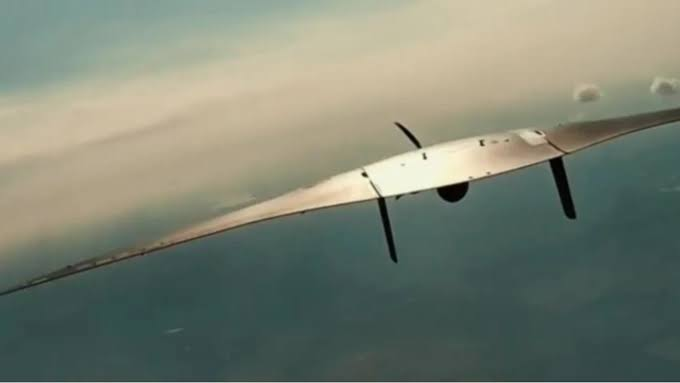
The reported warning identifies the Russian-made Gerbera as a possible platform.
The Gerbera is a comparatively small unmanned aircraft that has been used in Russia’s war against Ukraine. Open-source reporting puts its length at around two meters and its range at as much as 600 kilometers, with a reported maximum speed of approximately 160 kilometers per hour.
Its payload is much smaller than that of a conventional missile. Reports describe the drone as capable of carrying roughly 4 to 5 kilograms of explosives.
That would make it better suited to localized damage, fires or disruption than to destroying heavily fortified military installations.
Why is the Gerbera significant?
The Gerbera’s relatively low cost and small size could make it useful in operations where the objective is to create disruption rather than deliver a massive explosive payload.
A drone does not necessarily need to destroy a major facility to create consequences.
An attack near an airport, port, energy installation or communications facility could result in closures, emergency responses and temporary interruptions even if the physical damage were limited.
That potential for disruption is one reason small drones have become a growing security concern for European governments.
What could Russia potentially target?
The reported intelligence assessment does not identify specific buildings or installations.
The broad categories mentioned in reports include ports, energy infrastructure and coastal communications facilities.
Those locations are strategically important because Mediterranean ports handle large volumes of European trade and energy-related shipping.
Critical communications infrastructure is similarly important because disruption to digital or physical networks can affect businesses, transportation and government services well beyond the immediate target.
The reported scenario therefore appears focused on economically and strategically important coastal infrastructure.
Has Russia tested maritime drone launches before?
The idea of launching drones from maritime platforms is not entirely theoretical.
Euronews reported that Swedish naval forces detected a drone taking off from a Russian intelligence vessel in the Öresund Strait in February 2026.
That incident does not prove that Russia is preparing an attack on southern European countries. It does, however, demonstrate that maritime platforms can be used in connection with unmanned aircraft operations.
The possibility becomes more significant when combined with the use of commercial shipping as a concealment method, as described in the El Mundo report.
Why are Spain, France and Italy being mentioned?
All three countries have extensive Mediterranean coastlines and operate major ports and energy infrastructure.
They are also members of NATO and have supported Ukraine in different ways since Russia launched its full-scale invasion in 2022.
A maritime drone operation would potentially allow an attacker to approach from a direction that is less associated with the traditional Russia-NATO confrontation along Europe’s eastern frontier.
The reported intelligence therefore focuses on geographical access as well as the strategic importance of the countries involved.
Could small drones really cause serious disruption?
Potentially, although the impact would depend heavily on the target.
A Gerbera carrying several kilograms of explosives would not have the destructive power of a cruise missile or large aerial bomb.
Its potential value could instead come from precision, surprise and relatively low operating cost.
For example, an attack causing a fire near an airport or industrial site could force authorities to suspend operations temporarily. A strike on a port could disrupt shipping schedules, while an incident affecting communications infrastructure could trigger wider operational problems.
The psychological and political impact could also be greater than the physical damage.
Why is this being treated as a hybrid threat?
The alleged tactic combines military technology with civilian infrastructure and concealment.
That is characteristic of what European governments often describe as hybrid activity, where cyberattacks, sabotage, espionage, disinformation and other disruptive measures are used alongside conventional military pressure.
Drones launched from a commercial ship would create an attribution problem because investigators would have to determine not only what aircraft was used, but also who controlled it and where the launch took place.
That ambiguity could become an important part of the operation itself.
What has Italy said about the reported warning?
Italian Defense Minister Guido Crosetto said on September 24 that the reported alert had not been confirmed by Italian authorities.
That is an important qualification because the original allegation comes from media reporting based on unnamed intelligence and defense sources.
The lack of public confirmation does not establish that the warning is inaccurate. Intelligence services frequently share information privately while withholding the evidence and sources behind an assessment.
It does mean that the reported Russian plan should currently be described as a potential threat assessment rather than a confirmed attack order.
What role did CIA Director John Ratcliffe’s Moscow visit play?
The El Mundo report reportedly links the origin of the warning to CIA Director John Ratcliffe’s visit to Moscow in August.
The Kremlin confirmed that Ratcliffe met Russian intelligence officials during the trip, although he did not meet President Vladimir Putin.
The exact contents of those discussions have not been made public.
Reuters reported that the Moscow meetings were conducted against the backdrop of the war in Ukraine and US efforts to maintain intelligence contacts with Russia.
That does not independently establish that the meetings produced the reported warning about Mediterranean drone attacks.
Why would Russia choose southern Europe?
The reported scenario highlights a potentially different vulnerability from the traditional eastern European theater.
Countries such as Poland and the Baltic states are geographically closer to Russia and have been central to discussions about NATO’s eastern flank.
Southern European countries are farther away, but their long coastlines and dense maritime traffic could offer different opportunities for covert operations.
A drone launched from the Mediterranean would not need to cross a long stretch of NATO-controlled land territory before reaching a target.
That geographic distinction is one reason maritime security is becoming increasingly relevant to European counter-drone planning.
How is Europe responding to the broader drone threat?
European governments have been increasing efforts to protect airports, ports, military bases, power facilities and other critical infrastructure from unmanned aircraft.
Counter-drone systems can include radar, electronic warfare, optical sensors and short-range interception technologies.
The challenge is particularly difficult when the aircraft is small, slow and flying at low altitude.
A military air-defense system designed to intercept fighter jets or ballistic missiles is not necessarily the most cost-effective solution against a small commercial-sized drone.
That has pushed NATO members toward layered counter-drone defenses that can identify and respond to a wider range of threats.
Is this the same as Russia declaring war on Western Europe?
No.
The reported scenario describes a potential covert or deniable drone operation, not a conventional Russian military campaign against Spain, France or Italy.
There is also no public evidence showing that Russia has formally announced or acknowledged plans to attack any of the three countries.
The significance of the warning lies instead in the type of operation being discussed: a small number of unmanned aircraft, launched covertly from civilian shipping, potentially aimed at infrastructure in countries far from the main battlefield in Ukraine.
Why does attribution matter?
Determining who carried out an attack would be especially important in a scenario involving a commercial vessel.
Investigators would need to establish where the drone came from, who controlled it, how it reached the launch site and whether the ship itself was knowingly involved.
That evidence would be critical because a confirmed attack attributed to Russia against a NATO member could have serious diplomatic and security consequences.
A deliberately ambiguous operation could therefore be designed to make the initial response more difficult.
What happens next?
European security agencies are likely to continue monitoring maritime traffic, coastal infrastructure and unusual drone activity while assessing the credibility of the reported warning.
The most important development would be independent evidence showing that Russia has actually prepared or attempted to use commercial ships as drone launch platforms in the Mediterranean.
For now, the public record supports a more cautious description.
US intelligence has reportedly shared a warning about a possible Russian drone operation targeting Spain, France or Italy. The alleged plan involves Gerbera drones launched from commercial vessels in the Mediterranean, but the specific warning has not been publicly confirmed by the CIA or the governments named in the report.
That leaves an unusual security question hanging over Europe’s southern flank: how do you defend a coastline against a threat that could arrive disguised as ordinary maritime traffic?