
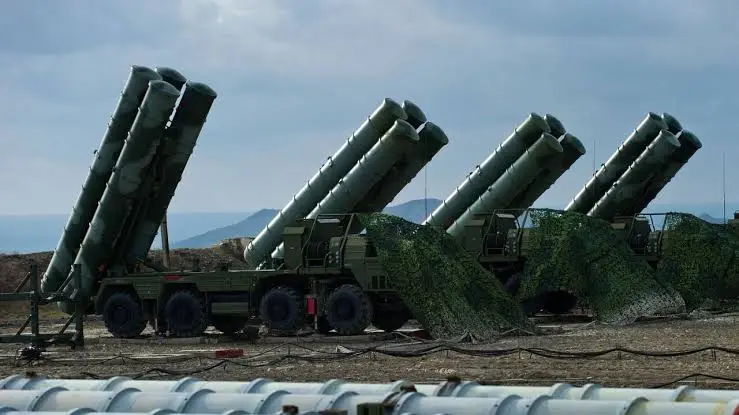
Russia’s S-400 has become one of the world’s best-known long-range air defense systems, but its successor is already taking shape. Over the next two decades, the S-500 Prometheus is expected to take on a growing share of the missions currently associated with the S-400, while the more specialized S-550 could handle selected strategic missile-defense and counter-space roles.
The shift is not simply about replacing one missile system with a newer model. It reflects a broader change in air warfare: from defending against aircraft and cruise missiles to tracking and intercepting ballistic missiles, hypersonic weapons and, potentially, objects in low Earth orbit.
There is an important caveat, however. Many of the most impressive performance figures associated with the S-500 and S-550 come from Russian statements or secondary reporting, while several technical specifications remain classified or independently unverified.
What is replacing the S-400?
The most credible answer is the S-500 Prometheus, but it is better understood as a higher layer of Russia’s air and missile-defense architecture than as a direct one-for-one replacement.
The S-400 remains optimized for long-range air defense, including aircraft and cruise missiles. The S-500 adds a strategic missile-defense role, with interceptors intended to engage ballistic targets at much higher altitudes.
Russia’s Defense Ministry has been moving toward a layered structure in which different systems perform different jobs. The S-500 is therefore expected to complement the S-400 before gradually assuming some of its most demanding missions.
Russia said in December 2025 that the first S-500 regiment had entered combat duty. At the same time, the exact performance characteristics of the system have not been officially published.
How does the S-500 differ from the S-400?
The biggest difference is not simply range. It is altitude and target type.
Open-source assessments generally put the S-400’s maximum engagement range at around 400 kilometers for certain missiles. The S-500 is widely reported to have an engagement range of roughly 500–600 kilometers, depending on the interceptor and target. CSIS, for example, cites reported ranges of 500–600 kilometers for the S-500’s 77N6-series interceptors.
More importantly, the S-500 is intended to operate against ballistic missiles at altitudes far above those normally associated with conventional air-defense engagements.
Russian claims and open-source assessments have put its potential intercept altitude at approximately 200 kilometers. That would bring portions of low Earth orbit within the system’s theoretical engagement envelope.
That does not mean the S-500 can routinely shoot down satellites. The distinction matters. An ability to intercept a ballistic target at very high altitude is not the same thing as possessing a proven, operational anti-satellite capability.
What weapons can the S-500 intercept?
The S-500 is designed around a mixture of interceptors rather than a single missile.
Open-source assessments identify the 40N6M as an interceptor intended for aircraft and cruise-missile targets, while the 77N6 and 77N6-N1 families are associated with ballistic-missile defense and potentially high-altitude targets. CSIS estimates the 40N6M’s range at about 400 kilometers and reports 500–600-kilometer figures for the 77N6 family.
The system is therefore designed to bridge two traditionally separate missions:
- Long-range air defense
- Strategic ballistic-missile defense
Russian officials have also claimed that the S-500 can counter hypersonic weapons. Independent analysts have treated some of these claims more cautiously because the system’s full operational performance remains difficult to verify publicly.
Why are hypersonic weapons changing air defense?
Hypersonic weapons create a particularly difficult problem because defenders have less time to detect, classify and engage them.
A conventional aircraft or cruise missile may provide a defender with a comparatively large engagement window. A maneuvering hypersonic weapon can compress that window dramatically while also making its trajectory harder to predict.
That changes what an air-defense system needs:
- Faster detection and tracking
- More capable radar networks
- Shorter decision cycles
- Interceptors with greater speed and maneuverability
- Better integration between sensors, command systems and launchers
The S-500 is intended to address this higher-end threat environment. However, claims that it can reliably defeat every type of hypersonic weapon should be treated as Russian capability claims rather than independently established facts.
What is the S-550?
The S-550 is more difficult to assess because considerably less reliable public information exists about it.
Russian officials have described the S-550 as part of the country’s strategic air and missile-defense architecture. A 2021 statement from Russian Defense Minister Sergei Shoigu identified the S-550 alongside the S-350 and S-500 as systems Russia wanted to deliver to its armed forces. (TASS)
However, reports about its actual status and capabilities have been inconsistent.
In December 2021, TASS reported that a source close to Russia’s Defense Ministry claimed the first S-550 brigade had entered combat duty. TASS also explicitly noted that official sources had not confirmed the information.
That uncertainty is important when discussing the S-550 in a 20-year forecast.
Rather than describing it as a confirmed replacement for the S-400, it is more accurate to view the S-550 as a potential specialist layer within Russia’s future missile-defense architecture.
How could the S-500 and S-550 work together?
The most likely long-term model is a layered network rather than a single system replacing everything below it.
Russian reporting has previously described the S-500 and S-550 as systems with different missions. One TASS report, citing an unnamed source, said the S-550 would not replace the S-500 and would instead have different combat objectives. (TASS)
A future architecture could broadly look like this:
Lower layer
- Pantsir-family systems
- Defense against drones, low-flying aircraft and other short-range threats
Medium layer
- S-350 and related systems
- Coverage against aircraft, cruise missiles and other conventional threats
Long-range layer
- S-400
- Long-range air defense against aircraft and missiles
High-altitude/strategic layer
- S-500
- Ballistic missiles and selected high-altitude threats
Specialized strategic layer
- S-550, if deployed as described
- Potentially strategic ballistic-missile and counter-space missions
The result would be less like replacing an old car with a new one and more like adding increasingly specialized layers to a defensive network.
Will the S-500 really replace the S-400?
Probably only partially and gradually.
The S-400 is already deeply integrated into Russia’s air-defense structure and remains a capable long-range system. Replacing large numbers of operational launchers, radars, command vehicles and missiles would be expensive and time-consuming.
The S-500 is also considerably more specialized. Its value is likely to be greatest against the most demanding targets rather than against every aircraft or cruise missile that enters Russian airspace.
That makes a mixed fleet logical for decades.
The S-400 can handle a substantial portion of conventional air-defense requirements while the S-500 is reserved for targets that demand its higher-end capabilities. As newer systems become available, older S-400 units could progressively move to secondary roles or be retired.
What could replace the S-400 after 2040?
Looking beyond the S-500 and S-550 introduces much more uncertainty.
By the 2040s, Russia’s air-defense architecture is likely to depend increasingly on networked sensors and multiple interceptor types, rather than a single missile family.
The important technological trends will include:
- Longer-range and more precise radars
- Greater automation in the command-and-control chain
- Improved electronic-warfare resistance
- Interceptors designed specifically for maneuvering hypersonic weapons
- Greater integration with space-based and airborne sensors
- Potential directed-energy systems for selected lower-cost threats
In other words, the eventual successor to the S-400 may not have an “S-600” label at all. It could be an integrated air-and-missile-defense network in which individual launchers are only one component.
What about satellites?
This is where claims surrounding the S-500 and S-550 require the most caution.
The S-500’s reported ability to engage targets at altitudes approaching 200 kilometers has led to speculation about anti-satellite applications. The International Institute for Strategic Studies has noted that Russia has discussed the system’s potential role against low-orbit satellites, but also emphasized that there have been no known demonstrations of the S-500 destroying objects beyond the atmosphere.
That distinction matters because counter-space warfare is not simply another form of air defense.
Satellites travel at enormous speeds and follow orbital paths. Successfully intercepting one requires precise tracking, timing and an interceptor capable of reaching the appropriate geometry. A system designed to intercept a ballistic missile’s trajectory does not automatically become a universal anti-satellite weapon.
Why the S-400 may remain relevant for years
Even if the S-500 becomes Russia’s most sophisticated surface-based air-defence system, the S-400 is unlikely to disappear quickly.
There are several reasons:
- Scale: Russia already operates and produces large numbers of S-400-related equipment and missiles.
- Cost: High-end strategic interceptors are expensive resources.
- Mission fit: Not every target requires an S-500-class interceptor.
- Layered defense: Multiple systems make it harder for an attacker to overwhelm one defensive layer.
- Industrial constraints: Production capacity can determine how quickly a military can replace an existing fleet.
The broader lesson is that military modernization rarely works as a clean handoff from one generation to the next. Older systems often remain useful because they are cheaper, numerous and already integrated into the force.
The bigger shift is from missiles to networks
The most important development over the next 20 years may not be the S-500 or S-550 themselves.
It will be the ability to connect sensors, command systems and interceptors into a single defensive network.
That matters because future attackers may combine stealth aircraft, drones, cruise missiles, ballistic missiles and hypersonic weapons in the same operation. A defender cannot efficiently counter all of them with one interceptor or one radar.
The emerging Russian model therefore points toward a layered aerospace-defense network in which the S-400 becomes one layer, while the S-500 and potentially the S-550 take on increasingly specialized missions.
So, what will replace the S-400?
The short answer is the S-500, but not by itself.
Over the next two decades, the S-500 is the clearest candidate to assume the S-400’s most demanding long-range and missile-defense missions. The S-550 could complement it in specialized strategic roles, although publicly available information about that system remains too limited to make firm predictions.
The likely transition will be gradual:
S-400 → S-500 for higher-end threats, with S-550 potentially adding a specialized strategic layer → increasingly networked air and missile defense by the 2040s.
That is a more realistic picture than a simple “S-500 replaces S-400” narrative. Russia’s future air-defense strategy is likely to be defined not by one super-system, but by how effectively multiple systems work together.