
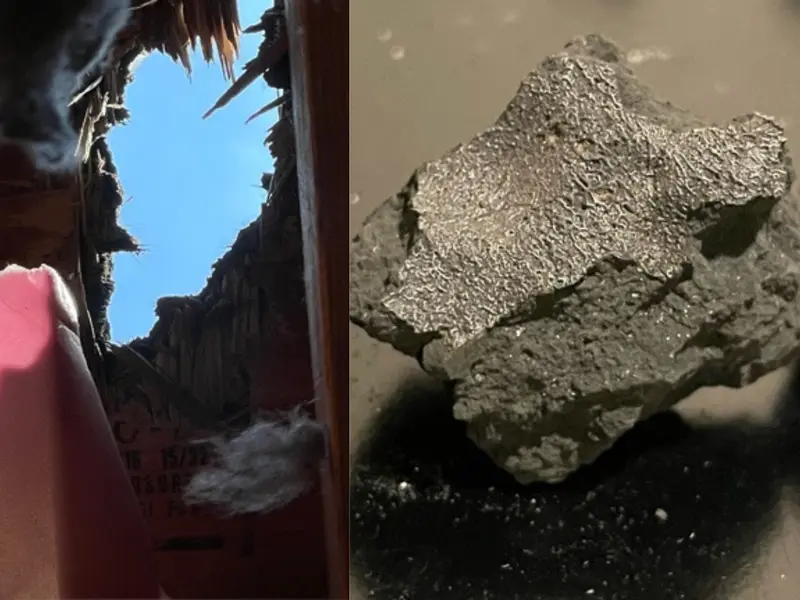
A meteorite that smashed through the roof of a New Jersey home has provided scientists with an extraordinary glimpse into the chemistry of the early solar system—and possibly the ingredients that helped make life on Earth possible.
The space rock, known as the Hillsborough meteorite, crashed into a bedroom in 2024 after streaking through Earth’s atmosphere. Now, detailed laboratory analysis has revealed evidence of an unusual salty-water environment and a rich collection of organic molecules unlike anything previously identified in this type of meteorite.
The findings suggest that some primitive asteroids may have hosted more chemically diverse environments than scientists once believed, offering new clues about how the building blocks of life formed billions of years ago.
TL;DR
- Scientists analyzed the Hillsborough meteorite that landed in New Jersey in 2024.
- The meteorite contains evidence of an unusual salty-water environment not previously identified in this class of asteroid.
- Researchers also detected amino acids and numerous organic compounds.
- The findings could improve scientists’ understanding of how life’s chemical ingredients formed in the early solar system.
- The meteorite was recovered within hours of impact, making it one of the best-preserved samples ever studied.
What Happened in New Jersey?
In 2024, a meteorite weighing about two pounds crashed through the roof of a home in Hillsborough, New Jersey.
After entering Earth’s atmosphere at tremendous speed, the object produced a loud sonic boom before punching through the ceiling of the home’s master bedroom.
The homeowner later described hearing a powerful crash before discovering black fragments scattered across the bed beneath a hole in the ceiling.
The meteorite was recovered quickly, allowing scientists to examine an unusually uncontaminated sample.
Why Is the Hillsborough Meteorite So Important?
Meteorites are often described as time capsules from the early solar system.
Unlike rocks on Earth, many meteorites have remained largely unchanged since the planets formed more than 4.5 billion years ago.
The Hillsborough meteorite is especially valuable because researchers found evidence of chemical processes that had not previously been documented in this category of primitive asteroid.
According to the research team, the object preserves traces of highly concentrated salty fluids that once interacted with minerals inside its parent asteroid.
That type of chemistry could have created favorable conditions for producing increasingly complex organic molecules.
Suggested visual: An illustration showing the meteorite’s journey from the asteroid belt to its impact inside the New Jersey home.
What Did Scientists Discover?
Laboratory analysis revealed an unexpectedly rich chemical inventory.
Researchers identified:
- Amino acids.
- Carbon-rich organic molecules.
- Nitrogen-bearing compounds.
- Carboxylic acids.
- Dozens of other soluble organic compounds.
The meteorite contained approximately 1.8% carbon and 0.07% nitrogen, with isotopic signatures consistent with primitive carbon-rich meteorites known as CM carbonaceous chondrites.
Scientists also detected magnesium-containing organic compounds whose origin remains uncertain.
These molecules may have formed through interactions with concentrated salty water or during ancient impacts experienced by the asteroid.
What Is Meant by ‘Alien Chemistry’?
The phrase “alien chemistry” does not imply evidence of extraterrestrial life.
Instead, it refers to chemical processes that occurred in an environment unlike anything found naturally on Earth today.
Researchers say the Hillsborough meteorite records evidence of an unusual briny environment inside its parent asteroid.
Because this type of salty-water chemistry had not previously been identified in similar meteorites, it provides scientists with new information about the range of chemical environments that existed during the early history of the solar system.
Where Did the Meteorite Come From?
Scientists traced the Hillsborough meteorite back to the lower asteroid belt between Mars and Jupiter.
They believe it originated from a primitive asteroid that underwent an episode of concentrated saline water activity billions of years ago.
Lead author Peter Jenniskens of the SETI Institute and NASA Ames Research Center said the fragments preserve material from near the surface of that ancient asteroid, allowing researchers to study processes that would otherwise remain hidden.
Could This Help Explain How Life Began?
The discovery supports one of the leading ideas in astrobiology—that meteorites helped deliver important chemical ingredients to the young Earth.
Scientists emphasize that the meteorite does not contain life.
Instead, it contains molecules that are considered essential building blocks for biology.
Compounds such as amino acids and carboxylic acids can participate in the complex chemical reactions that eventually produce proteins and other molecules required for living organisms.
Researchers believe meteorites may have continuously supplied these ingredients during Earth’s earliest history, enriching the planet’s chemical environment before life emerged.
Why Was This Sample So Valuable?
Many meteorites become contaminated after landing because they are exposed to rain, soil, microbes, and human handling.
The Hillsborough meteorite was different.
Fragments were recovered within hours of impact and preserved under carefully controlled conditions.
That rapid recovery allowed scientists to analyze material that closely reflects its original composition in space, making it one of the cleanest meteorite samples ever examined.
Several fragments will now become part of the collections at the American Museum of Natural History for continued research.
Why This Discovery Matters
Every well-preserved meteorite provides another opportunity to reconstruct the history of the solar system.
The Hillsborough meteorite stands out because it reveals an unexpectedly complex chemical environment that scientists had not previously associated with this class of asteroid.
Its unusual chemistry suggests that primitive asteroids may have hosted a wider variety of chemical processes than once believed, expanding researchers’ understanding of how organic molecules formed long before Earth became habitable.
Suggested infographic: A cross-section of a primitive asteroid illustrating salty-water circulation, mineral reactions, and the formation of organic molecules later delivered to Earth by meteorites.
The Bottom Line
The Hillsborough meteorite has given scientists an exceptionally well-preserved glimpse into the chemistry of the early solar system. By uncovering evidence of an unusual salty-water environment and a rich collection of organic molecules, researchers have identified a previously unknown chemical pathway that may have contributed to the formation of life’s building blocks.
Although the discovery does not point to extraterrestrial life, it strengthens the idea that primitive asteroids may have played a crucial role in delivering the raw materials needed for life to eventually emerge on Earth.