
What are the Oahu petroglyphs, and why are they significant?
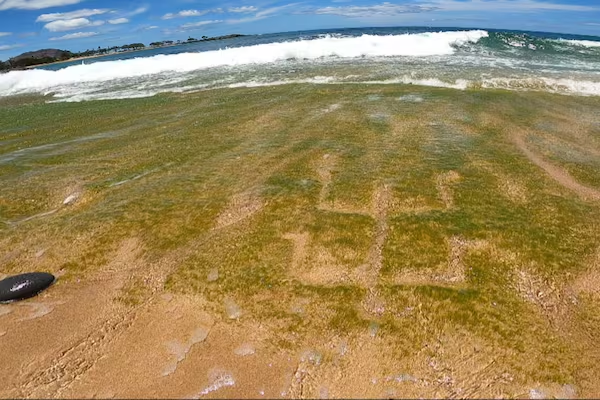
Recently uncovered along a public beach near Waianae on Oahu’s west coast, these petroglyphs—estimated to be at least 500 years old—offer a striking glimpse into Hawaii’s deep-rooted ancestral heritage. Archaeologists have identified 26 distinct carvings, most of them anthropomorphic stick figures, some with clearly defined genitalia, carved into a 115-foot sandstone panel.
This rare exposure is the first full-panel appearance since 2016, when a series of storms and ocean swells temporarily revealed them. Since then, portions of the carvings have occasionally emerged, but this is the first summer in nearly a decade where the full stretch is visible again.
Petroglyphs like these are historically crucial. They function as records of rituals, migrations, and everyday life—essentially the storytelling canvas of Native Hawaiians long before written language arrived. Their artistic simplicity masks layers of cultural and spiritual symbolism.
How did these ancient carvings resurface now?
The carvings are typically buried under coastal sand. But recent low-pressure weather systems in the eastern Pacific, active between May and November, have stirred up ocean swells powerful enough to strip the sand from the beach and expose the sandstone layer.
During low tide, the petroglyphs are best viewed, especially when gentle waves slide across the neon-green algae growing on the rock, enhancing contrast and visibility. According to the U.S. Army’s archaeological report, this natural phenomenon is likely cyclical and influenced by climate patterns, rising sea levels, and coastal erosion.
In 2016, a similar resurfacing followed hurricanes and strong spring storms, hinting that changing weather behavior may now be playing a recurring role.
What do experts and locals believe the petroglyphs are telling us?
For Glen Kila, a Native Hawaiian cultural practitioner and recognized expert on Waianae history, the timing of the petroglyphs’ return is no coincidence.
“It’s telling the community that the ocean is rising,” he said.
Kila interprets the images not just as historical relics but as living messages from ancestors. One of the largest figures, with arms in a sunrise/sunset position, is seen as symbolic of natural cycles and celestial ceremonies.
His belief underscores a deeper cultural view—these petroglyphs are more than art; they are warnings, lessons, and reminders passed down through stone.
What challenges come with protecting these petroglyphs?
The petroglyphs lie within a publicly accessible beachscape adjacent to a U.S. Army recreation center, itself built on former Native Hawaiian lands seized in the 1930s. Since their rediscovery, the Army has worked closely with Kila and local experts to balance public access and cultural preservation.
According to archaeologist Laura Gilda of the U.S. Army Garrison Hawaii, the key challenge is awareness without exploitation:
“How much attention do you want to bring to this area? You don’t really want people to go digging for them when they’re not exposed,” she warned.
The Army is reportedly assessing protective measures, including signage, public education campaigns, and increased monitoring during periods of visibility.
Why do these petroglyphs evoke such deep emotion in locals?
For many Native Hawaiians, the resurfacing of these carvings is more than a visual curiosity—it’s a validation of their presence, culture, and resilience.
Donald Kaulia, a local who grew up in Waianae, said seeing the carvings felt like “validation that our ancestors were from here.” The moment was personal, reflective, and symbolic of an ongoing struggle to reclaim cultural identity.
Kila also recalled his family’s resistance to displacement during the military’s takeover nearly a century ago. His great-great-grandmother remained near the bay after his family traded inland property to stay connected to the coast.
Despite experiencing military exclusion—he remembers being shoved off a seawall by police as a child—Kila said:
“We never fostered any hatred for the military because one day we believed that the land will eventually return to us.”
That spirit of peaceful reclamation is what now informs his work with the Army, which he says represents a meaningful shift in relations.
What can we learn from these ancient carvings today?
The Hawaiian petroglyphs of Oahu serve not just as archaeological artifacts but as mirrors of cultural endurance, environmental awareness, and historical continuity.
They remind us that:
- Cultural stories live in landscapes, not just in books.
- Nature and history are deeply intertwined—as rising tides expose more of the past, they also warn us of the future.
- Preserving heritage requires cooperation, especially in shared spaces like military-run recreational areas on ancestral lands.
As climate change reshapes coastlines and the sands continue to shift, these stone-etched stories will likely appear and disappear again. Whether we choose to listen to them—carved into the Earth—is up to us.