
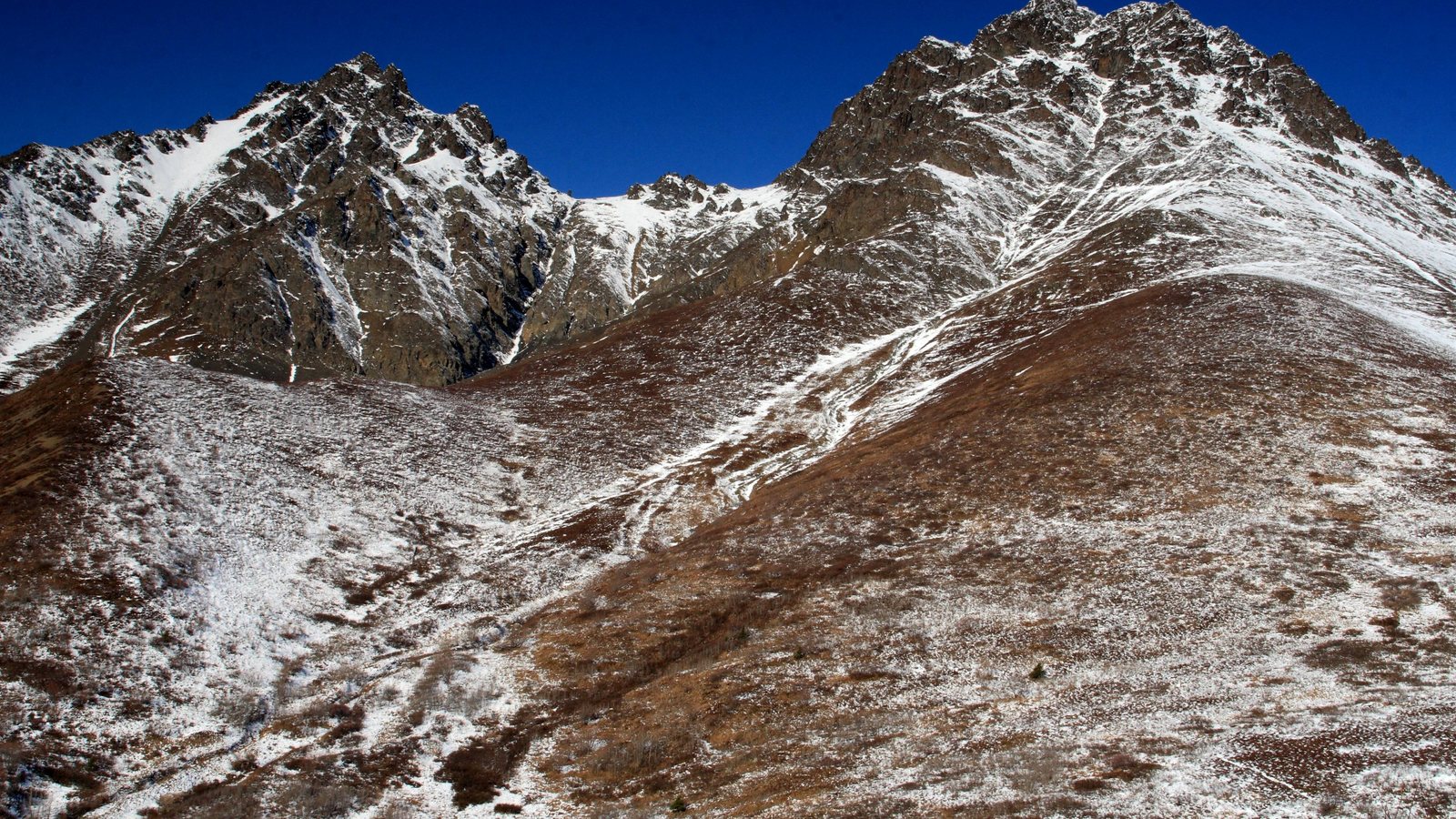

A four-year-old huskydoodle named LouLou was found alive about 50 hours after an Alaska avalanche on Oct. 10 swept away the two men she was hiking with. The slide hit north of Eklutna Lake in Chugach State Park, and it left both climbers with broken bones.
LouLou’s story has been everywhere since, mostly framed as an AirTag saving a dog. The fuller version is more useful. The tracker on her collar didn’t pinpoint her for two days, because of how AirTags work. And the slide itself was a reminder that thin October snow can still avalanche.
What happened north of Eklutna Lake on Oct. 10
LouLou was with Brian Shum, the boyfriend of her owner Lauren Padawer, and his climbing partner Rachad Rayess. They were hiking through snow only about five inches deep, Padawer told Alaska Public Media. A wind-loaded pocket of snow above them released and carried them through about 500 feet of rocky terrain.
Shum broke his jaw and later needed surgery on one hand. Rayess broke three ribs and damaged a vertebra, Padawer said.
“I think that they were really banged up,” Padawer told Alaska Public Media. “They knew that they needed help and that it wasn’t time to focus on the dog.”
Alaska State Troopers asked the Alaska Rescue Coordination Center for help, according to an Alaska National Guard release. An Air National Guard HH-60W helicopter flew to the site, about 30 miles northeast of Anchorage. Pararescuemen stabilized the two men and flew them to Providence Alaska Medical Center. The crew was there to save the men and didn’t see LouLou, Alaska Public Media reported.
Why LouLou’s AirTag couldn’t find her at first
Padawer was overseas for her father’s 80th birthday when she learned of the slide on Facebook, she told PEOPLE. LouLou had an Apple AirTag on her collar. But its first location estimate was off by nearly half a mile.
“In the rugged Chugach Mountains, half a mile can mean an entirely different ridge, drainage, or mountainside,” Padawer wrote on Facebook, as quoted by PEOPLE.
That gap comes from how the device works. An AirTag has no GPS. It sends out a Bluetooth signal that nearby iPhones, iPads and Macs pick up and relay to iCloud, Apple explains.
On a city street that happens constantly. On a snowy ridge with nobody around, the location only refreshes when someone carrying an Apple device gets close.
That’s what happened here. Padawer gave two volunteer pilots access to the tracker, and it updated when their helicopter got close, Alaska Public Media reported. Meanwhile she compared the coordinates with satellite imagery and mapping apps from abroad.
“I found the same patch of snow and the same shadow of a ridge and the same gully and the same line of a drainage,” she told Alaska Public Media.
How two pilots spotted LouLou
At least 20 people offered to help, Padawer said. Bad weather turned back many who reached the ridge area near Pepper Peak, she told Alaska’s News Source. Two days after the slide, one team was readying a scent-detection dog and another a thermal-imaging drone.
The private helicopter got there first. Dave Beckett was flying his red Robinson R44, with his friend Amanda Barker on board.
“Some fresh snow had fallen the night before, and we saw paw prints. So we followed the paw prints, and there she was, just waiting,” Barker told Alaska Public Media.
Beckett landed nearby, and LouLou stayed put. “She patiently waited for us. She did make us come all the way up to her. We had to hike a couple hundred feet up to her,” Barker said.
They put a black puffy coat on her, flew her to Beckett’s home in Wasilla and took her to a veterinarian. Padawer called them “the heroes of LouLou’s rescue” in her interview with PEOPLE. She and LouLou were reunited on Oct. 14.
How did LouLou survive two nights alone?
Nobody has a full answer, and nobody has claimed one. The tracker data offers a clue. Padawer and Barker said it looked as if LouLou followed the men’s slide path down to where the Guard picked them up. She then walked back up to where the avalanche started and waited there, Alaska Public Media reported.
Padawer believes the dog’s coat and habits helped. LouLou likes to sleep outside and is a seasoned backcountry ski companion, she told PEOPLE. “I think she’s just built for cold… she’s got a soft downy undercoat and thick curly guard hairs,” she said.
LouLou didn’t come through untouched. “She appears to have broken a toe and a canine tooth. She’s enjoying the couch and naps. Otherwise back to normal,” Padawer told PEOPLE.
Alaska Public Media described the injuries as a chipped tooth and a broken toenail.
Dogs usually appear in disaster stories as the rescuers, like the Border Collie named Tsunami that helped find 13 survivors after Venezuela’s earthquakes. Here the roles flipped, and strangers spent two days searching for a dog.
Why five inches of October snow was enough
The detail that should worry hikers is how little snow there was. “There was no logic behind what happened. I mean, there was barely any snow where they were,” Padawer told Alaska’s News Source.
Thin snow can still fail when wind piles it into a slab, which is what Padawer described. With so little cover, the slide carried the men over rock, and the broken bones fit that. Last year we reported on another Alaska backcountry rescue, of a Seward man pinned by a 700-pound boulder in an icy creek.
In the Guard’s release on the rescue, Graham Predeger of the Chugach National Forest Avalanche Center warned that the season has started. “It’s avalanche season in Alaska,” he said. He advised carrying a beacon, shovel and probe, traveling with a partner and telling someone your plans. The rescue coordination center urged people to carry a personal locator beacon as part of a communication plan.
Padawer has said both men are expected to make a full recovery, SnowBrains reported. The avalanche center holds its annual Southcentral Alaska Avalanche Workshop at Hilltop Ski Area in Anchorage on Nov. 13, according to its website.