
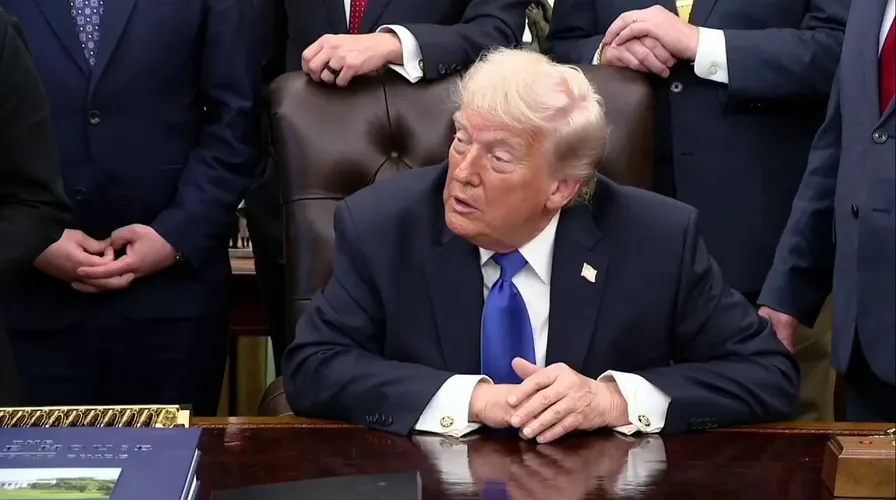
US President Donald Trump brushed aside speculation that he wore a bulletproof vest following the recent shooting incident tied to the White House Correspondents’ Dinner, joking that he did not want to look “20 pounds heavier” while acknowledging that security concerns around the presidency remain very real.
The remarks came days after authorities said a gunman allegedly attempted to target the president during events surrounding the annual White House Correspondents’ Dinner in Washington, D.C., triggering evacuations and a massive federal investigation.
Speaking to reporters on Thursday, Trump mixed humor with criticism of the event venue’s security setup while insisting he does not spend much time thinking about the possibility of another assassination attempt.
What Trump said about the bulletproof vest speculation
Trump was asked directly about reports and online speculation suggesting he may have worn additional protective gear after the attack scare.
He responded with characteristic sarcasm.
“I don’t know if I can handle looking 20 pounds heavier,” Trump said, drawing laughs as he referenced the bulky appearance often associated with protective vests.
He continued by joking about security personnel who routinely wear body armor.
“These guys, they look so… some of these guys are physical specimens,” he said.
While Trump acknowledged that enhanced protection is something officials discuss after a security incident, he suggested he dislikes the symbolism of appearing overly guarded.
“I guess it’s something you consider,” Trump said. “In one way, you don’t like to do it because you’re giving in to a bad element.”
The comments reflected a balancing act Trump has maintained throughout his political career: projecting confidence and resilience while operating under increasingly intense security threats.
The White House dinner attack has intensified security concerns
The controversy stems from last weekend’s shooting incident connected to the White House Correspondents’ Dinner, one of Washington’s highest-profile annual political gatherings.
According to federal officials, the suspect, identified as Cole Allen, allegedly attempted to assassinate the president during events surrounding the dinner at the Washington Hilton hotel.
Trump was not injured during the incident, and senior US officials were evacuated safely.
Authorities have since treated the case as a major federal investigation involving the Secret Service, FBI, and federal prosecutors.
Newly released footage adds to the investigation
Jeanine Ferris Pirro on Thursday released video footage tied to the investigation.
In a public statement posted on X, Pirro said the footage showed Allen shooting a US Secret Service officer during what prosecutors describe as an assassination attempt.
According to Pirro, investigators also recovered footage allegedly showing the suspect surveying the Washington Hilton the day before the attack.
That detail is significant because prosecutors appear to be building a case that the incident was planned rather than spontaneous.
Pirro also pushed back against online speculation surrounding the shooting.
“There is no evidence the shooting was the result of friendly fire,” she said.
Federal investigators say the probe remains ongoing.
Trump criticizes security at the Washington Hilton
During his remarks, Trump also questioned whether the Washington Hilton was sufficiently secure for an event involving the president and other top political leaders.
He suggested the hotel lacked the type of hardened security environment typically associated with presidential events.
The criticism is likely to fuel renewed debate about how public venues handle major political gatherings in an era of rising political violence and assassination threats.
Why the White House Correspondents’ Dinner matters politically
The White House Correspondents’ Dinner is more than a media gala.
The annual event traditionally brings together the following:
- The president
- Senior administration officials
- Journalists
- Celebrities
- Diplomats
- Political insiders
Because of the concentration of high-profile attendees, the event requires an enormous security operation involving multiple federal agencies.
Any breach or attempted attack instantly becomes a national security issue.
Trump says he avoids thinking about assassination threats
When reporters asked whether he felt nervous after the incident, Trump dismissed the idea that he spends much time dwelling on potential attacks.
“I don’t think about it,” he said.
The response aligns with Trump’s long-standing public image of projecting toughness under pressure, particularly after surviving previous assassination attempts and security scares during his political career.
Still, the latest incident underscores how dramatically the threat environment surrounding American political leaders has changed in recent years.
Political violence and presidential security are under renewed scrutiny
The alleged attack has reignited concerns about political extremism, security failures, and the increasing frequency of threats targeting public officials in the United States.
Presidents already operate within one of the world’s most sophisticated security systems, but public appearances continue to pose unique risks.
Why public events remain difficult to secure
Even with extensive planning, large events create vulnerabilities because they involve:
- Massive crowds
- Multiple access points
- Hotel staff and contractors
- Public-facing venues
- Media movement
- Real-time schedule changes
Security experts often describe hotels and convention venues as especially challenging environments compared to government facilities.
Trump’s comments criticizing the Washington Hilton may lead to questions about whether future correspondents’ dinners or similar political events will face tighter restrictions.
What happens next in the Cole Allen investigation?
Federal authorities say the investigation remains active.
Prosecutors are expected to focus on:
- The suspect’s movements before the attack
- Possible motives
- Weapons acquisition
- Security breaches
- Digital evidence and communications
- Whether others assisted in planning
The FBI and federal prosecutors have signaled they intend to pursue the case aggressively.
Why Trump’s remarks resonated online
Trump’s “20 pounds heavier” comment quickly spread online because it blended humor with a very real backdrop of political violence.
For supporters, the remark reinforced his image as defiant and unshaken.
Critics, meanwhile, viewed the comments as another example of Trump using humor to dominate the news cycle even during serious moments.
Either way, the exchange highlighted how modern presidential politics increasingly unfolds at the intersection of security threats, media spectacle, and viral moments.