
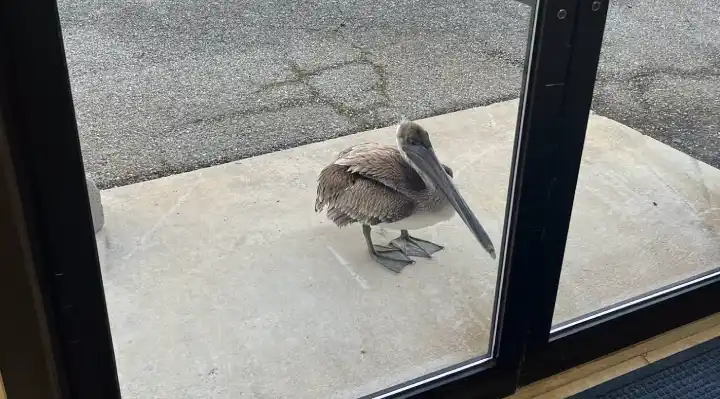
Scientists at a marine research facility in Florida were in for an unexpected surprise when an injured brown pelican appeared to knock on their door, seemingly seeking help.
The incident occurred on September 8 at a National Oceanic and Atmospheric Administration (NOAA) facility in Panama City. A researcher heard a knocking sound at the building’s back door and went to investigate.
Outside, she found a brown pelican pecking at the glass with its beak. The bird remained there as though waiting for someone to respond. When researchers examined it, they discovered that it was carrying several injuries, including a fishing hook lodged in its right wing.
The unusual encounter left the scientists surprised and raised an intriguing question: Had the pelican deliberately approached humans for assistance, or was it simply looking for food?
What Injuries Did the Pelican Have?
When researchers inspected the bird, they found that it had become entangled in fishing equipment and had sustained additional injuries.
The pelican had:
- Fishing line wrapped around its right wing.
- A double-barbed treble hook embedded in the wing.
- Nearly a dozen cactus spines lodged in its left foot.
The fishing line was approximately six feet long, making it a substantial obstacle for the injured bird.
A research associate at the facility estimated that the pelican may have walked roughly half a kilometer to reach the building.
Researchers Were Surprised by the Bird’s Arrival
Annsli Hilton, a research associate at the facility, told The Washington Post that she initially assumed another researcher had brought the pelican inside.
She said she had heard colleagues talking about the bird and believed someone must have found it and carried it to the laboratory.
Hilton was surprised to learn that the pelican had apparently arrived on its own.
She said she had often wondered whether animals in need of help might approach humans, but had never expected to witness such an encounter herself.
How Did Scientists Treat the Injured Pelican?
The researchers at the facility primarily study fish and sharks rather than treating injured pelicans.
Nevertheless, they worked together to remove the fishing equipment and cactus spines.
One researcher carefully held the bird’s beak to reduce the risk of being bitten while the others worked on its injuries.
The treatment involved several steps:
- Removing the fishing line: Researchers used scissors to cut away the line wrapped around the pelican’s wing.
- Extracting the hook: Wire cutters were used to remove the treble hook lodged in the wing.
- Removing the barbs: Forceps helped the researchers extract the small barbs and cactus spines.
Hilton said she had never treated a pelican before. However, she drew on her experience inserting tags into smalltooth sawfish to help remove the foreign objects.
Although the procedure took approximately five minutes, the researchers felt that the tense encounter lasted much longer.
After the treatment, the pelican was taken back to the basin, where it flew away.
Why Did the Pelican Approach the Research Facility?
The bird’s arrival has prompted questions about whether it understood that humans could help it.
The laboratory is gated from the road, and researchers were confident that no one had carried the pelican to the building.
However, scientists have not established exactly why the bird approached the door.
Gerald Hough, a Rowan University professor who studies bird behavior, offered a possible explanation in comments to The Washington Post.
He suggested that the pelican may have observed researchers carrying fish in and out of the facility and associated the building with a potential food source.
Could the Pelican Have Mistaken Its Reflection for Another Bird?
Hough also suggested that the pelican may have mistaken its reflection in the glass door for another bird.
If that happened, the bird might have approached the glass because it perceived the reflection as another pelican rather than recognizing the door as an entrance.
This possibility could help explain the pecking behavior without requiring the bird to have understood how to request human assistance.
However, it remains a hypothesis rather than a confirmed explanation for the encounter.
What Does the Incident Tell Us About Animal Behavior?
The encounter is a reminder that animal behavior can sometimes appear surprisingly purposeful to human observers.
Wild animals may approach people or buildings for different reasons, including food, shelter, curiosity or responses to their surroundings.
In this case, the pelican’s injuries and its arrival at a research facility created the impression that it was deliberately asking for help.
But the available information does not establish that the bird understood the researchers could treat it or that it intentionally sought medical assistance.
The distinction is important: an animal’s behavior can lead it to a place where humans provide help without necessarily demonstrating that it understands the human concept of rescue.
A Brief Encounter With a Happy Ending
Despite the uncertainty surrounding the pelican’s intentions, the encounter ended with the bird receiving treatment and flying away.
The researchers’ response allowed them to remove the fishing equipment and cactus spines that had injured it.
The incident also highlights the potential dangers discarded fishing gear can pose to wildlife. Fishing lines and hooks can entangle birds and other animals, sometimes leaving them unable to move or feed normally.
For the scientists in Panama City, what began as an unexpected knock at the door became a memorable wildlife encounter.
Whether the pelican was searching for food, reacting to its reflection or seeking help remains unclear. What is known is that the injured bird reached the facility, received assistance and was able to fly away afterward.