Jeff Bezos has called plenty of business decisions mistakes over the years. He once compared a $50 million bet on the failed startup Pets.com to a root canal with no anesthesia. But according to a forthcoming book, none of his prior flops compare to how he now feels about owning The Washington Post.
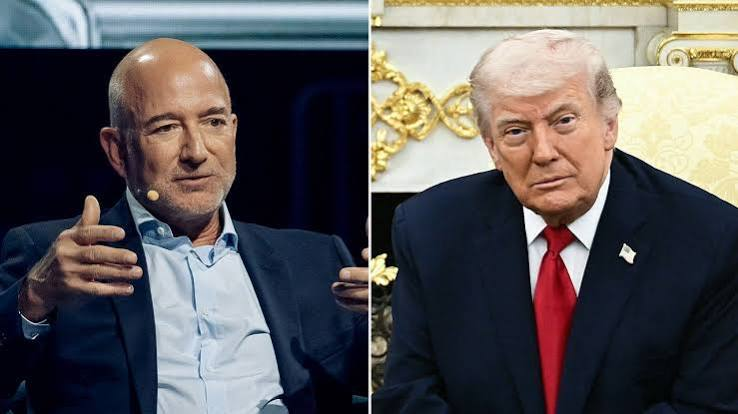
At a December 2024 dinner with then-President-elect Donald Trump, Bezos reportedly vented about the paper’s leadership in blunt terms: “The people there are terrible. They don’t listen. My other companies, they listen.” Two months later, the paper’s opinion section was overturned. A year after that, nearly 300 journalists lost their jobs.
The claims come from “Regime Change: Inside the Imperial Presidency of Donald Trump,” a book by New York Times reporters Jonathan Swan and Maggie Haberman set for release on June 23. The New York Post obtained an early excerpt, and the details add a new layer to a Washington Post saga that’s already reshaped one of America’s most storied newsrooms.
What Did Bezos Tell Trump About The Washington Post?
The dinner took place a month before Trump’s second inauguration, at a moment when several tech billionaires were openly courting the incoming administration. Bezos used the conversation to air a specific grievance: the people running the Post’s business operations, in his view, simply weren’t listening to him.
“The people there are terrible,” Bezos reportedly said, contrasting the paper with Amazon and Blue Origin. “They don’t listen. My other companies, they listen.”
That framing matters. According to reporting on the book’s excerpt, Bezos’s complaint was aimed primarily at the business side of the paper rather than the newsroom itself — the executives responsible for turning around a publication that lost more than $100 million in 2024, on top of a $77 million loss the year before.
Trump, for his part, used the same dinner to raise his own long-running complaint about the Post’s coverage of him. “This Washington Post is really unfair,” he reportedly told Bezos. “You’ve got to take better care.” The book suggests the two men left the dinner having found common ground — for very different reasons.
Why Was Bezos So Frustrated With His Own Newspaper?
Bezos bought The Washington Post for $250 million in 2013, promising to give it the “runway” to experiment and grow. Twelve years later, by his own account to Trump, the paper had become his biggest regret.
The financial picture explains part of it. Digital subscriptions have been sliding industry-wide as readers shift to social platforms and AI search summaries, and the Post hasn’t been immune. A newsroom that once prided itself on aggressive, well-funded investigative journalism was now bleeding nine figures a year.
There’s also a more personal layer, according to the book’s authors. Trump’s version of events has Bezos saying he’d lost half his friends over the Post investment. Bezos reportedly tells a different story to others — he didn’t lose friends, but people close to him had been urging him for some time to just sell the paper.
Trump’s Side of the Grudge
The book also reportedly captures how Trump’s view of Bezos shifted over time. During Trump’s first term, he believed Bezos was personally steering negative Post coverage of him. “I didn’t believe him the first time, first term,” Trump is quoted as saying of denials he heard back then. “And I hated him for it.” By the December 2024 dinner, that hostility had visibly cooled.
How Did the Kamala Harris Endorsement Block Set the Stage?
The December dinner didn’t happen in a vacuum. Weeks earlier, the Post’s editorial board had drafted an endorsement of Kamala Harris for president — standard practice for a paper that had endorsed a candidate in nearly every election since 1976.
Bezos personally blocked it from running, just over a week before Election Day. The paper then announced it would stop endorsing presidential candidates altogether, a move executives framed as a return to neutrality.
Readers didn’t see it that way. Within days:
- More than 250,000 subscribers canceled, according to NPR and the New York Post — roughly 10% of the paper’s paid circulation.
- Three of nine editorial board members resigned.
- Several columnists publicly quit in protest.
- Former executive editor Marty Baron called the timing “craven.”
Bezos later wrote an op-ed defending the decision as principled, while admitting the timing was “inadequate planning, and not some intentional strategy.” It did little to stop the bleeding.
What Happened To Washington Post Staff After The Dinner?
This is where the timeline in some retellings gets compressed, so it’s worth laying out precisely. Two distinct events followed that December dinner — not one.
February 2025 — the opinion section overhaul. About two months after the Trump dinner, Bezos announced in a memo, shared on X, that the opinion pages would write “every day in support and defense of two pillars: personal liberties and free markets.” Opinion editor David Shipley resigned rather than lead the new direction.
February 2026 — the mass layoffs. A full year after that, citing the mounting financial losses, the Post laid off close to 300 of its roughly 800 journalists — about a third of the newsroom. The cuts gutted the sports desk, eliminated the staff photography team, and hollowed out the foreign desk, including the paper’s entire Middle East roster and its Kyiv-based Ukraine correspondent.
Neither Bezos nor then-CEO Will Lewis attended the staff meeting where the cuts were announced; that task fell to executive editor Matt Murray. Days later, Lewis resigned, replaced on an acting basis by chief financial officer Jeff D’Onofrio. By that point, NPR reported, the paper had lost more than 375,000 digital subscribers — about 15% of its base — since the endorsement controversy began.
Why Does This Story Matter Beyond One Newsroom?
The Washington Post isn’t the only legacy paper navigating a billionaire owner’s preferences. The Los Angeles Times, owned by Patrick Soon-Shiong, made a similar non-endorsement call in October 2024 and lost subscribers of its own.
The pattern raises a question that extends well past Bezos: what happens to a news organization’s credibility when its owner’s business relationships — government contracts, regulatory exposure, political access — start to shape what gets published, or what doesn’t?
For readers, the practical effect has been straightforward. Hundreds of thousands of people canceled subscriptions specifically because they felt the paper’s independence had been compromised. That’s a measurable trust cost, not just an abstract one.
For the industry, it’s another data point in a rough stretch for print journalism generally, as outlets across the country contend with falling ad revenue and shrinking newsroom budgets.
What Comes Next For Bezos and The Washington Post?
“Regime Change” hits shelves on June 23, and its account of the December 2024 dinner is likely just one of several Bezos-Trump anecdotes that surface once the full book is out. A Washington Post spokesperson has so far declined to comment on Bezos’s reported remarks about the staff.
Inside the paper, the open questions are more practical. D’Onofrio’s “acting” title leaves the top job unsettled. The Washington Post Guild has publicly called on Bezos to either reinvest in the paper or sell it to someone who will. Whether Bezos does either is, for now, anyone’s guess — though if the book’s account is accurate, he’s already told the sitting president exactly how he feels about the investment.
TL;DR
- Bezos reportedly told Trump in December 2024 that buying The Washington Post was his worst investment, complaining that the paper’s leadership “don’t listen.”
- The remark came two months after Bezos blocked a Kamala Harris endorsement, a decision that cost the paper hundreds of thousands of subscribers.
- Two months after the dinner, Bezos overhauled the opinion section to focus on “personal liberties and free markets,” prompting the opinion editor’s resignation.
- A full year later, in February 2026, the paper laid off roughly 300 of its 800 journalists. CEO Will Lewis resigned days after.
- The episode has become a case study in what happens when a billionaire owner’s business interests collide with a newsroom’s editorial independence.