
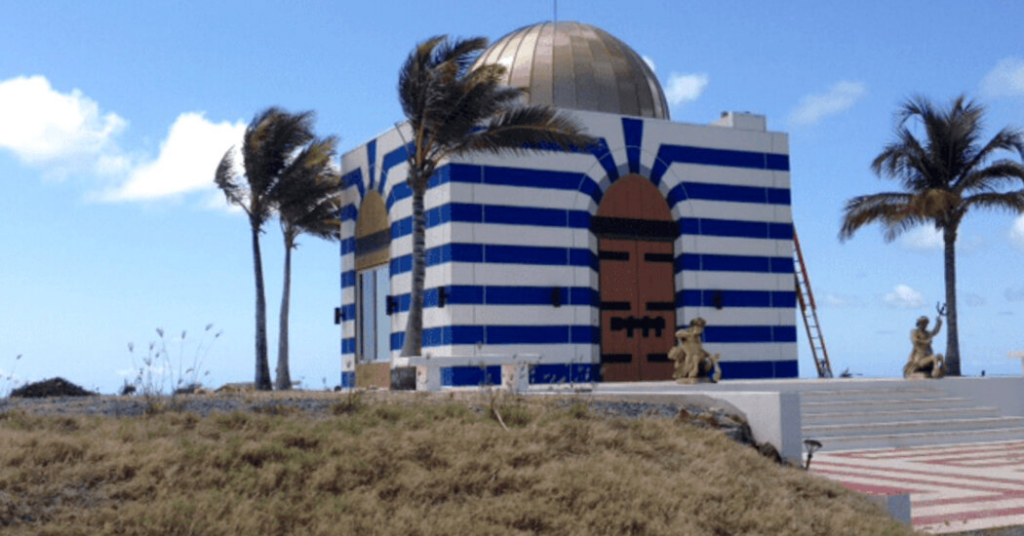
Freshly released records have added another unusual chapter to the long-running scrutiny of Jeffrey Epstein. The documents describe his efforts to build a structure on his private Caribbean island, one he reportedly referred to as a “mosque,” and to source rare Islamic artifacts from across the Middle East.
The revelations are striking. But they also require careful reading. Here’s what the documents say, what they don’t, and why this story is drawing renewed attention.
What Do the Documents Reveal About Epstein’s “Mosque”?
According to records released by the United States Department of Justice, Epstein oversaw the construction of a distinctive building on Little Saint James, his private island.
The structure:
- Featured blue-and-white striping and a gold dome
- Was previously described as a pavilion, chapel, or music room
- Was referred to by Epstein himself as a “mosque” in correspondence
Was It Actually a Mosque?
That remains unclear.
The documents suggest:
- The building incorporated Islamic design elements
- Epstein used the term “mosque” informally in emails
- There is no confirmed evidence it functioned as a religious site
This distinction matters. Aesthetic inspiration is not the same as religious purpose.
What Islamic Artifacts Were Involved?
One of the most controversial elements in the documents is Epstein’s acquisition of religious and cultural artifacts.
Reported items include:
- Tapestries embroidered with Quranic verses
- Tiles sourced from a mosque in Uzbekistan
- Pieces linked to the Kaaba, including parts of the Kiswa cloth
Why This Raises Questions
These items are not decorative curiosities—they carry deep religious significance.
Key concerns include the following:
- Provenance: It’s unclear how these artifacts were obtained
- Legitimacy: Whether their transfer complied with cultural heritage laws
- Intent: Why Epstein sought such items for a private island structure
What Do the Documents Say About Epstein’s Global Connections?
The records also point to Epstein’s attempts to expand his influence internationally.
Reported activities include:
- Building connections across Middle Eastern political and business circles
- Facilitating introductions related to defense and security discussions
- Seeking meetings with high-level figures, including Mohammed bin Salman
At one point, Epstein reportedly pitched unconventional financial ideas, including a proposed currency concept tied to Islamic finance.
Did Any Deals Materialize?
There is no confirmed evidence that these efforts resulted in formal agreements.
Instead, the documents suggest:
- Ongoing networking and outreach
- Attempts to position himself as an advisor
- Limited success in securing lasting partnerships
How Did the “Mosque” Idea Evolve?
The concept for the island structure changed over time.
Early plans reportedly included:
- A Turkish-style bathhouse (hammam)
- Gardens inspired by Islamic architecture
- Interior designs modeled on mosques
Later, Epstein appears to have:
- Expanded the design concept
- Customized religious motifs
- Proposed replacing traditional Arabic script with his own initials
This blending of cultural symbolism with personal branding has drawn criticism and raised ethical questions.
Why Is This Story Resurfacing Now?
The timing is tied to newly released documents, which provide the following:
- Greater detail on Epstein’s activities
- Direct excerpts from correspondence
- Visual evidence of the structure
These records offer a more complete picture, but not a definitive explanation.
What Questions Still Remain?
Despite the new information, several key issues are unresolved:
1. What Was the Building’s True Purpose?
Was it:
- A personal architectural project?
- A symbolic statement?
- Or something else entirely?
No clear answer has been confirmed.
2. How Were the Artifacts Obtained?
The documents do not fully explain:
- Ownership history
- Transfer legality
- Whether proper permissions were granted
3. What Was the End Goal of Epstein’s Middle East Outreach?
While connections were made, the broader strategy remains unclear:
- Financial ambition?
- Political influence?
- Personal interest in the region?
Why This Matters Beyond Epstein
This story touches on broader issues that extend beyond one individual.
Cultural Heritage Protection
The movement of religious artifacts raises concerns about:
- Preservation
- Ownership rights
- Ethical acquisition
Influence Networks
Epstein’s outreach highlights how private individuals can:
- Attempt to access high-level political circles
- Position themselves in sensitive geopolitical spaces
Information Gaps and Public Speculation
When details are incomplete, narratives can quickly shift from facts to assumptions.
Responsible reporting requires:
- Clear distinction between evidence and interpretation
- Avoiding conclusions not supported by documentation
TL;DR
- New documents detail Jeffrey Epstein’s plans for a structure he called a “mosque”
- The building incorporated Islamic design but may not have served a religious function
- Artifacts linked to the Kaaba were reportedly acquired
- Epstein sought connections with Middle Eastern leaders, including Mohammed bin Salman
- Key questions about intent, legality, and purpose remain unanswered