
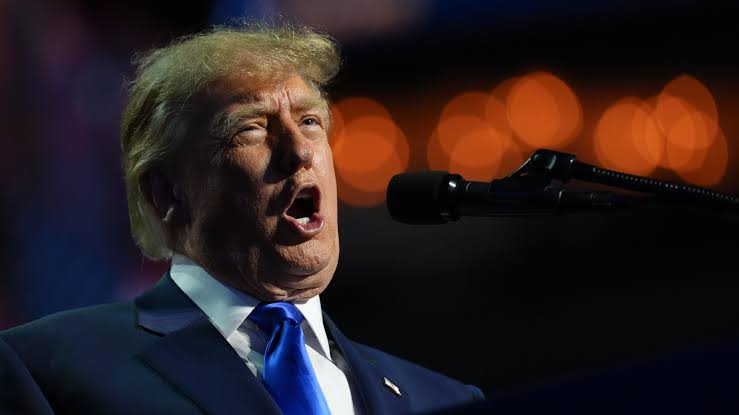
US President Donald Trump used the opening night of the Republican Party’s first-ever midterm convention to do far more than rally his party ahead of the November 3 elections.
In a nearly two-hour speech on Wednesday, September 9, Trump put himself at the center of the 2026 midterm contest, urging voters to treat the election as though his own name were on the ballot. He attacked Democrats and former presidents Joe Biden and Barack Obama, promoted his administration’s record on Iran and previewed an aggressive campaign schedule.
Trump also made one of the speech’s biggest promises: a proposed $5,000 payment to every adult US citizen if Republicans win control of both chambers of Congress. He called for the payment to be known as the “Trump Dividend” and said it should be spent inside the United States.
The speech came as Republicans seek to protect their congressional majorities in the November elections, making Trump’s role potentially decisive in some of the country’s most competitive races.
What were the biggest points from Trump’s Republican midterm convention speech?
Trump’s address combined campaign messaging, foreign policy claims, attacks on political opponents and promises aimed directly at voters.
The most significant moments included:
- A proposed $5,000 “Trump Dividend” for adult Americans if Republicans win the House and Senate.
- A call for voters to “pretend” Trump himself is on the ballot.
- A pledge to campaign heavily in competitive congressional races.
- A prediction that the Iran war would end shortly after the midterm elections.
- A forecast that oil prices would eventually decline.
- New suggestions for renaming major geographic landmarks.
- An endorsement of Texas Senate candidate Ken Paxton despite mocking his appearance.
- Attacks on Michigan Democratic Senate nominee Abdul El-Sayed.
- A tribute to conservative activist Charlie Kirk.
- An unexpected appearance by Democratic Sen. John Fetterman backing Republican Sen. Dave McCormick.
What is Trump’s proposed $5,000 “Trump Dividend”?
The most attention-grabbing economic proposal came when Trump promised a $5,000 payment to every adult US citizen if Republicans win control of both the House of Representatives and Senate.
“Only I can make this promise to you,” Trump said while outlining the proposal, according to the speech details provided.
Trump also suggested that the payment should carry his name, calling it the “Trump Dividend.”
The president added an important condition: recipients would have to spend the money in the United States rather than taking it across the border.
Why does the $5,000 dividend matter?
The proposal could become a powerful campaign message because it connects control of Congress to a direct financial benefit for voters.
However, the announcement raises major questions that cannot be answered by the speech alone:
- How would the payments be funded?
- Who would qualify as an “adult citizen”?
- Would Congress need to authorize the program?
- Would the payment be taxable?
- How much would the program cost the federal government?
- Would restrictions on where the money could be spent be legally and practically enforceable?
For publication, these details should be checked against any subsequent White House proposal, congressional legislation or budget documents.
Why did Trump say “I am on the ballot”?
Trump made his personal political standing a central theme of the speech.
He urged Americans to “pretend” that he was on the ballot and framed the midterms as a referendum on his presidency and Republican control of Congress.
“Pretend that I’m on the ballot. I’m on the ballot. Just one more time.”
The message reflects Trump’s unusually direct involvement in the midterm campaign. Rather than allowing congressional candidates to run primarily on their own records, he is presenting the election as a broader choice between his political agenda and the Democratic Party.
Trump also told supporters that Republicans needed another chance to control Congress so his administration could continue pursuing its agenda.
Why is Trump putting himself at the center of the midterms?
Midterm elections traditionally function as a test of the sitting president’s popularity and political standing. The party controlling the White House frequently faces losses, particularly when voters use congressional elections to express dissatisfaction with the administration.
Trump’s strategy appears designed to turn that dynamic to his advantage by making Republican candidates part of a larger national campaign centered on his presidency.
The approach could energize his core supporters, but it also means Democratic attacks on Trump may have a direct effect on Republican candidates in competitive districts and states.
How extensive will Trump’s midterm campaign be?
Trump said he intends to campaign aggressively in the final stretch of the election.
He pointed to roughly 35 of the most competitive races and indicated that he would become a major presence in those contests.
That strategy could give Republican candidates access to Trump’s enormous political platform and loyal voter base.
But there is also a potential downside: candidates in politically competitive areas may want to emphasize local issues rather than national controversies surrounding the president.
Trump nevertheless made clear that he intends to play a direct role in determining which Republicans remain in Congress.
What did Trump say about the Iran war?
Foreign policy featured prominently in the speech, with Trump making a specific prediction about the war involving Iran.
He said the conflict would end shortly after the US midterm elections, describing the timing as immediately after the vote.
Trump did not provide a detailed explanation for why he expected the war to end on that schedule.
The statement is particularly significant because developments involving Iran can affect US military policy, energy markets, global shipping and the political environment surrounding the administration.
What did Trump say about oil prices?
Trump also addressed rising oil prices, which have become a major economic concern amid escalating tensions involving the United States and Iran.
Brent crude had moved above $100 a barrel, according to the information provided, as tensions intensified.
Trump said he expected prices to decline, although he acknowledged that the reduction could take longer than the midterm elections.
Oil prices are politically important because higher crude prices can feed into gasoline costs, transportation expenses and inflation across the wider economy.
For readers, the key distinction is between Trump’s prediction and an established market forecast. The two should not be treated as equivalent without supporting economic or market data.
Why did Trump talk about renaming the Strait of Hormuz?
Trump once again floated a striking proposal to rename the Strait of Hormuz the “Trump Strait.”
He joked that Iran’s leadership would presumably be pleased with the idea and said he would make an announcement.
Trump also referenced other geographic renaming efforts, including the administration’s use of “Gulf of America” for the Gulf of Mexico and “Lake America” for Lake Ontario.
He went even further by suggesting that New Mexico should be renamed “New America.”
The remarks fit a broader pattern of Trump’s use of symbolic naming as a political tool. Such proposals can generate attention well beyond their practical policy implications, particularly when they involve internationally recognized geographic names.
Why did Trump mock Ken Paxton before endorsing him?
Trump delivered an unusual endorsement of Texas Senate candidate Ken Paxton.
Before strongly backing Paxton, Trump mocked his appearance, clothing and speaking style. He then pivoted to praise Paxton as one of the country’s strongest attorneys general.
Trump urged Texas voters to elect Paxton to the Senate and said he would return to campaign for him if necessary.
The episode demonstrated Trump’s willingness to use blunt personal commentary even while endorsing a candidate, while also showing how strongly he is investing in individual Senate contests.
What did Trump say about Abdul El-Sayed?
Trump also targeted Abdul El-Sayed, the Democratic Senate nominee in Michigan.
During his speech, Trump made claims concerning El-Sayed’s family members and their alleged reactions to the October 7, 2023, Hamas attack on Israel. He also claimed that El-Sayed’s mother worked for an organization that provided money to Osama bin Laden.
These are serious allegations and should not be presented as established facts without independent verification.
Any published version should identify the specific organization involved, establish the nature and timing of any employment or association, and use primary documents or authoritative reporting to verify Trump’s claims.
How did Trump remember Charlie Kirk?
Trump also devoted part of the speech to remembering conservative activist Charlie Kirk, whose death Trump described as the result of an assassination by a far-left extremist.
The convention audience responded by chanting “Charlie, Charlie.”
Trump said Kirk had been killed because he “spoke the truth” and criticized people who, he claimed, had celebrated or excused the killing.
He also attempted to locate Kirk’s wife, Erika Kirk, in the audience.
The emotional segment allowed Trump to connect the midterm campaign to his broader argument that the political left poses a threat to conservative America.
Because the speech contains specific claims about a criminal killing and political reactions to it, those claims should be verified against law-enforcement records and reputable reporting before publication.
Why was John Fetterman’s appearance significant?
One of the night’s biggest surprises came from the Democratic Party.
Pennsylvania Democratic Sen. John Fetterman made an unscheduled, prerecorded 64-second video appearance supporting Republican Sen. Dave McCormick.
Fetterman’s message focused on Pennsylvania’s steel industry and regional jobs. He said he would work with Trump to defend what he described as the “steel way of life” in the Steel Valley.
The appearance was notable because Fetterman crossed party lines at a Republican political event to support a Republican colleague.
It also highlighted the importance of industrial jobs and manufacturing to Pennsylvania politics, where steel and trade policy remain politically powerful issues.
What does Trump’s speech mean for the 2026 midterms?
The speech offered a clear picture of Trump’s strategy: make the midterms a vote on Trump himself.
Rather than treating November’s contests as dozens of separate House and Senate races, Trump is attempting to nationalize them around a handful of themes:
- Republican control of Congress.
- Continuation of his policy agenda.
- Economic promises such as the proposed $5,000 dividend.
- His handling of Iran and energy prices.
- Opposition to Democrats and the Biden-Obama political legacy.
- Stronger Republican support for Trump-aligned candidates.
That strategy could help Republicans by motivating voters who remain strongly supportive of Trump. At the same time, it places Republican candidates directly inside the national debate over his presidency.
The outcome will ultimately depend on factors beyond Trump’s rallies, including candidate quality, local economic conditions, turnout, fundraising, congressional approval ratings and the political environment in individual states and districts.
TL;DR
Trump’s opening-night Republican midterm convention speech was effectively a campaign rally built around his presidency.
His most consequential announcement was a proposed $5,000 “Trump Dividend” for every adult US citizen if Republicans win both chambers of Congress, although the funding, eligibility and legal structure remain unclear.
He also urged voters to “pretend” he was on the ballot, promised to campaign in competitive races, predicted the Iran war would end after the midterms and forecast lower oil prices.
The speech also featured attacks on Democratic candidates, a controversial endorsement of Ken Paxton, a tribute to Charlie Kirk, and an unexpected endorsement of Republican Sen. Dave McCormick from Democratic Sen. John Fetterman.