
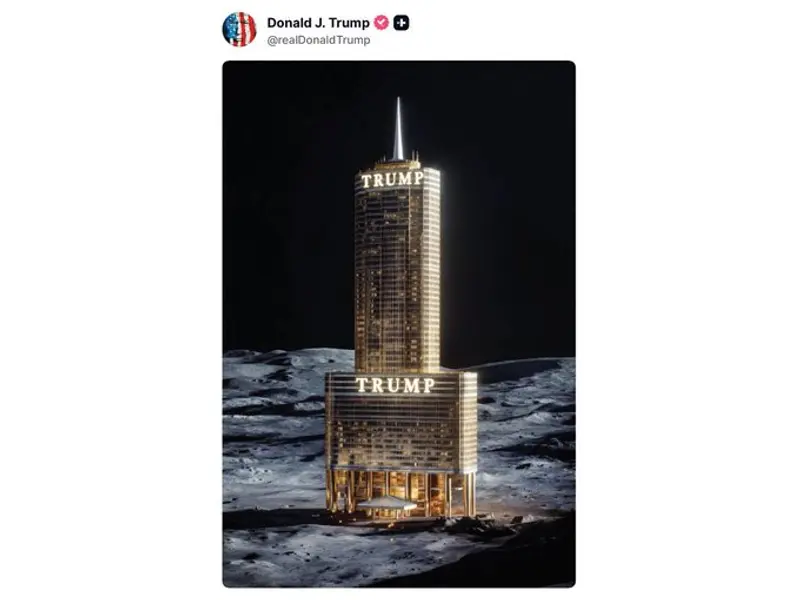
Within hours of posting an AI-generated image of a gold-plated skyscraper on the lunar surface, Donald Trump did what he often does best: spark a conversation that blends spectacle with speculation. The idea of a “Trump Tower on the Moon” is not a policy proposal. But it taps into a real question people are increasingly asking as space missions ramp up again: how close are we to building anything permanent on the Moon?
The short answer: not close. The long answer is more interesting.
What sparked the Trump Tower on the moon conversation?
The viral image appeared just days after Artemis II completed its crewed flyby, the first such mission since the Apollo era. That timing matters.
NASA’s Artemis program is designed to return humans to the Moon and establish a sustained presence. So while Trump’s image is clearly stylized and symbolic, it piggybacks on a moment when lunar ambitions are back in the headlines.
The image itself shows a gleaming, oversized tower stamped with “TRUMP,” standing improbably on gray regolith. It looks less like architecture and more like a branding exercise launched into orbit.
How realistic is a Trump Tower on the Moon?
Let’s ground this in physics and engineering.
Building a skyscraper on Earth is already a complex orchestration of materials, labor, logistics, and time. Transplant that challenge to the Moon, and every variable becomes exponentially harder.
Key barriers to lunar skyscrapers
- Material transport
- Every kilogram sent to the Moon costs tens of thousands of dollars
- A skyscraper would require millions of kilograms of material
- No construction ecosystem
- No cranes, no roads, no workforce infrastructure
- Everything must be shipped or built from scratch
- Extreme environment
- Temperature swings from -173°C to 127°C
- Constant radiation exposure due to a lack of atmosphere
- Micrometeorite impacts
- Low gravity complications
- The Moon’s gravity is about one-sixth of Earth’s
- Tall structures behave differently and may require entirely new engineering models
- Life support dependency
- Any structure must be airtight, shielded, and self-sustaining
- That makes vertical expansion far less practical than compact habitats
In simple terms, the Moon is not Manhattan with worse weather. It’s a fundamentally hostile environment where survival comes before skyline aesthetics.
What is NASA actually planning for the Moon?
NASA is not thinking about skyscrapers. It is thinking about survival, sustainability, and science.
Artemis roadmap (current trajectory)
- Artemis II (completed)
Crewed flyby of the Moon - Artemis III (planned)
First crewed landing of the Artemis era - Artemis IV and V (late 2020s)
Expanded missions, longer stays, and early infrastructure testing
These missions will rely on partnerships with private companies like SpaceX and Blue Origin to deliver cargo and astronauts.
What early lunar “buildings” will actually look like
Instead of towers, expect:
- Inflatable or modular habitats
- Structures partially buried under lunar soil for radiation shielding
- Low-profile designs that prioritize stability over height
Think bunker, not Burj Khalifa.
When could humans actually live on the Moon?
This is where timelines stretch.
Realistic phases of lunar presence
Phase 1: Short-term missions (now to ~2030)
Astronauts visit for days or weeks. No permanent presence.
Phase 2: Semi-permanent bases (~2030–2040)
Small crews rotate through habitats. Limited local resource use.
Phase 3: Early settlement (~2040–2070)
- Use of lunar ice for water and fuel
- Partial self-sufficiency
- Population still in the dozens, not thousands
Phase 4: True colony (post-2070)
- Closed-loop life support systems
- Local manufacturing
- Larger populations
Even in the most optimistic projections, we are decades away from anything resembling a “city,” let alone a skyline.
Why a skyscraper on the Moon makes little sense
Even if technology catches up, the question becomes, why build one?
Practical limitations
- No economic demand
There are no tenants, no commercial districts, no tourism at scale - Energy constraints
Power generation is limited and precious - Structural inefficiency
Vertical buildings are not ideal in low-gravity and high-risk environments - Better alternatives exist
Underground or shielded horizontal structures are safer and more efficient
A lunar skyscraper would be the architectural equivalent of wearing a tuxedo to a survival expedition.
Could private companies attempt something like this?
Private space firms are ambitious but also pragmatic.
Companies like SpaceX are focused on:
- Reducing launch costs
- Enabling cargo transport
- Supporting exploration missions
Even futuristic concepts like lunar hotels tend to favor compact, modular designs.
A gold-plated tower visible from orbit would be the following:
- Astronomically expensive
- Technically unnecessary
- Operationally risky
In other words, a branding triumph but an engineering nightmare.
The cultural appeal of “Moon real estate”
So why does the idea resonate?
Because it sits at the intersection of:
- Space ambition
- Wealth symbolism
- Sci-fi imagination
From classic films to modern billionaires, the Moon has always been framed as the “next frontier.” Trump’s post plays into that narrative, translating terrestrial luxury into extraterrestrial fantasy.
It’s less about construction and more about projection.
How long would a Trump Tower on the Moon actually take?
Let’s map it realistically:
- Basic human return to Moon: happening now
- Functional lunar base: 10 to 20 years
- Early settlement: 20 to 40 years
- Large-scale infrastructure: 50+ years
- Something like a skyscraper: possibly never
Even if attempted, such a project would likely take decades of preparation and trillions of dollars.
What this moment says about space in 2026
The Trump Tower image is not a roadmap. It’s a signal.
It shows that space is no longer just a scientific domain. It’s becoming:
- A political talking point
- A branding opportunity
- A cultural canvas
As missions like Artemis gain momentum, expect more bold, sometimes absurd visions of what humanity might build beyond Earth.
Some will inspire real innovation. Others will remain digital mirages.
TL;DR
- Trump shared an AI image of a golden tower on the Moon, sparking debate
- Real lunar construction is focused on survival, not skyscrapers
- NASA’s Artemis program aims for bases, not cities
- Permanent settlements are decades away
- A “Trump Tower on the Moon” is technically possible in theory but impractical and unlikely for at least half a century, if ever