
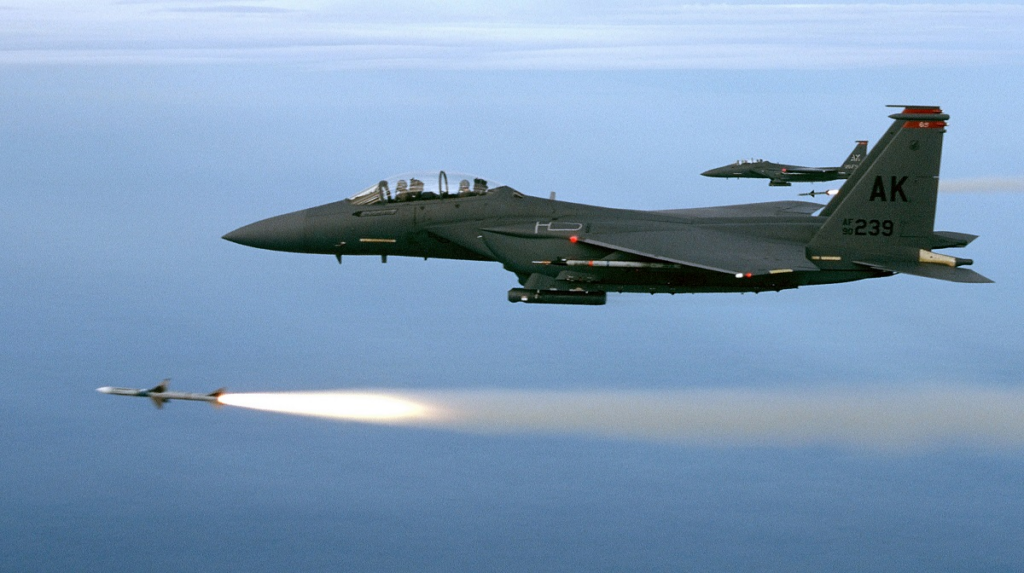
A U.S. Air Force F-15 pilot rescued after being shot down over Iran has reportedly described an extraordinary sight during his ejection and survival ordeal: a formation of drones moving together in the sky in a pattern that resembled a giant jellyfish.
The account, allegedly shared during a classified debriefing, has raised fresh questions about Iran’s drone capabilities and whether modern battlefields are evolving faster than military planners anticipated.
While some observers have focused on the pilot’s colorful description of what he saw, defense experts are paying closer attention to a more significant possibility: the emergence of highly coordinated drone swarms that could reshape future warfare.
What Did the F-15 Pilot Reportedly See?
According to sources familiar with the debriefing, the pilot described seeing multiple drones interconnected in the sky while descending after ejecting from his aircraft.
The formation reportedly appeared almost organic.
As recounted by sources, the pilot described:
- Larger drones positioned above
- Smaller drones hanging beneath them
- A coordinated movement pattern resembling the tentacles of a jellyfish
- Multiple units moving together as a single system
The pilot allegedly referred to the sight as “real alien sh*t” during discussions with intelligence officials, underscoring how unusual the scene appeared from his perspective.
Sources told CNN that the pilot also described the area as a “minefield of drones,” suggesting the sky contained far more unmanned aircraft than military personnel might normally expect during combat operations.
Why Intelligence Officials Are Taking the Report Seriously
Military debriefings routinely separate battlefield facts from perceptions formed during highly stressful situations. Pilots experiencing combat, ejection, and survival scenarios often encounter conditions that can affect depth perception, distance estimation, and object identification.
However, sources indicate that intelligence officials did not immediately dismiss the pilot’s observations.
One official involved in the debriefing reportedly asked the airman whether he was certain about what he had witnessed.
That reaction highlights a broader challenge facing military analysts: determining whether the pilot observed an optical illusion, a classified drone system, a coordinated swarm operation, or something else entirely.
Combat Conditions Can Distort Perception
Several factors can influence what pilots see during combat:
- Extreme adrenaline levels
- Rapid altitude changes
- Limited visibility
- Electronic warfare interference
- Smoke, fire, and debris
- Multiple aircraft and drones are operating simultaneously
Even so, trained military aviators are among the most experienced observers in modern warfare, which is why unusual reports often receive careful scrutiny.
Could Iran Really Be Operating ‘Jellyfish’ Drone Formations?
Defense analysts say the most plausible explanation involves advanced drone networking rather than anything mysterious.
Modern militaries increasingly invest in swarm drone technology, which allows multiple unmanned aircraft to communicate, coordinate, and move collectively.
Instead of operating as individual aircraft, drone swarms function more like a single organism.
How Drone Swarms Work
Swarm systems typically rely on:
- Artificial intelligence algorithms
- Real-time communication links
- Shared targeting information
- Autonomous navigation
- Cooperative decision-making
A swarm can spread out, regroup, change direction, and react to threats without requiring direct human control for every movement.
From a distance—or during a high-speed descent—a large swarm featuring drones of different sizes could potentially resemble a single connected structure.
Why This Matters
If Iran has developed highly coordinated swarm capabilities, it would represent a notable advancement in its military technology.
Drone warfare has already transformed conflicts across:
- Ukraine
- The Middle East
- The Caucasus region
- The Red Sea
The next phase of that evolution may involve hundreds of interconnected drones acting as a single combat system.
A good place for an infographic would be here, comparing traditional drone operations with AI-enabled swarm formations.
The Incident That Led to the Sighting
The reported observation occurred after an American F-15 was shot down over Iran during the conflict between Washington and Tehran.
According to reports, the aircraft carried two crew members:
- The pilot
- A weapons systems officer
The pilot was rescued within hours through what former President Donald Trump described as one of the most daring search-and-rescue missions in U.S. military history.
The second crew member reportedly escaped into mountainous terrain before later being recovered.
The incident marked a significant moment in the conflict because it represented one of the most serious losses suffered by U.S. forces during the confrontation.
What Experts Are Looking At Now
Military analysts examining the report are likely focusing on several possibilities.
Scenario 1: A Genuine Drone Swarm
The pilot may have observed a highly advanced drone network operating in coordinated formations.
If true, it could offer rare insight into Iranian battlefield capabilities.
Scenario 2: Multiple Independent Drones
Separate drones operating in the same area may have appeared interconnected due to distance, lighting conditions, or perspective.
Scenario 3: Experimental Technology
The formation could have involved previously unknown systems, either Iranian or belonging to another military actor operating in the region.
Scenario 4: Battlefield Misidentification
Combat environments are chaotic. What appears extraordinary in the moment may later prove to have a conventional explanation.
Why the Story Has Captured Attention
Reports involving unidentified aerial phenomena often generate headlines because they blur the line between technology and mystery.
In this case, however, the bigger story may not be the unusual description itself.
The real significance lies in what the sighting could reveal about the future of warfare.
The world’s major military powers—including the United States, China, Russia, and regional powers such as Iran—are investing heavily in autonomous systems and drone networks.
A decade ago, a sky filled with coordinated drones would have sounded like science fiction.
Today, it is becoming a realistic feature of modern combat.
What Happens Next?
Intelligence agencies are expected to continue analyzing the pilot’s testimony alongside radar data, electronic intelligence, satellite imagery, and operational reports from the conflict.
Whether the explanation turns out to be advanced drone technology, a battlefield illusion, or something in between, the account offers a glimpse into how rapidly aerial warfare is changing.
For military planners, the key question is no longer whether drone swarms will shape future conflicts.
It is how advanced those swarms have already become—and whether adversaries have capabilities that remain largely unknown to the outside world.
TL;DR
- A U.S. F-15 pilot rescued after being shot down over Iran reported seeing drones arranged in a jellyfish-like formation.
- Intelligence officials reportedly found the account unusual enough to investigate further.
- Experts say the sighting could point to advanced drone swarm technology.
- Drone swarms use AI and networked communication to move as a coordinated system.
- The incident highlights how rapidly unmanned systems are transforming modern warfare.
- No official explanation for the reported sighting has been publicly confirmed.