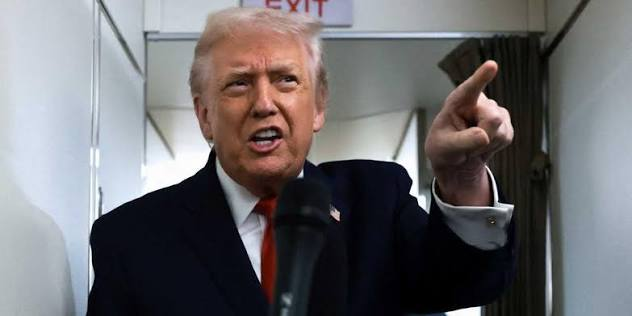
President Donald Trump again drew attention for his treatment of a female journalist after he dismissed a question about the possible use of nuclear weapons against Iran as “stupid.”
The exchange took place Monday, August 31, at the White House, when NewsNation White House correspondent Libbey Dean asked Trump whether he had ruled out using nuclear weapons against Iran.
Trump said he had ruled out such an option, but immediately criticized the question.
“Well, I would never say that, but the answer is yes. I ruled out… there’s no reason for it. What a stupid question that is, actually,” Trump said.
He then elaborated, arguing that Iran had already been “totally defeated militarily” and questioning why the United States would use a nuclear weapon after achieving that outcome.
What did Libbey Dean ask Trump?
Dean asked Trump whether he had ruled out using nuclear weapons against Iran.
The question came against the backdrop of renewed military tensions between Washington and Tehran. The United States and Iran had exchanged attacks again, with Trump warning that Washington could respond forcefully after Iranian strikes on US military positions in the region.
Trump’s answer was initially straightforward: he said nuclear weapons were not under consideration.
But his response quickly turned into a criticism of the reporter who asked the question.
He repeated that there was no reason to use nuclear weapons against Iran and characterized Dean’s question as “stupid.”
Why was Trump asked about nuclear weapons?
The question came at a particularly tense moment in the US-Iran conflict.
The two countries had recently exchanged military strikes, raising concerns about a renewed escalation after a period of reduced hostilities.
Trump had also warned that the United States would strike Iran “hard,” creating uncertainty about how far Washington was prepared to go militarily.
Against that background, asking whether nuclear weapons had been ruled out was directly related to the administration’s military policy.
Trump’s answer appeared to close the door on the nuclear option, at least in the context of the exchange.
What exactly did Trump say?
After Dean asked whether he had ruled out nuclear weapons, Trump responded:
“I would never say that, but yes, there’s no reason for it.”
He then added:
“What a stupid question that is, actually.”
Trump continued by arguing that Iranian forces had already been defeated militarily and asked why the United States would use a nuclear weapon after accomplishing that.
The president’s comments therefore contained two distinct elements: a statement that nuclear weapons were not necessary and a direct dismissal of the reporter’s question.
Is this the first time Trump has insulted a female reporter?
No.
Trump has repeatedly used personal or dismissive language toward women in the press during his political career.
His comments have targeted female journalists over questions involving his administration, foreign policy, politics and personal controversies.
The pattern has also drawn criticism from press-freedom advocates and journalism organizations, particularly when Trump attacks a reporter’s intelligence, appearance or professionalism rather than simply addressing the question.
Recent examples have renewed attention to whether Trump’s exchanges with female journalists differ from his interactions with male reporters.
What happened with Catherine Lucey?
In November 2025, Trump confronted Bloomberg White House correspondent Catherine Lucey aboard Air Force One after she asked him about the Epstein files.
Trump told her, “Quiet, quiet, piggy.”
The remark prompted criticism from journalism groups and became another example cited by critics of Trump’s often combative relationship with the press.
The White House defended Trump at the time, arguing that his comments reflected his direct style of interacting with reporters.
What did Trump say to Nancy Cordes?
Trump has also clashed with CBS News correspondent Nancy Cordes.
During a 2025 exchange, Cordes asked Trump about his administration’s handling of immigration and the shooting of National Guard personnel in Washington, DC.
Trump responded by questioning her intelligence and repeatedly called her “stupid.”
The exchange was widely circulated because of the president’s decision to turn a policy question into a personal confrontation with the reporter.
Why does Trump frequently clash with journalists?
Trump’s relationship with the news media has been adversarial for years.
During both his presidential campaigns and his time in office, he has frequently criticized outlets whose reporting he considers unfair and has singled out individual journalists during press conferences.
Supporters argue that Trump is willing to confront journalists directly rather than accept what he considers biased questioning.
Critics argue that personal attacks can distract from substantive questions and may discourage journalists from asking difficult questions.
The disagreement reflects a broader tension between political leaders and the press, particularly when presidents use live appearances to challenge individual reporters.
Did Trump answer the nuclear-weapons question?
Yes, at least on the substance of the immediate question.
Trump said there was “no reason” to use nuclear weapons against Iran and indicated that he had ruled them out.
The interesting part of the exchange was therefore not that Trump appeared to endorse nuclear use. He did the opposite.
The controversy arose from the way he characterized the question and addressed the journalist who asked it.
That distinction is important because the exchange combined a potentially consequential foreign-policy statement with Trump’s familiar confrontational treatment of reporters.
Why does the exchange matter?
Questions about nuclear weapons are inherently significant because even a discussion of their potential use can affect perceptions of escalation and deterrence.
Trump’s statement that nuclear weapons were not necessary provided a clear answer amid heightened tensions with Iran.
At the same time, his dismissal of the question illustrates the increasingly familiar dynamic at Trump’s press appearances: a journalist asks a difficult or sensitive question, the president answers it, and then attacks the framing or the person asking it.
That pattern has become part of the political story surrounding Trump’s relationship with the media.
What is happening between the US and Iran?
The exchange occurred as tensions between Washington and Tehran were again rising.
Recent military confrontations had raised concerns about a broader escalation, particularly around the strategically important Strait of Hormuz.
Trump had warned Iran that the United States would respond strongly after attacks on American positions.
The White House’s military calculations therefore remained under intense scrutiny, making questions about the limits of US force particularly relevant.
Dean’s nuclear question came within that larger context.
Trump’s broader record with female journalists
The latest exchange is part of a longer pattern.
Trump has previously criticized female reporters using terms relating to their intelligence, appearance and character.
Some of the most widely reported confrontations have involved women asking questions on foreign policy, national security or controversies surrounding the administration.
These interactions are frequently analyzed not only for what Trump says but also for how he responds to scrutiny.
His supporters see the confrontational style as evidence that he refuses to be pressured by the media.
Critics see it as an attempt to shift attention away from the substance of a question and toward the journalist asking it.
The bottom line
Donald Trump dismissed NewsNation White House correspondent Libbey Dean’s question about whether he had ruled out using nuclear weapons against Iran, calling it “a stupid question.”
Despite the insult, Trump’s substantive answer was clear: he said there was no reason to use nuclear weapons against Iran and indicated that he had ruled out such an option.
The exchange came as US-Iran tensions were rising again following renewed military confrontations.
It also fits a broader pattern in Trump’s dealings with female journalists, including previous public clashes with reporters such as Catherine Lucey and Nancy Cordes.
For the latest episode, however, the most consequential part of Trump’s answer was not the insult.
It was his statement that, despite the escalating conflict with Iran, he did not see a reason to use nuclear weapons.