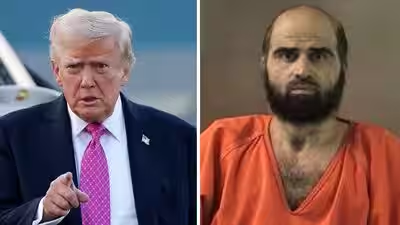
U.S. President Donald Trump has approved the execution of former Army Major Nidal Malik Hasan, who was convicted of killing 13 people and wounding 32 others during the 2009 Fort Hood shooting in Texas.
The execution will be carried out by an Army firing squad under the order announced by the Pentagon on October 5, 2026. Defence Secretary Pete Hegseth recommended the execution, and Trump approved it, according to Pentagon spokesman Sean Parnell.
The decision does not mean Hasan will be executed immediately. The army secretary must still determine the time and location, and additional legal avenues remain available.
If the execution ultimately takes place, it would be the first U.S. military execution since 1961 and the first military firing-squad execution since 1945.
The move comes only days after Tennessee’s failed lethal-injection attempt involving death-row prisoner Christa Pike, adding a striking new chapter to the wider U.S. debate over capital punishment and execution methods.
Who is Nidal Malik Hasan?
Nidal Malik Hasan is a former U.S. Army major and military psychiatrist who was stationed at Fort Hood, now known as Fort Cavazos, in Texas.
On November 5, 2009, Hasan opened fire inside the base’s Soldier Readiness Processing Center, where troops were preparing for deployments overseas.
Thirteen people were killed, and 32 were wounded in the attack.
Hasan was shot by a civilian police officer during the response and survived, but the injuries left him paralyzed from the waist down.
The shooting became one of the deadliest attacks ever carried out on a U.S. military installation.
What happened at Fort Hood in 2009?
Hasan was about to be deployed to Afghanistan when he opened fire on soldiers and military personnel at the Texas base.
Witnesses reported that he shouted “Allahu Akbar” before firing.
Investigators later uncovered his communications with Anwar al-Awlaki, an extremist cleric who was associated with al-Qaeda in the Arabian Peninsula.
Hasan ultimately acknowledged carrying out the shooting but offered a justification rooted in his opposition to U.S. military operations in Muslim-majority countries.
The attack generated years of debate over Hasan’s motives, his contacts with extremist figures and whether warning signs before the shooting had been properly addressed.
Why was Nidal Hasan sentenced to death?
Hasan was convicted by a military court in 2013 on 13 counts of premeditated murder and 32 counts of attempted premeditated murder.
The military court sentenced him to death and dismissed him from the Army.
Hasan represented himself during the court-martial and did not present a conventional defense seeking to avoid a conviction.
The military justice system automatically reviews death sentences, meaning Hasan’s case continued through mandatory appeals even though he did not personally abandon responsibility for the shooting.
The lengthy appellate process is one reason the death sentence remained unresolved for more than a decade.
What happened to Hasan’s appeals?
The military justice system reviewed Hasan’s conviction and death sentence through multiple levels.
The U.S. Army Court of Criminal Appeals upheld the sentence, and the U.S. Court of Appeals for the Armed Forces later affirmed the judgment.
Hasan then asked the U.S. Supreme Court to review his case.
On March 31, 2025, the Supreme Court denied his petition, leaving the military conviction and death sentence intact.
That ruling removed the last major stage of direct appellate review in the military justice system, although additional legal challenges can still be attempted in federal court.
Why did Trump’s approval matter?
Unlike many civilian death-penalty cases, executions under the military justice system require presidential authorization.
The Pentagon announced that Hegseth recommended Hasan’s execution and that Trump approved it.
That decision moves the case from an unresolved death sentence toward the practical stages of carrying out the punishment.
The Army Secretary, currently Adam Telle in an acting capacity, will determine when and where the execution is to take place.
The execution date has not yet been announced.
Why is the execution being carried out by firing squad?
Firing squad is one of the execution methods available under U.S. military law.
The Trump administration has also expanded the use of alternative execution methods at the federal level amid continuing problems obtaining drugs used for lethal injections.
The military’s decision to use a firing squad in Hasan’s case makes the case particularly unusual because the U.S. armed forces have not carried out an execution in more than six decades.
The last military execution occurred in 1961, when Army Pvt. John Bennett was hanged at Fort Leavenworth, Kansas.
The last known U.S. military firing-squad execution took place in 1945.
Is this the first military execution approved by a president since 1961?
There is an important distinction.
The last military execution actually carried out was Bennett’s in 1961.
Former President George W. Bush approved the execution of Army serviceman Ronald Gray in 2008, but a federal judge issued a stay that prevented the execution from going forward.
Gray remains on military death row.
Therefore, Hasan’s case would be the first U.S. military execution carried out since 1961 if the order is ultimately implemented.
It would also be the first military execution by firing squad since 1945.
Why are military executions so rare?
Military death sentences are subject to a highly structured legal process and require multiple layers of review.
Capital punishment is also rarely imposed under the Uniform Code of Military Justice.
Only a small number of people are currently held on military death row at the U.S. Disciplinary Barracks at Fort Leavenworth.
Because of the lengthy appeal process and the presidential authorization requirement, military death sentences can remain unresolved for decades.
Hasan’s case is therefore unusual even within the already narrow category of U.S. military capital punishment.
Who was the last person executed by the U.S. military?
The last military execution was carried out in 1961 against Pvt. John A. Bennett.
Bennett was hanged at Fort Leavenworth after being convicted of rape and attempted murder involving an 11-year-old girl in Austria.
More than 65 years have passed since that execution.
That long gap is why Trump’s authorization of Hasan’s execution represents such a significant development in the history of the U.S. military death penalty.
Was Hasan’s attack treated as terrorism?
Hasan was convicted under the military justice system of premeditated murder and attempted murder rather than under a separate military offense labeled terrorism.
That legal distinction became part of the public debate surrounding the case.
Investigators and officials examined his extremist contacts, communications with al-Awlaki and views about the wars in Iraq and Afghanistan.
During his court-martial, Hasan described his actions as being connected to his opposition to U.S. military operations and stated that he believed American troops were killing Muslims abroad.
The criminal judgment, however, rested on the murder and attempted-murder charges for which he was convicted.
What did Hasan say during his trial?
Hasan effectively admitted responsibility for the shooting.
Rather than attempting to prove that he was not responsible, he used his court-martial to explain why he had carried out the attack.
He argued that American military personnel were preparing to deploy against Muslims and portrayed his actions as an attempt to prevent further deaths.
His statements were controversial and formed part of the evidence surrounding his motive.
The prosecution sought the death penalty from the beginning of the case.
Why does the Fort Hood shooting still matter?
The attack continues to influence debates about military security, extremism and the treatment of warning signs within government institutions.
Hasan was a military psychiatrist with access to other service members and had attracted scrutiny before the shooting because of his views and communications.
After the attack, officials faced questions over whether his contacts with al-Awlaki and other conduct should have prompted stronger intervention.
The shooting also became part of a broader debate about how the military responds when an active-duty service member may present an ideological or security threat.
Where is Nidal Hasan now?
Hasan is being held at the U.S. Disciplinary Barracks at Fort Leavenworth, Kansas, where he has spent years on military death row.
The facility houses prisoners convicted under the military justice system, including other service members with death sentences.
His continued confinement there means the Army can proceed with the next steps following the president’s authorization.
However, the exact timing of an execution will depend on the Army’s scheduling and any additional legal proceedings.
Can Hasan still challenge the execution?
Yes.
Trump’s approval does not eliminate every possible legal challenge.
The Supreme Court declined to hear Hasan’s petition in March 2025, but defendants facing military death sentences can pursue certain claims in federal courts after the military appellate process concludes.
Those proceedings can potentially delay an execution.
Whether Hasan pursues additional litigation, and whether any court grants relief, will affect how quickly the presidential authorization can translate into an actual execution.
What role does the Army Secretary have?
The Army Secretary is responsible for determining the time and place of the execution after the president authorizes it.
That means Trump’s decision is a critical step, but not the final logistical action.
Military officials must also complete the required preparations and comply with applicable legal procedures before the execution can occur.
The Pentagon has not yet announced a date.
Why is the firing-squad method controversial?
Firing squads remain one of the most controversial execution methods in the United States.
Supporters often argue that the method is straightforward and avoids some of the problems associated with lethal injection, particularly when execution drugs are difficult to obtain.
Critics argue that firing squads are incompatible with modern standards of humane punishment and can be traumatic for witnesses and personnel involved.
The method is currently authorized in only a small number of U.S. states for civilian executions.
Hasan’s case would be different because it would involve the military justice system rather than a state prison.
How does this case fit into the wider U.S. death-penalty debate?
Trump’s decision arrives during a period of renewed attention to capital punishment in the United States.
Tennessee recently halted the attempted execution of Christa Pike after officials administered two doses of pentobarbital but failed to complete the execution.
That incident triggered calls for reviews of lethal-injection procedures and renewed questions about whether execution methods can reliably meet the standards required by law.
Hasan’s case moves the discussion in another direction by bringing a long-unused military punishment method back into focus.
The United States now has simultaneous debates over lethal injection, firing squads and other alternatives such as nitrogen hypoxia.
What happens next for Hasan?
The Army will determine the next procedural steps and eventually set the time and location of the execution.
Hasan may still seek additional judicial review.
If no court blocks the process and the required military procedures are completed, his execution would end a military death-penalty case that began with the Fort Hood shooting nearly 17 years ago.
It would also mark the return of an execution practice that the U.S. military has not used since 1961.
For the victims’ families and survivors, the decision represents a new stage in a case that has stretched across generations of military and legal proceedings.
For the U.S. government, it marks an exceptionally rare exercise of presidential authority over a military death sentence.
And for the American death-penalty debate, Hasan’s case raises a separate question from the one surrounding lethal injection: after decades without a military execution, is the United States prepared to use one of its oldest methods of capital punishment again?