
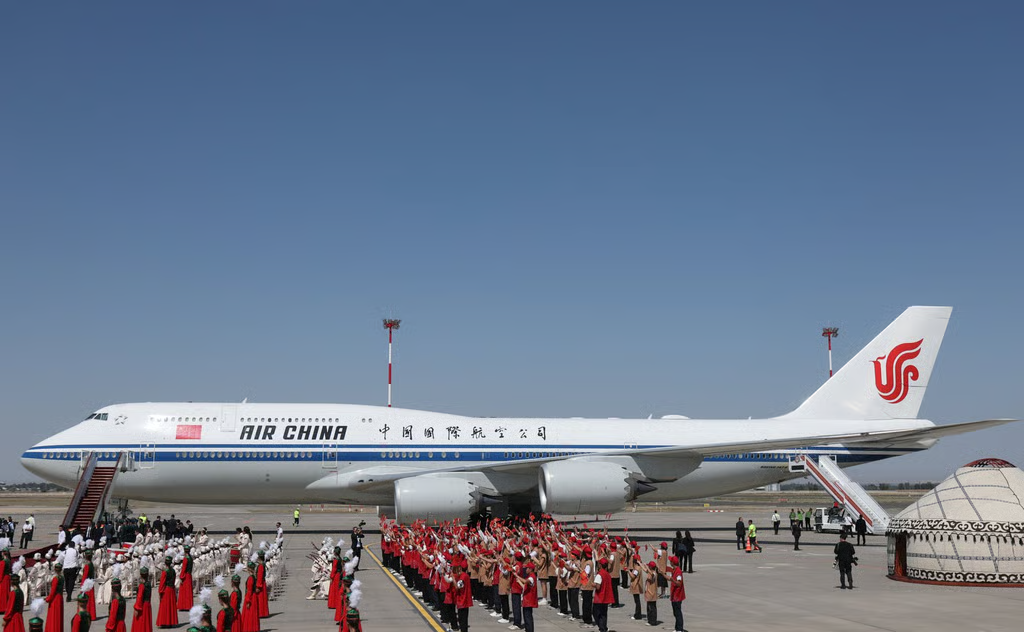
Chinese President Xi Jinping and US President Donald Trump both travel aboard Boeing 747s, but the similarities largely end there. Xi’s aircraft is a heavily modified Boeing 747-8 Intercontinental operated by Air China and used for his long-haul international trips. The United States, meanwhile, operates specially configured presidential aircraft that form part of a dedicated presidential airlift system. When the US president is aboard an Air Force aircraft, its call sign becomes “Air Force One.”
That distinction has become particularly interesting as Xi arrives in Washington for his September 23-25, 2026 state visit to meet Trump.
Both leaders are traveling in four-engine jumbo jets, but their aircraft differ in ownership, visibility, configuration, communications systems and the way each government manages presidential air travel.
What aircraft does Xi Jinping use?
Xi’s main aircraft for long-distance international travel is a Boeing 747-8 Intercontinental registered as B-2479 and operated under the Air China brand.
The aircraft originally entered Air China’s fleet as a commercial passenger jet in 2014. It was later removed from regular passenger service and underwent extensive modification before becoming the primary aircraft used for China’s top leader on overseas journeys.
The aircraft is generally referred to in Chinese official and state-media contexts as a “special plane,” rather than as a direct equivalent of America’s Air Force One.
Unlike the US presidential fleet, China has traditionally kept many details of its top leaders’ aircraft arrangements out of the public spotlight. Even the interior of Xi’s current 747-8 has not been officially documented in detail.
Why does Xi’s plane still have Air China markings?
One of the easiest ways to distinguish Xi’s aircraft from Air Force One is the exterior.
B-2479 retains Air China branding and the airline’s familiar white-and-blue appearance. It does not carry the highly recognizable presidential livery associated with the US aircraft.
That gives China’s presidential aircraft a much lower public profile.
There is also a practical reason for the arrangement. Rather than maintaining a publicly identifiable presidential fleet resembling America’s VC-25 aircraft, China uses specially prepared aircraft managed within its state aviation system.
The approach allows Xi to travel aboard a heavily modified wide-body aircraft without creating the same visual identity that surrounds an American presidential flight.
How is Air Force One different?
The term Air Force One technically refers to the radio call sign used whenever the US president is traveling aboard a US Air Force aircraft. It is commonly used as shorthand for the specially modified presidential jets themselves.
The long-serving American presidential aircraft are two Boeing VC-25A aircraft, derived from the Boeing 747-200B. They entered US Air Force service in 1990 and 1991. The aircraft have dedicated presidential suites, offices, conference and dining areas, separate spaces for senior staff and security personnel, news-media accommodations, medical equipment and advanced communications systems.
The US aircraft also have features designed specifically for presidential operations, including front and rear air stairs and the ability to refuel in flight.
That turns the aircraft into much more than a conventional VIP transport.
Trump is currently using an interim VC-25B aircraft
There is an important 2026 update to America’s presidential fleet.
Trump is currently flying aboard the aircraft known as the VC-25B Bridge, an interim presidential aircraft based on a Boeing 747-8. The aircraft was originally a VIP-configured 747-8 associated with Qatar and was subsequently modified by L3Harris for US presidential operations.
The aircraft entered presidential service in 2026 as a temporary “bridge” capability while the long-term Boeing-built VC-25B program continues. The US Air Force says the Bridge aircraft was delivered to the Presidential Airlift Group in June 2026 after receiving government modifications and beginning commissioning flights.
Trump has already used the Qatar-origin aircraft for presidential travel. Reuters reported in September that he was flying aboard the 747-8 and that additional security upgrades were planned later in the year.
Xi’s 747-8 and Trump’s aircraft are from the same Boeing family
The comparison becomes especially interesting because both aircraft are based on the Boeing 747.
Xi’s aircraft is a 747-8 Intercontinental, the newer passenger version of the 747 family.
Trump’s current Bridge aircraft is also a 747-8, although it has been converted and modified specifically for presidential use.
The Boeing 747-8 features a longer fuselage, a redesigned wing and newer GEnx engines compared with earlier 747 variants. Boeing gives the 747-8 Intercontinental a cruise speed of approximately Mach 0.855 and a range of about 7,480 nautical miles in airline configuration.
The similarity in basic airframe therefore does not mean the two aircraft provide the same capabilities. Most of the important differences are buried inside the fuselage.
How do the interiors compare?
This is where the public information becomes uneven.
The interior of Air China’s B-2479 has never been fully disclosed officially, so many descriptions of its presidential configuration are based on aviation research and historical reporting.
It is understood to contain VIP areas suitable for Xi, senior officials and meetings during international travel.
The US aircraft, by contrast, are extensively documented by the Air Force. The VC-25A includes a presidential suite with a bedroom, dressing room, bathroom and shower, along with an office and conference/dining space. Separate areas are provided for guests, staff, security personnel and journalists.
That level of public documentation reflects a broader difference in how the two governments present presidential aviation to the outside world.
Which aircraft has better communications?
The precise communications architecture aboard Xi’s aircraft is not publicly documented in comparable detail.
US presidential aircraft are specifically built around secure communications and command-and-control requirements.
The Air Force describes the VC-25A as having advanced electronic and communications equipment, allowing the president to remain connected while traveling. The aircraft also contains medical equipment for minor emergencies and dedicated spaces for staff who support presidential operations.
The exact security and communications capabilities of China’s B-2479 remain much harder to establish from open sources.
That makes claims about one aircraft having a specific classified capability over the other difficult to verify without government disclosure.
How fast and how far can the aircraft fly?
Both aircraft are capable of intercontinental travel, but their official specifications come from different sources and configurations.
The US VC-25A has a published maximum speed of about 630 mph, a service ceiling of 45,100 feet and a stated range of about 7,800 statute miles.
The Boeing 747-8 Intercontinental has a published cruise speed of around Mach 0.855 and an airline-configured range of approximately 7,480 nautical miles.
The practical performance of Xi’s modified aircraft cannot be assumed to match the commercial aircraft figures exactly because VIP modifications, fuel loads, passenger loads and mission requirements can alter operating characteristics.
Why doesn’t China simply have its own Air Force One?
The comparison with the US can be misleading because China has developed a different system of executive air travel.
Historically, Chinese leaders flew on Air China aircraft that could be temporarily modified for state visits. Xi’s current 747-8 represents a more permanent solution, but it remains part of a broader state-controlled aviation arrangement rather than a highly visible presidential fleet modeled on the American system.
Earlier Chinese presidential travel often involved Air China 747-400 aircraft being specially prepared before an overseas trip and subsequently returned to normal airline use.
The shift toward the dedicated B-2479 configuration reduced the need for that temporary conversion process.
What makes Air Force One so recognizable?
The American aircraft is deliberately designed as a symbol as well as a transportation system.
Its exterior carries “United States of America,” the US flag and the presidential seal. The livery has become one of the most recognizable symbols associated with the American presidency.
Whenever the president is aboard the aircraft, the plane becomes Air Force One for air traffic control purposes.
Xi’s aircraft has no comparable global visual identity. Its Air China livery can make it look like an ordinary commercial aircraft to someone unfamiliar with the aircraft’s registration and mission.
That difference is striking when the two leaders’ aircraft are placed side by side.
Why is the US presidential plane more than a VIP jet?
Air Force One has been designed to keep the president functioning as head of government while airborne.
The aircraft’s communications, workspace, security arrangements and support facilities allow the president and senior personnel to continue working during long international trips.
The VC-25A can accommodate more than 70 passengers and has a crew of around 30. Its facilities include two galleys capable of preparing up to 100 meals at once and a dedicated medical compartment.
The aircraft is therefore closer to a flying government office than a conventional executive jet.
Does Xi’s aircraft serve the same purpose?
Broadly, yes, but the exact capabilities are not publicly known.
Xi’s long-haul aircraft is designed to support the Chinese president and his delegation during international travel, and reporting indicates that it includes specialized VIP and communications arrangements.
However, China has released far less information about its aircraft’s interior and security systems than the US has released about its presidential fleet.
That makes direct comparisons difficult.
It is safer to say that both aircraft are specially configured for head-of-state travel while acknowledging that the details of China’s system are considerably more opaque.
Xi’s plane vs Trump’s current Air Force One
| Feature | Xi Jinping’s special plane | Trump’s current Air Force One |
|---|---|---|
| Aircraft | Boeing 747-8 Intercontinental | Boeing 747-8-based VC-25B Bridge |
| Operator | Air China/state aviation system | US Air Force |
| Registration/designation | B-2479 | VC-25B Bridge |
| Exterior | Air China livery | US presidential livery |
| Primary role | Chinese head-of-state international travel | US presidential transport |
| Dedicated presidential system | Specially modified Air China aircraft within state aviation system | Dedicated US presidential airlift structure |
| Interior details | Largely undisclosed | Extensively documented |
| Secure communications | Details not publicly disclosed | Advanced secure communications systems |
| Medical facilities | Public details limited | Dedicated medical compartment on VC-25A |
| Public visibility | Relatively low-profile | Globally recognizable |
Why are both leaders traveling on Boeing 747s?
The 747 is unusually well suited to long-range VIP travel because of its size, range and ability to accommodate large delegations and specialized equipment.
Its four-engine design also gives governments a platform capable of crossing oceans while carrying personnel, communications equipment and substantial support infrastructure.
Boeing has stopped producing the 747 passenger version, making the aircraft increasingly rare in commercial aviation.
That gives Xi’s 747-8 and America’s presidential 747-based aircraft an added historical significance: both are built around an aircraft type that is gradually disappearing from regular passenger service.
The biggest difference is not the Boeing badge
At first glance, Xi’s 747-8 and Trump’s aircraft appear to be two versions of the same idea.
But the underlying systems are different.
China’s aircraft combines a commercial-airliner airframe with a highly restricted state-operated presidential configuration. The US system is built around purpose-modified military presidential aircraft supported by the Presidential Airlift Group.
Trump’s current VC-25B Bridge adds another twist because it is an interim presidential platform created from an existing VIP 747-8 rather than a brand-new aircraft built specifically for the US government.
Xi’s aircraft, meanwhile, remains intentionally low-profile, with limited official information about its internal configuration.
What happens to the aircraft after Xi and Trump land?
The aircraft themselves are only one part of the security operation.
Xi’s travel involves China’s state aviation system, support aircraft and extensive ground security arrangements.
US presidential travel is similarly backed by an enormous logistical system involving Air Force personnel, Secret Service protection, communications teams, support aircraft and advance security operations.
That means neither aircraft operates like an ordinary passenger jet.
The plane is simply the most visible piece of a much larger machine operating behind the scenes.
The bigger picture
The comparison between Xi’s special plane and Trump’s Air Force One offers a glimpse into how two major powers approach executive aviation.
Both rely on the Boeing 747 platform. Both require specialized communications, security and VIP facilities. Both can carry the leadership teams needed for major international diplomacy.
But the US emphasizes a highly visible presidential aircraft with publicly documented features, while China’s system is considerably more discreet.
As Xi and Trump meet in Washington, their aircraft provide a useful reminder that presidential travel is not merely about getting from one capital to another.
For leaders meeting at the highest level of international politics, the aircraft itself becomes a mobile extension of the state.