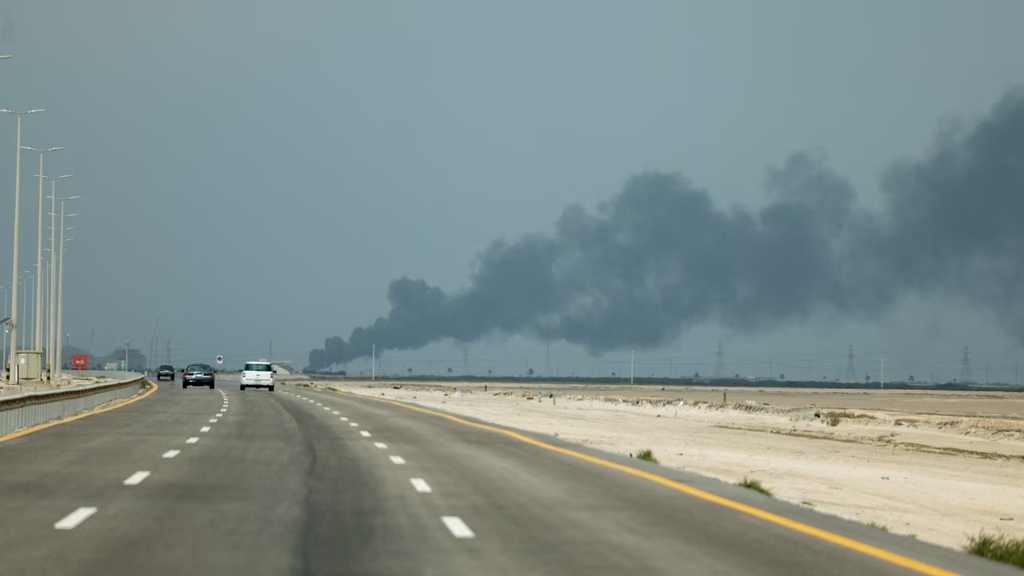
Three people have been killed and 36 injured in attacks on two major Saudi airports as fighting between Yemen’s Houthi movement and Saudi-backed forces intensifies, pushing the long-running conflict into a dangerous new phase.
Saudi Arabia’s General Authority of Civil Aviation said two people were killed and 28 wounded in an attack on Abha International Airport, while another person was killed and eight injured at King Khalid International Airport in Riyadh.
The attacks took place on October 6 and 7, according to Saudi aviation authorities.
The Houthis have claimed responsibility for the strikes, saying they targeted the airports with missiles and drones. Saudi authorities confirmed the attacks and casualties but did not publicly assign responsibility in their initial statements.
The escalation comes as fighting inside Yemen has intensified around the strategic Bab al-Mandab Strait and along the country’s western coast, with Saudi-backed Yemeni forces attempting to push back Houthi advances.
The renewed violence has already displaced more than 200,000 people, according to the UN’s International Organization for Migration.
What happened at the Saudi airports?
The first attack targeted Abha International Airport in southwestern Saudi Arabia, relatively close to Yemen’s border.
Saudi authorities said two women, one of Moroccan nationality and one of Algerian nationality, were killed. Another 28 people were injured and taken to hospitals, with authorities reporting injuries ranging from minor to serious.
A separate attack struck King Khalid International Airport in the Saudi capital, Riyadh.
One Sudanese national was killed, while eight people were injured.
The two incidents represent a significant escalation because civilian aviation facilities inside Saudi Arabia are again being directly affected by the conflict.
The attacks also occurred only a day apart, highlighting how quickly the violence has spread beyond Yemen’s battlefields.
Did the Houthis carry out the attacks?
The Houthi movement has said that it did.
Houthi military spokesperson Yahya Saree claimed that the group launched missile and drone attacks against Saudi targets, including King Khalid International Airport in Riyadh.
In separate statements, the Houthis said the attacks were retaliation for Saudi military action in Yemen.
The Saudi civil aviation authority, however, stopped short of publicly naming the attackers in its initial casualty statement.
That distinction is important. The Houthi claim establishes responsibility only as an assertion by the group. Saudi and independent assessments of the attacks are continuing.
Saudi authorities also said their forces intercepted a ballistic missile north of Riyadh and later destroyed a launch platform in Sanaa that they said had been used against the Saudi capital.
Those military claims could not be independently verified immediately.
Why are the Houthis fighting Saudi Arabia again?
The latest attacks are part of a much broader escalation in Yemen.
The Houthi movement seized Yemen’s capital, Sanaa, in 2014. Saudi Arabia subsequently led a military coalition that intervened the following year in support of Yemen’s internationally recognized government.
Years of airstrikes, ground combat and economic collapse followed.
A UN-brokered truce in 2022 dramatically reduced cross-border attacks and eased the intensity of the conflict for a period, although it never produced a permanent political settlement.
The latest fighting represents the most serious escalation between Saudi-backed forces and the Houthis since that truce largely halted large-scale cross-border hostilities.
The current conflict has been intensified by a major Houthi offensive and a Saudi-backed counteroffensive on Yemen’s western coast.
What is happening around the Bab al-Mandab Strait?
One of the biggest strategic concerns is the Bab al-Mandab Strait, a narrow waterway connecting the Red Sea and the Gulf of Aden.
The strait is one of the world’s important maritime chokepoints because ships traveling between the Indian Ocean and the Mediterranean through the Suez Canal pass through the broader Red Sea route.
Control or disruption of the area could therefore affect commercial shipping and energy flows far beyond Yemen.
Reuters reported that Houthi and Saudi-backed forces have been fighting around areas near the strait, while pro-government forces have attempted to regain strategically important territory.
The town of Mocha, near the Red Sea coast, has also become part of the battle for control of the region.
Saudi-backed forces say they are trying to reverse recent Houthi gains, but the situation remains fluid.
The Houthis have also attacked an airport in Aden
Saudi airports were not the only aviation facilities caught up in the latest violence.
On Wednesday, Yemen’s Transport Ministry said the Houthis attacked Aden International Airport with ballistic missiles and explosive-laden drones.
One projectile landed near the runway shortly before a civilian flight from Cairo was due to arrive.
The aircraft was diverted to Jeddah, according to reporting from the region.
Aden is particularly important because it serves as the main international gateway for territory controlled by Yemen’s internationally recognized government.
The attack therefore raised immediate concerns over the safety of civilian air traffic in southern Yemen.
Saudi Arabia vows retaliation
The Saudi-led coalition supporting Yemen’s internationally recognized government said the attacks on Saudi airports “will not go unpunished.”
Later, the coalition said it had carried out strikes against more than 80 Houthi military sites across several Yemeni governorates, including Saada, Hodeidah, Jawf and Marib.
The coalition says its campaign is aimed at Houthi military capabilities and launch infrastructure.
The Houthis, meanwhile, argue that Saudi Arabia is responsible for escalating the conflict by backing Yemeni government forces.
The cycle of missile and drone attacks followed by airstrikes has raised fears that the conflict could move into another prolonged regional war.
More than 200,000 people displaced in Yemen
The humanitarian consequences are already severe.
The UN’s International Organization for Migration said more than 200,000 people had been displaced inside Yemen since the latest fighting began.
The figure jumped dramatically in a matter of weeks, rising from about 76,000 in mid-September to more than 200,000 by October 7.
People have fled across at least 10 governorates, with Taiz among the areas hit hardest.
More than 3,700 people have also reportedly crossed the sea to Djibouti to escape the fighting.
IOM Director General Amy Pope described the situation as alarming, warning that displaced families urgently need food, shelter and other assistance.
The renewed war is taking place in a country that was already experiencing one of the world’s worst humanitarian crises.
Food insecurity is worsening
The conflict is also worsening an already fragile food situation.
The World Food Programme has warned that three out of four families in parts of Yemen are facing severe hunger as fighting disrupts access to food and humanitarian assistance.
The danger is not limited to immediate casualties.
As roads become unsafe and communities are displaced, markets, health facilities and aid distribution networks can also be disrupted.
Families forced to move repeatedly may lose access to work, shelter and basic services, increasing the long-term humanitarian cost of the fighting.
Why the airport strikes matter
Attacks on airports carry significance beyond the immediate casualties.
Airports are civilian infrastructure, and their disruption can isolate communities, interfere with humanitarian operations and affect international travel.
The targeting of Riyadh’s King Khalid International Airport is particularly notable because it brings the conflict closer to Saudi Arabia’s political and economic center.
Abha has previously been targeted by Houthi attacks during earlier phases of the Yemen war, but the latest incident comes as fighting on the ground has intensified dramatically.
The simultaneous spread of attacks toward multiple airports suggests a widening battlefront rather than an isolated exchange of fire.
Could the conflict threaten Red Sea shipping?
That is one of the biggest regional risks.
The Bab al-Mandab is a critical route for global commerce, and prolonged fighting in the surrounding area could raise insurance costs, force shipping companies to alter routes and increase the risk to commercial vessels.
The strategic importance has become even greater amid wider disruptions affecting Middle Eastern maritime trade.
Any sustained fighting around the strait could therefore have consequences for countries and companies far removed from the Yemeni battlefield.
The conflict is becoming part of a wider regional crisis
The latest fighting is also unfolding amid broader tensions across the Middle East.
Reuters described the current escalation in Yemen as linked to the wider US-Iran conflict, adding another layer to an already complicated regional security landscape.
Saudi Arabia views the Houthis as a major security threat and accuses Iran of providing weapons, training and financial support to the group.
The Houthis reject the characterization that they are simply an Iranian proxy and say they develop their own weapons.
Iran likewise denies the Saudi accusations.
The competing claims make it difficult to separate Yemen’s internal power struggle from the wider contest for influence across the region.
What happens next?
For now, neither side appears ready to step back.
Saudi-backed Yemeni forces are seeking to recover territory along the western coast and around the Bab al-Mandab, while the Houthis have demonstrated that they can still threaten targets far beyond the immediate battlefield.
The airport attacks have added a dangerous civilian dimension to the escalation.
Three people are dead, dozens are injured, and more than 200,000 Yemenis have been displaced in a matter of weeks.
The United Nations has called on all parties to exercise restraint and comply with international humanitarian law, including the obligation to protect civilians and civilian infrastructure.
Whether the latest offensive develops into another prolonged phase of Yemen’s war could depend on the battle for the country’s western coast, the security of the Bab al-Mandab and the willingness of regional powers to prevent further escalation.
For civilians, however, the consequences are already being measured in lives lost, homes abandoned, and families once again searching for somewhere safe to go.